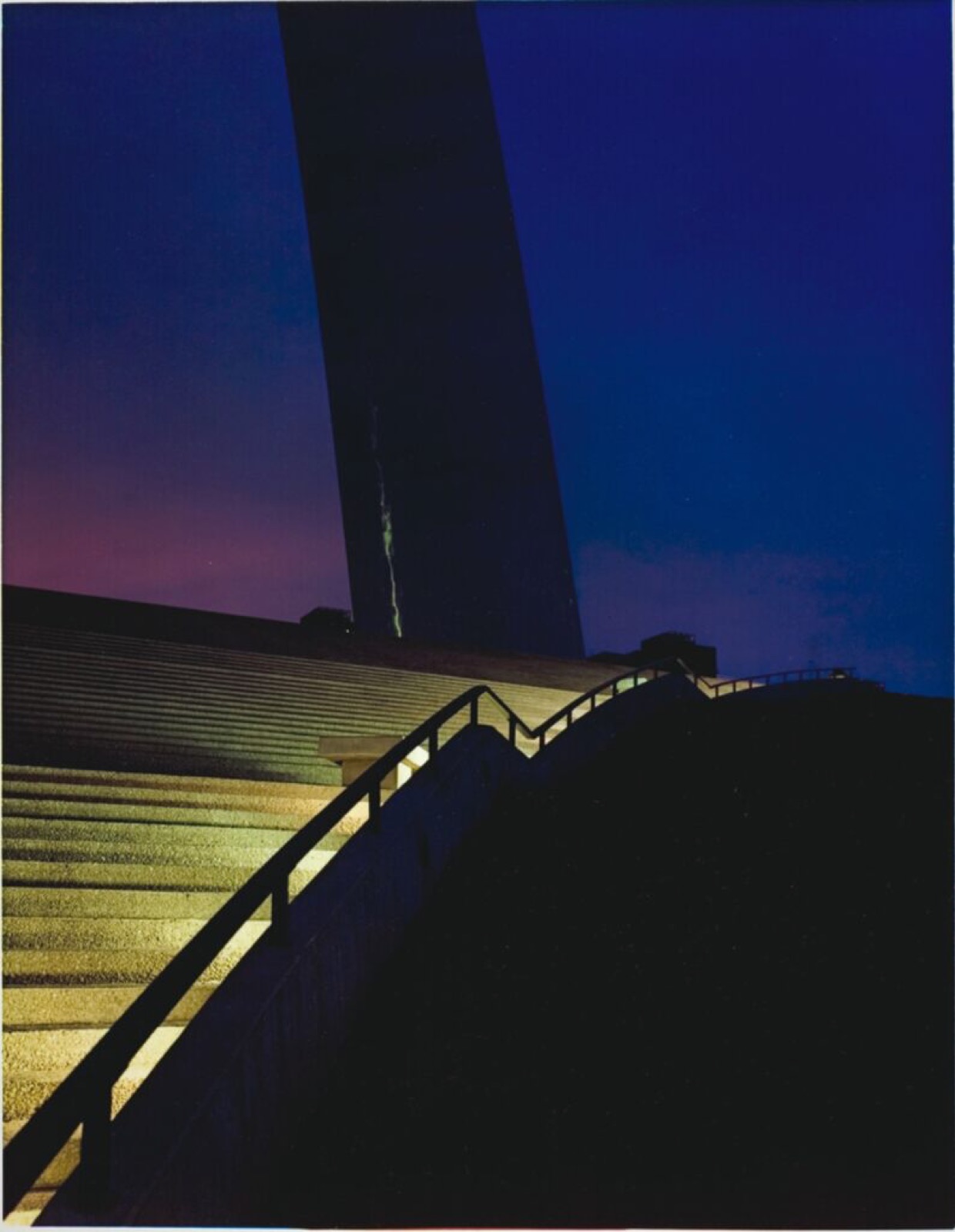
A minute earlier the sky still had its daylight; a minute later it will surrender the last band of magenta at the left and the great arch will stand wholly black. The photograph fixes the hinge between those two states, that brief dusk when the stone steps are washed warm by lamplight while the sky above deepens from violet to a saturated marine blue. A black handrail zigzags up the treads, and one leg of the monument tapers past the top edge, unfinished, immense.
What the picture records is not the arch so much as an exposure long enough to catch a moment the eye alone could never hold this evenly. Twilight and artificial light balance for only a few minutes; the eight-by-ten negative drinks them both, giving the amber of the lamps and the electric blue of the sky equal chemical weight. The result is almost an abstraction, a diagram of a monument built from a slab of shadow, a curve of lit stone and a wedge of colour, more felt than identified.
Meyerowitz spent these years describing American light as no one else did, moving from the porches and shores of Cape Light to the harder monuments of the interior; his work is collected by the Modern, the Met and the Boston MFA. He worked slow, on a tripod, letting the object print itself onto the film across whole seconds. Issued as an archival pigment print, the sheet preserves that patient gradient from horizon glow to zenith dark, an image you read as much with the skin as with the eye.
A minute earlier the sky still had its daylight; a minute later it will surrender the last band of magenta at the left and the great arch will stand wholly black. The photograph fixes the hinge between those two states, that brief dusk when the stone steps are washed warm by lamplight while the sky above deepens from violet to a saturated marine blue. A black handrail zigzags up the treads, and one leg of the monument tapers past the top edge, unfinished, immense.
What the picture records is not the arch so much as an exposure long enough to catch a moment the eye alone could never hold this evenly. Twilight and artificial light balance for only a few minutes; the eight-by-ten negative drinks them both, giving the amber of the lamps and the electric blue of the sky equal chemical weight. The result is almost an abstraction, a diagram of a monument built from a slab of shadow, a curve of lit stone and a wedge of colour, more felt than identified.
Meyerowitz spent these years describing American light as no one else did, moving from the porches and shores of Cape Light to the harder monuments of the interior; his work is collected by the Modern, the Met and the Boston MFA. He worked slow, on a tripod, letting the object print itself onto the film across whole seconds. Issued as an archival pigment print, the sheet preserves that patient gradient from horizon glow to zenith dark, an image you read as much with the skin as with the eye.