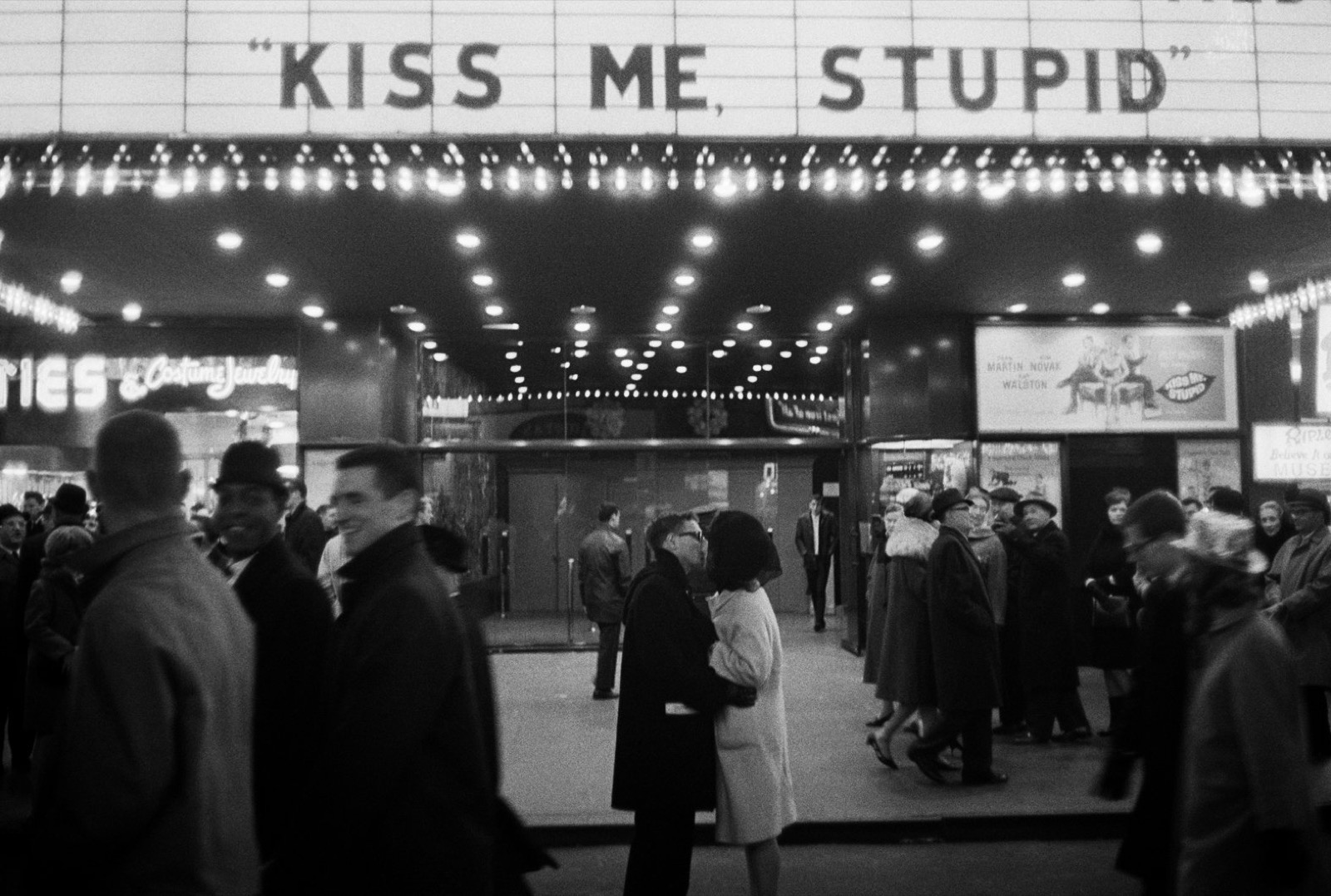
You wait your whole life for a coincidence this good and then distrust it when it comes. The marquee, in those fat block capitals with the quotation marks doing the heavy lifting, says KISS ME, STUPID — Billy Wilder, 1964, not Wilder's most loved film but here promoted to oracle — and directly beneath it, dead centre, a man in glasses and a woman in a pale coat are doing exactly that. Following instructions. The thing about a photograph like this is that nobody would believe it if you described it; you'd sound like you were making it up, which is partly why you have to photograph it instead.
What I love, though, is everything that isn't the kiss. The man on the left in the bowler hat, grinning at someone off-frame, who has no idea he's in a picture about romance and will never see it. The blur of coats sweeping in from the right edge, the whole pavement in motion while these two stand still as a monument. Meyerowitz is shooting before he's famous, before the color, still working out what he'd absorbed from walking the streets in Robert Frank's wake — the lesson that the city writes its own captions and your job is mostly to stand in the right doorway at the right second and not flinch.
That's the joke and the tenderness of it. The sign issues a command into the dark and two strangers, or not-strangers, obey it under all those lightbulbs as if the universe were a pushy friend. Everyone else just walks home. Sixty years on it still feels less staged than fated, which is the highest thing you can say about a moment someone managed not to miss.
You wait your whole life for a coincidence this good and then distrust it when it comes. The marquee, in those fat block capitals with the quotation marks doing the heavy lifting, says KISS ME, STUPID — Billy Wilder, 1964, not Wilder's most loved film but here promoted to oracle — and directly beneath it, dead centre, a man in glasses and a woman in a pale coat are doing exactly that. Following instructions. The thing about a photograph like this is that nobody would believe it if you described it; you'd sound like you were making it up, which is partly why you have to photograph it instead.
What I love, though, is everything that isn't the kiss. The man on the left in the bowler hat, grinning at someone off-frame, who has no idea he's in a picture about romance and will never see it. The blur of coats sweeping in from the right edge, the whole pavement in motion while these two stand still as a monument. Meyerowitz is shooting before he's famous, before the color, still working out what he'd absorbed from walking the streets in Robert Frank's wake — the lesson that the city writes its own captions and your job is mostly to stand in the right doorway at the right second and not flinch.
That's the joke and the tenderness of it. The sign issues a command into the dark and two strangers, or not-strangers, obey it under all those lightbulbs as if the universe were a pushy friend. Everyone else just walks home. Sixty years on it still feels less staged than fated, which is the highest thing you can say about a moment someone managed not to miss.