In this room the light is the weather of a painter’s mind: soft, sourceless, falling from the left just enough to lay a faint shadow of the vase across the table and no more. It is the light Giorgio Morandi lived inside, and Meyerowitz has gone to Bologna to photograph the objects the painter kept, one at a time. Here a black vase stands on a scored, rust-colored tabletop against an ochre wall, its trumpet mouth catching a thin gleam, a band of tarnished gold at its neck and foot. Nothing else competes.
What the light does is turn description into reverence. The wall behind is not blank but biography, stained and gouged, flecked with old paint and marked with a penciled letter, while the tabletop is a net of scratched lines where objects have been shifted and traced for decades. The vase itself is nearly a silhouette, yet the soft illumination finds the swell of its shoulder and the worn gilt at its base, so a humble prop becomes grave and particular. Photography, here, is an act of looking on behalf of another looker.
Meyerowitz, who with Shore and Eggleston made color serious in the 1970s and then spent decades describing American light from Cape Light onward, brings that same patience to a European still life. Working on the view camera, he lets the print carry the exact ochre of the wall and the deep, scuffed black of the glass. His work is collected by MoMA, the Met and the Boston MFA. This archival pigment print returns Morandi’s studio light to us, one dark vase at a time.
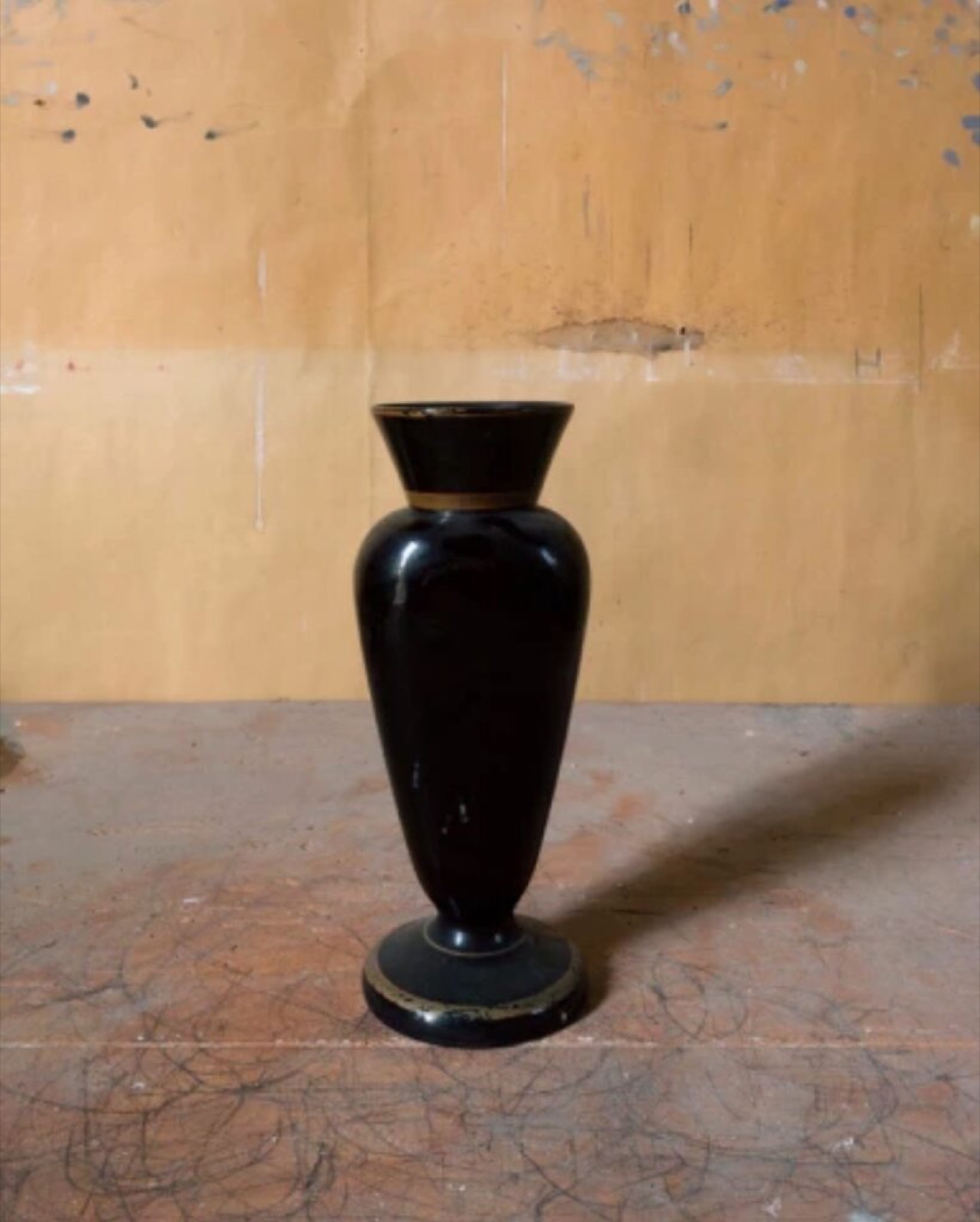

In this room the light is the weather of a painter’s mind: soft, sourceless, falling from the left just enough to lay a faint shadow of the vase across the table and no more. It is the light Giorgio Morandi lived inside, and Meyerowitz has gone to Bologna to photograph the objects the painter kept, one at a time. Here a black vase stands on a scored, rust-colored tabletop against an ochre wall, its trumpet mouth catching a thin gleam, a band of tarnished gold at its neck and foot. Nothing else competes.
What the light does is turn description into reverence. The wall behind is not blank but biography, stained and gouged, flecked with old paint and marked with a penciled letter, while the tabletop is a net of scratched lines where objects have been shifted and traced for decades. The vase itself is nearly a silhouette, yet the soft illumination finds the swell of its shoulder and the worn gilt at its base, so a humble prop becomes grave and particular. Photography, here, is an act of looking on behalf of another looker.
Meyerowitz, who with Shore and Eggleston made color serious in the 1970s and then spent decades describing American light from Cape Light onward, brings that same patience to a European still life. Working on the view camera, he lets the print carry the exact ochre of the wall and the deep, scuffed black of the glass. His work is collected by MoMA, the Met and the Boston MFA. This archival pigment print returns Morandi’s studio light to us, one dark vase at a time.