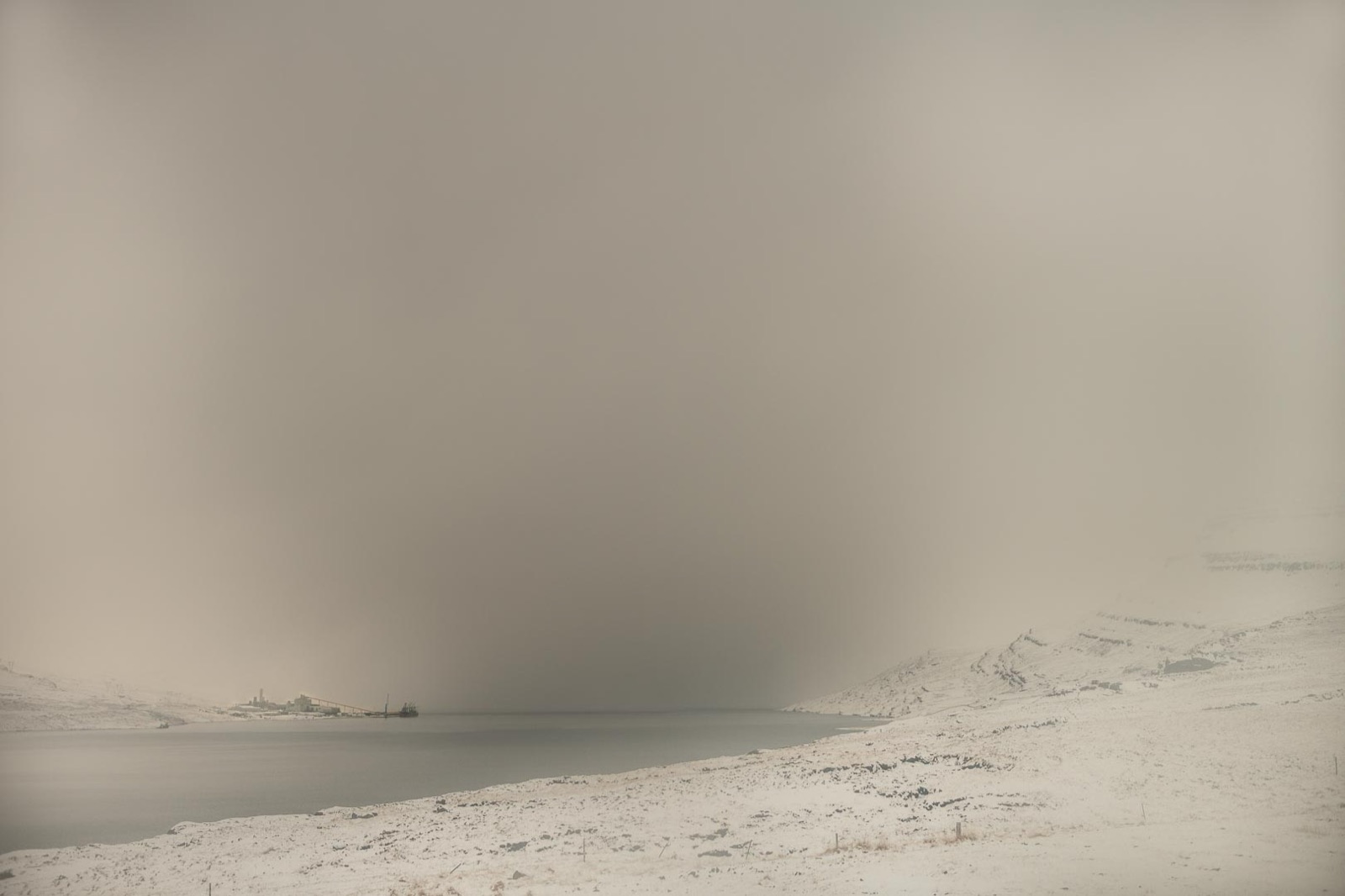
What this picture refuses to show is most of what was there: the far shore, the head of the water, the sky, whatever weather was arriving. Fog has eaten the middle of the world and left only its edges — a snowy foreshore stitched with fence posts, a channel of pewter water, and, far off at the left, a small industrial installation with its crane bent over the harbor like a heron. Everything else is withheld, and the withholding is gorgeous.
Beauty of this kind should be interrogated. A veil is never neutral: fog does to a landscape what tact does to a conversation, and both are forms of omission. The one hard fact the picture cannot quite dissolve is that machinery on the shore — work, cargo, the unpicturesque — reduced by distance and weather to an ornament. It would be easy to call the scene sublime and move on. But the sublime is often just information withheld. And yet: the eye accepts the bribe. I accept it. The gray is that beautiful.
Hido, whose prints hang at SFMOMA, the Getty and the Whitney, built his reputation on houses at night, where a curtained window did the withholding. In the open landscapes the fog volunteers for that job. The archival pigment print sustains the long, breathing gradient from ivory to slate that makes the image feel less printed than exhaled. One returns to the little harbor, the single verifiable thing, and understands the bargain: a photograph can only show the visible, and here the visible was in short supply. What is beautiful is what got through.
What this picture refuses to show is most of what was there: the far shore, the head of the water, the sky, whatever weather was arriving. Fog has eaten the middle of the world and left only its edges — a snowy foreshore stitched with fence posts, a channel of pewter water, and, far off at the left, a small industrial installation with its crane bent over the harbor like a heron. Everything else is withheld, and the withholding is gorgeous.
Beauty of this kind should be interrogated. A veil is never neutral: fog does to a landscape what tact does to a conversation, and both are forms of omission. The one hard fact the picture cannot quite dissolve is that machinery on the shore — work, cargo, the unpicturesque — reduced by distance and weather to an ornament. It would be easy to call the scene sublime and move on. But the sublime is often just information withheld. And yet: the eye accepts the bribe. I accept it. The gray is that beautiful.
Hido, whose prints hang at SFMOMA, the Getty and the Whitney, built his reputation on houses at night, where a curtained window did the withholding. In the open landscapes the fog volunteers for that job. The archival pigment print sustains the long, breathing gradient from ivory to slate that makes the image feel less printed than exhaled. One returns to the little harbor, the single verifiable thing, and understands the bargain: a photograph can only show the visible, and here the visible was in short supply. What is beautiful is what got through.