Hand-signed by the artist, with title, date, and edition number inscribed in ink on an archival label affixed to the reverse side of the mounted photograph.
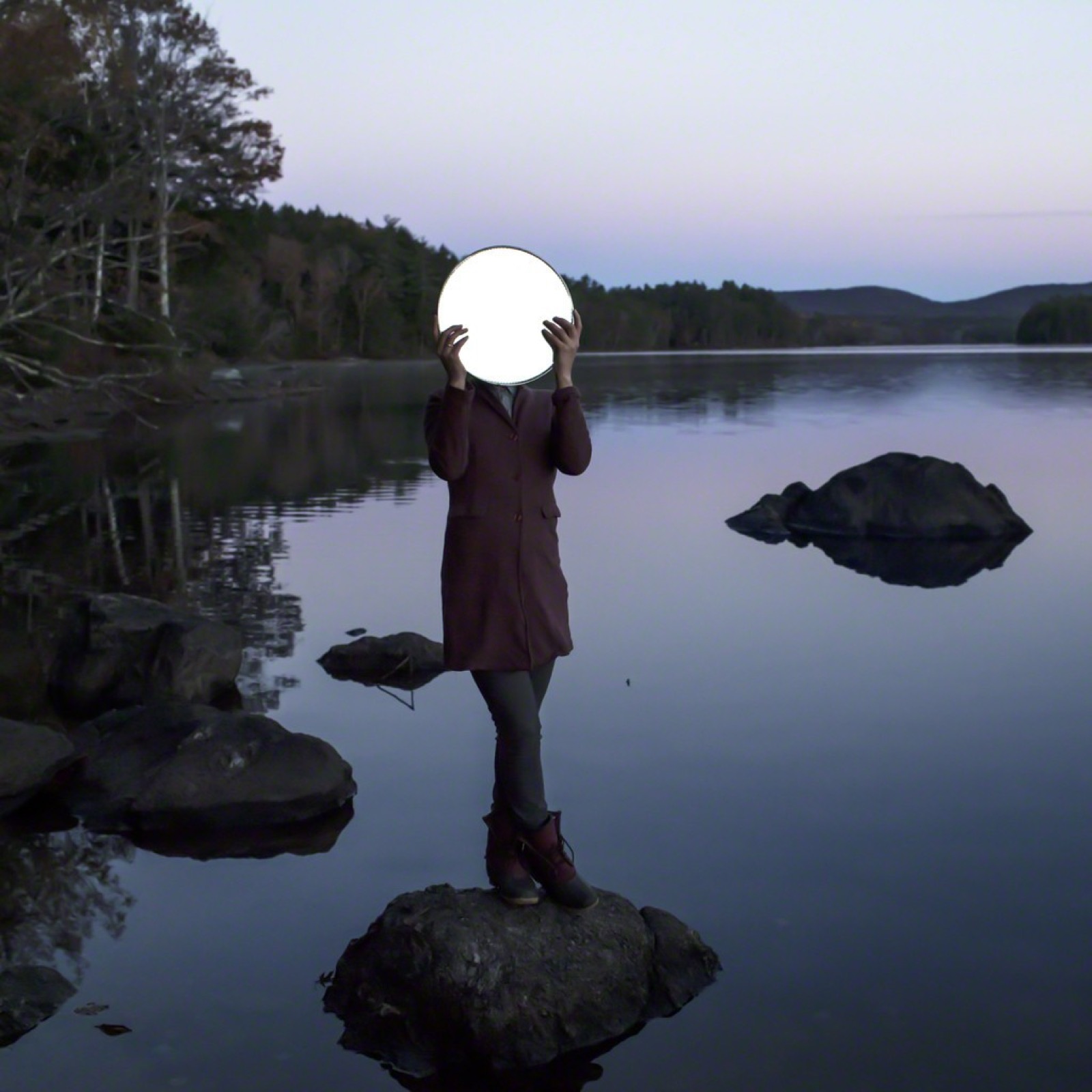
Long before the camera, people learned to hold a bright disc against the failing light and let it stand in for a face, a god, a full moon summoned early. Here that old habit returns at the edge of a Maine lake, where the water has gone the color of pewter and the far hills are already surrendering their green. A figure in a maroon coat stands on a black rock, arms lifted, cradling a circle of pure white light exactly where her features should be. The gesture is ancient; the surface is not.
What she offers is less a portrait than an eclipse. Two hands rise into the frame, fingers spread against the glowing rim, and the light spills nowhere, self-contained, refusing to warm the trousers or the burgundy boots planted on the wet stone. Around her the lake holds everything in reverse: rocks doubled, trees inverted, the lavender sky pressed flat into the water. The scene is utterly still, yet the disc reads as an interruption, a hole punched in the dusk through which something brighter is leaking. Erasure and revelation share one gesture.
Cig Harvey, who works from the coast at Rockport and has built books like The Blue Notebook and Blue Violet out of exactly this weather, treats the domestic and the uncanny as neighbors. Her pictures circulate through American museums and private collections precisely because they refuse to explain themselves. This one survives as an archival pigment print, its blacks deep enough to swallow the shoreline and its single white circle held at full intensity, a manufactured moon that will not dim on the wall.

Long before the camera, people learned to hold a bright disc against the failing light and let it stand in for a face, a god, a full moon summoned early. Here that old habit returns at the edge of a Maine lake, where the water has gone the color of pewter and the far hills are already surrendering their green. A figure in a maroon coat stands on a black rock, arms lifted, cradling a circle of pure white light exactly where her features should be. The gesture is ancient; the surface is not.
What she offers is less a portrait than an eclipse. Two hands rise into the frame, fingers spread against the glowing rim, and the light spills nowhere, self-contained, refusing to warm the trousers or the burgundy boots planted on the wet stone. Around her the lake holds everything in reverse: rocks doubled, trees inverted, the lavender sky pressed flat into the water. The scene is utterly still, yet the disc reads as an interruption, a hole punched in the dusk through which something brighter is leaking. Erasure and revelation share one gesture.
Cig Harvey, who works from the coast at Rockport and has built books like The Blue Notebook and Blue Violet out of exactly this weather, treats the domestic and the uncanny as neighbors. Her pictures circulate through American museums and private collections precisely because they refuse to explain themselves. This one survives as an archival pigment print, its blacks deep enough to swallow the shoreline and its single white circle held at full intensity, a manufactured moon that will not dim on the wall.