Hand-signed by the artist, with title, date, and edition number inscribed in ink on an archival label affixed to the reverse side of the mounted photograph.
Notice the pale flowers stitched into the bodice of her dress; they are the same size and nearly the same yellow as the buttercups strewn through the grass around her. That small rhyme organizes everything. A young woman lies on her back in a Maine meadow, eyes closed, head tipped away from us, and the picture is arranged so that she is neither quite separate from the field nor entirely dissolved into it. The dress proposes the terms of her belonging.
The vantage is from just above and to the side, close enough that the tall grass rises past her folded knees and crowds the lower edge, so we look down into the scene the way one might discover a sleeper by accident. Green fills the frame almost to the corners; the yellow arrives as punctuation, evenly distributed, never clustered. Light falls without drama, describing the bare shins, the cream fabric, a spray of seed heads gone to soft brown. Nothing is pushed. The composition trusts the meadow to hold her.
Cig Harvey has spent her career making the ordinary garden into a theater of feeling, and the pictures gathered in books such as You an Orchestra a Bomb and Blue Violet have carried that project into American museum collections. What keeps this one from mere prettiness is its restraint, the refusal to sentimentalize a girl asleep among flowers. As an archival pigment print it keeps the greens dense and the yellows exact, so that the field reads less as backdrop than as the true and patient subject.
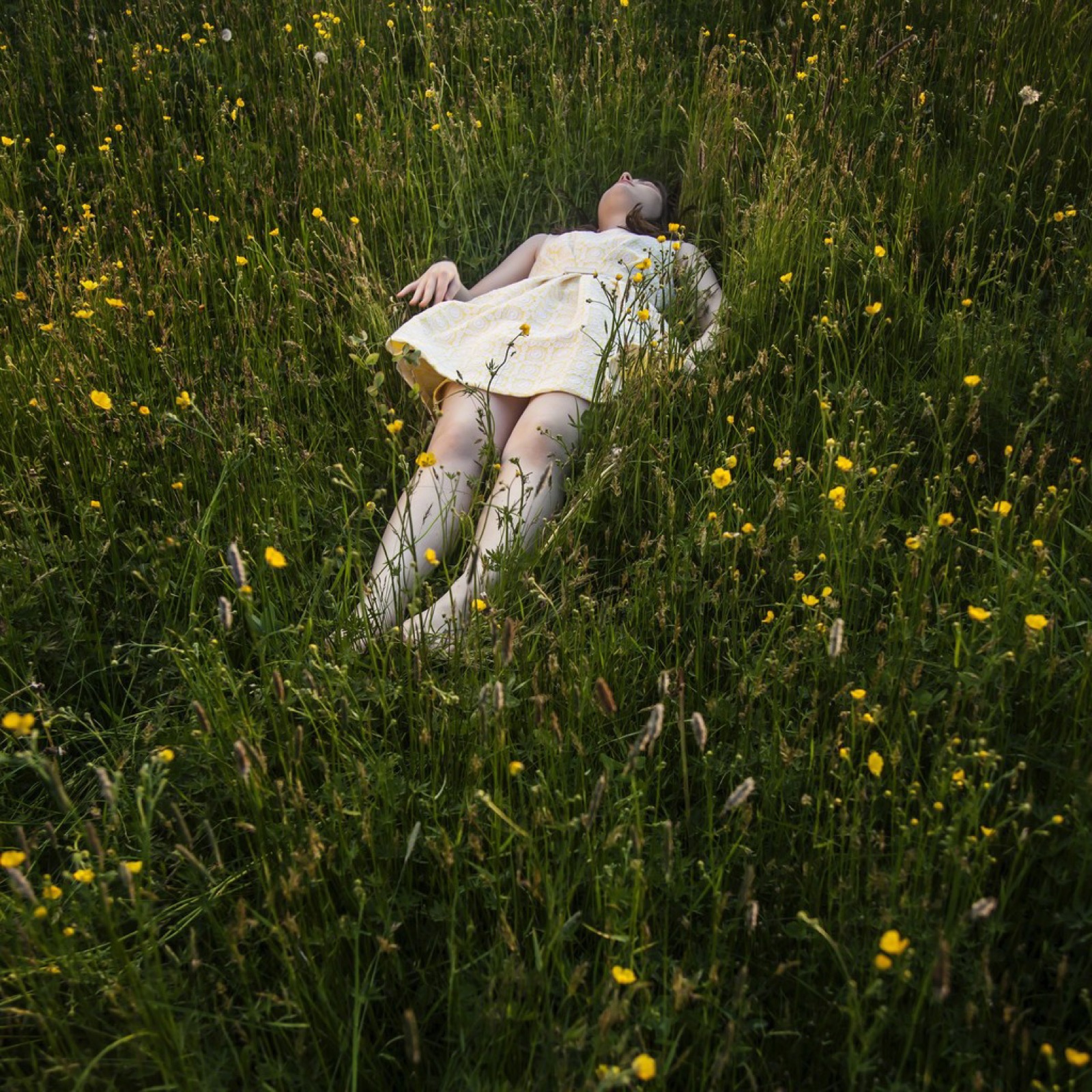

Notice the pale flowers stitched into the bodice of her dress; they are the same size and nearly the same yellow as the buttercups strewn through the grass around her. That small rhyme organizes everything. A young woman lies on her back in a Maine meadow, eyes closed, head tipped away from us, and the picture is arranged so that she is neither quite separate from the field nor entirely dissolved into it. The dress proposes the terms of her belonging.
The vantage is from just above and to the side, close enough that the tall grass rises past her folded knees and crowds the lower edge, so we look down into the scene the way one might discover a sleeper by accident. Green fills the frame almost to the corners; the yellow arrives as punctuation, evenly distributed, never clustered. Light falls without drama, describing the bare shins, the cream fabric, a spray of seed heads gone to soft brown. Nothing is pushed. The composition trusts the meadow to hold her.
Cig Harvey has spent her career making the ordinary garden into a theater of feeling, and the pictures gathered in books such as You an Orchestra a Bomb and Blue Violet have carried that project into American museum collections. What keeps this one from mere prettiness is its restraint, the refusal to sentimentalize a girl asleep among flowers. As an archival pigment print it keeps the greens dense and the yellows exact, so that the field reads less as backdrop than as the true and patient subject.