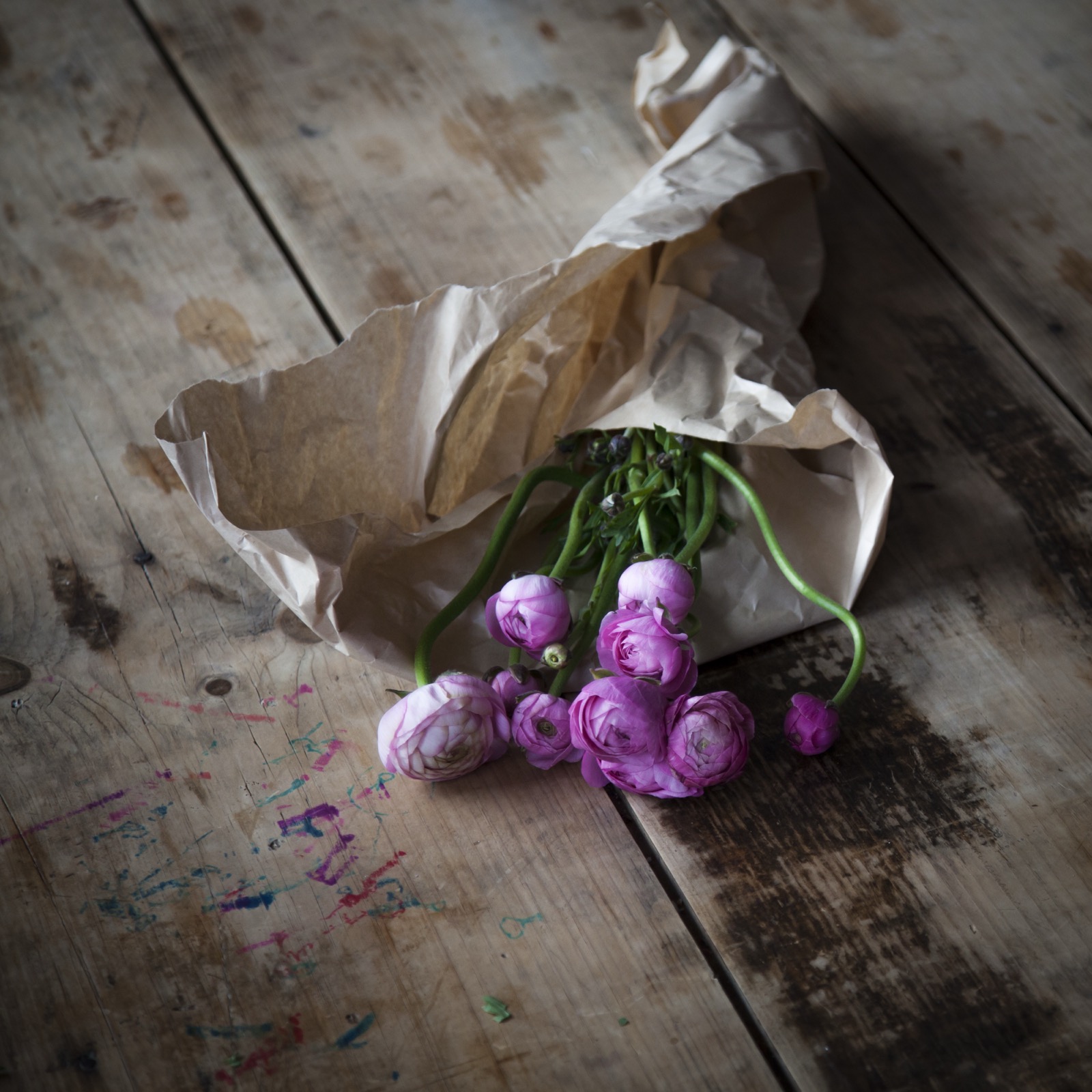
Ranunculus and the Felt Tip Markers, Rockport, Maine, 2013
Archival Pigment Print.
35.6 x 35.6 cm / 14 x 14 in
71.1 x 71.1 cm / 28 x 28 in
101.6 x 101.6 cm / 40 x 40 in
Hand-signed by the artist, with title, date, and edition number inscribed in ink on an archival label affixed to the reverse side of the mounted photograph.
Near the table’s left edge, worked into the grain, are faint scrawls of pink, teal, and violet: the traces of a child’s felt-tip markers, scrubbed but never quite erased. They are the smallest incident in the picture and the key to it. Without them this would be a florist’s still life; with them it becomes a family’s table, a surface where drawing and dinner and the day’s small chaos have all left their sediment.
The ranunculus arrive as a counterweight, a cluster of blossoms spilling from a cone of brown kraft paper, their stems still curved from the bucket. The palette is exact: rose and magenta heads against paper the color of oatmeal, green stems whose arcs repeat the loops of marker below. The photograph is organized like a seventeenth-century still life, dark at the right edge, light falling from the left, yet nothing here is arranged for allegory; the crumpled bag has simply been set down. The tabletop’s history of stains and scratches gives the print its tonal richness, a hundred shades of brown for the flowers to interrupt.
The artist has made the domestic her subject since settling in Rockport, Maine, where this was taken; her books The Blue Notebook and Blue Violet have placed flowers at the center of a sensory, autobiographical practice now held in American museum collections. In this archival pigment print the color does the remembering: the marker stains stay fugitive and soft, the ranunculus blaze, and the wood holds both, like a ledger of the household’s tenderness.

Near the table’s left edge, worked into the grain, are faint scrawls of pink, teal, and violet: the traces of a child’s felt-tip markers, scrubbed but never quite erased. They are the smallest incident in the picture and the key to it. Without them this would be a florist’s still life; with them it becomes a family’s table, a surface where drawing and dinner and the day’s small chaos have all left their sediment.
The ranunculus arrive as a counterweight, a cluster of blossoms spilling from a cone of brown kraft paper, their stems still curved from the bucket. The palette is exact: rose and magenta heads against paper the color of oatmeal, green stems whose arcs repeat the loops of marker below. The photograph is organized like a seventeenth-century still life, dark at the right edge, light falling from the left, yet nothing here is arranged for allegory; the crumpled bag has simply been set down. The tabletop’s history of stains and scratches gives the print its tonal richness, a hundred shades of brown for the flowers to interrupt.
The artist has made the domestic her subject since settling in Rockport, Maine, where this was taken; her books The Blue Notebook and Blue Violet have placed flowers at the center of a sensory, autobiographical practice now held in American museum collections. In this archival pigment print the color does the remembering: the marker stains stay fugitive and soft, the ranunculus blaze, and the wood holds both, like a ledger of the household’s tenderness.