Black is behaving like weather here, not fabric. Hundreds of paillettes, sewn onto sleeves and bodice, break loose across the frame in a dark spatter, as if the garment were dissolving into a swarm. Behind them the picture drifts from cool blue-green at the top to a dusty rose below, the whole surface softened as though shot through gauze or breathed on. And at the centre a woman presses both hands to her face, fingers spread over her eyes, hiding inside all that shimmer.
Photography has always been good at two contradictory jobs: describing a surface exactly and letting it fall apart. Yeste asks it to do both in a single frame. The sequins are rendered with real precision, each disc catching a point of light, yet the soft focus and the bleeding colour keep pulling them toward pure pattern, toward paint. The bare midriff anchors the body as fact; the covered face withholds identity. It keeps threatening to become abstraction, and holds both states in suspension.
Yeste is one of the leading Spanish fashion photographers of his generation, a maker who treats materials — fire, water, sand, sequins — as expressive weather rather than decoration. The archival pigment print is well suited to this hovering between description and dissolve: it renders the deep, unbroken black of the paillettes and the tender gradient of the ground without ever letting the softness curdle into mud. Tessa hides her face, and the image lets her; what it offers instead is the pleasure of a surface coming undone.
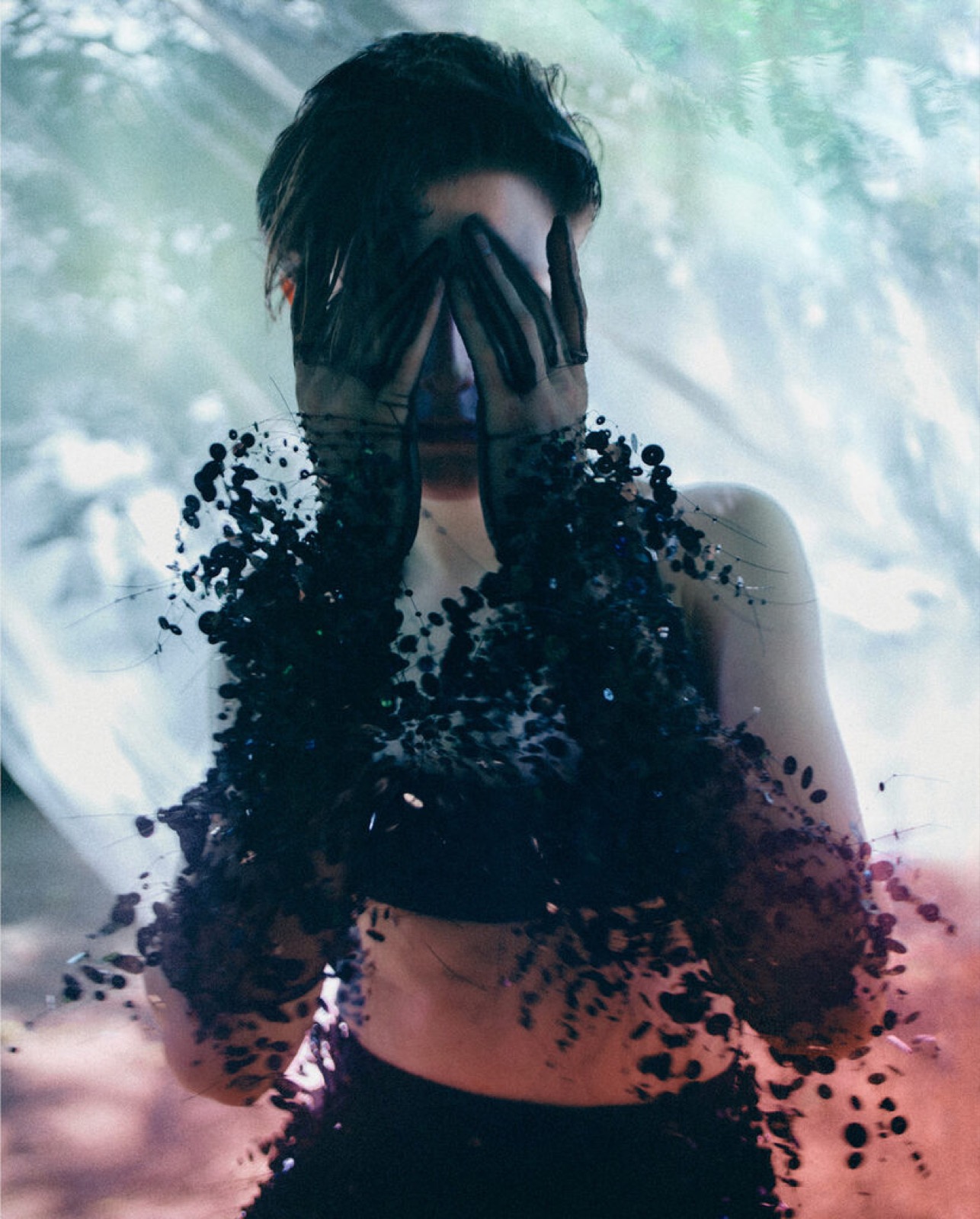

Black is behaving like weather here, not fabric. Hundreds of paillettes, sewn onto sleeves and bodice, break loose across the frame in a dark spatter, as if the garment were dissolving into a swarm. Behind them the picture drifts from cool blue-green at the top to a dusty rose below, the whole surface softened as though shot through gauze or breathed on. And at the centre a woman presses both hands to her face, fingers spread over her eyes, hiding inside all that shimmer.
Photography has always been good at two contradictory jobs: describing a surface exactly and letting it fall apart. Yeste asks it to do both in a single frame. The sequins are rendered with real precision, each disc catching a point of light, yet the soft focus and the bleeding colour keep pulling them toward pure pattern, toward paint. The bare midriff anchors the body as fact; the covered face withholds identity. It keeps threatening to become abstraction, and holds both states in suspension.
Yeste is one of the leading Spanish fashion photographers of his generation, a maker who treats materials — fire, water, sand, sequins — as expressive weather rather than decoration. The archival pigment print is well suited to this hovering between description and dissolve: it renders the deep, unbroken black of the paillettes and the tender gradient of the ground without ever letting the softness curdle into mud. Tessa hides her face, and the image lets her; what it offers instead is the pleasure of a surface coming undone.