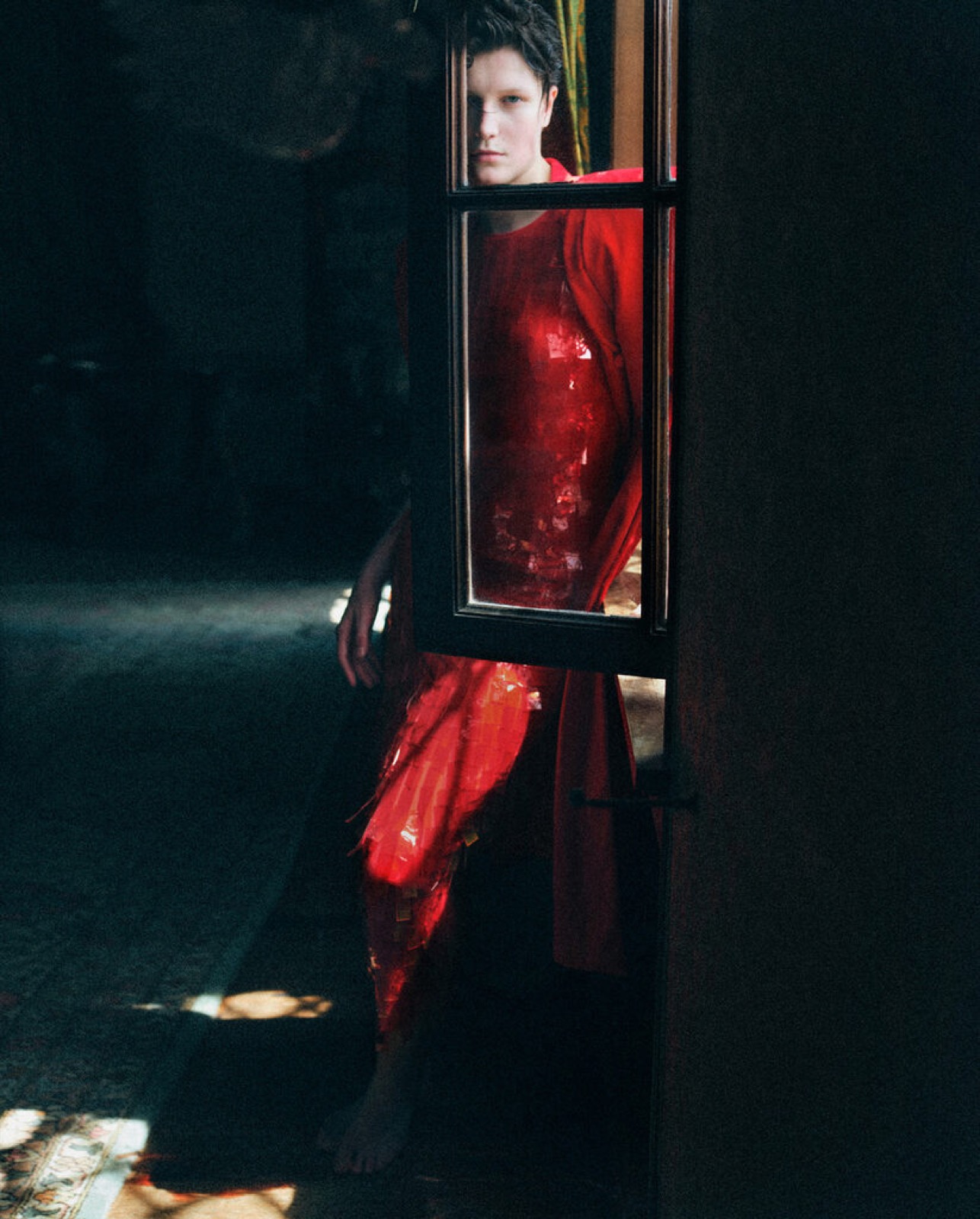
A young man stands in a half-open glazed door, one hand resting against the frame, looking out at us. He wears a long red robe over a tunic of some crumpled red plastic that catches light in hard facets, and he is barefoot. The room behind him is almost entirely dark — a patterned rug at the lower left, the suggestion of furniture — while through the doorway a shaft of daylight falls across the floor and breaks into coins of gold on the carpet.
The picture is built on a single division: the vertical black edge of the door and the dark wall to its right occupy nearly half the frame and carry no information at all. Everything visible is compressed into the lit strip at the left, and the figure is caught in the middle of it, half inside the room and half out. Whether he is leaving or has just been interrupted is left open; the hand on the frame suggests he has stopped.
Yeste is best known for work made outdoors in extreme terrain and for the high-production studio portrait, and this is neither. It belongs to a quieter register that has grown in his recent work — a domestic interior, available light, a single figure held in a doorway — nearer to Northern European genre painting than to editorial. The red does the job the desert or the coast does elsewhere in his pictures: it is the one saturated fact around which a very dark image organises itself.
A young man stands in a half-open glazed door, one hand resting against the frame, looking out at us. He wears a long red robe over a tunic of some crumpled red plastic that catches light in hard facets, and he is barefoot. The room behind him is almost entirely dark — a patterned rug at the lower left, the suggestion of furniture — while through the doorway a shaft of daylight falls across the floor and breaks into coins of gold on the carpet.
The picture is built on a single division: the vertical black edge of the door and the dark wall to its right occupy nearly half the frame and carry no information at all. Everything visible is compressed into the lit strip at the left, and the figure is caught in the middle of it, half inside the room and half out. Whether he is leaving or has just been interrupted is left open; the hand on the frame suggests he has stopped.
Yeste is best known for work made outdoors in extreme terrain and for the high-production studio portrait, and this is neither. It belongs to a quieter register that has grown in his recent work — a domestic interior, available light, a single figure held in a doorway — nearer to Northern European genre painting than to editorial. The red does the job the desert or the coast does elsewhere in his pictures: it is the one saturated fact around which a very dark image organises itself.