Archival pigment print mounted on aluminium Dibond.
One Size Only / 81.3 x 81.3 cm / 32 x 32 in
Hand-signed by the artist, with title, date, and edition number inscribed in ink on an archival label affixed to the reverse side of the mounted photograph
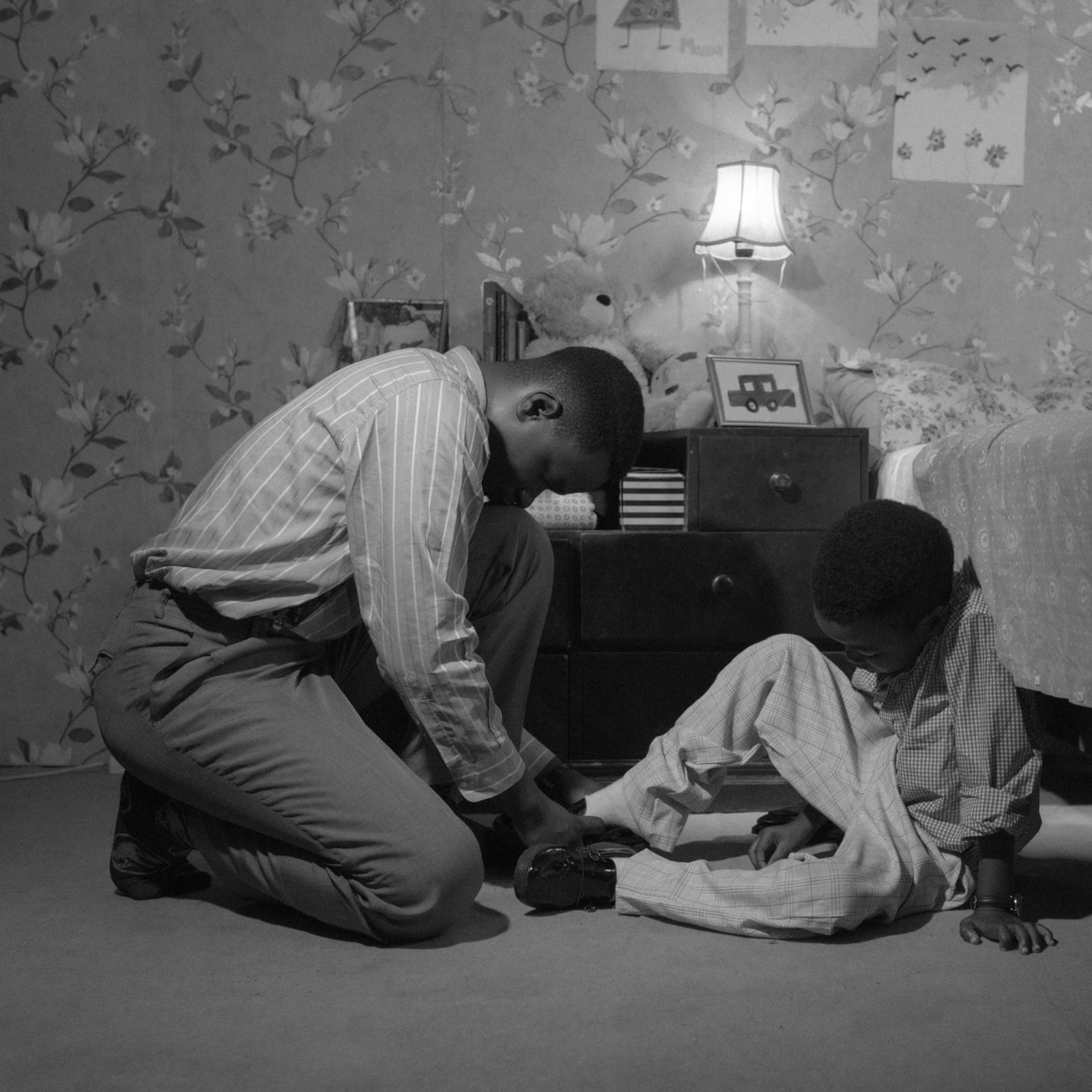
Carlos Idun-Tawiah’s Christmas Shoes, Accra, Ghana, 2024, from the series Hero Father Friend, is built around a gesture so familiar it might almost go unnoticed. In a child’s bedroom, a man kneels on the carpet to help a young boy with his shoe. The scene is quiet, but the photograph holds it with great care. Nothing is forced, nothing is overexplained. Its strength comes from the dignity given to an ordinary act.
The room feels lived in and protected: floral wallpaper, a glowing bedside lamp, framed pictures, books, children’s drawings, the edge of a made bed. Idun-Tawiah uses these details not as decoration, but as emotional evidence. They tell us where we are, and more importantly, what kind of space this is: a place shaped by routine, tenderness, and attention.
Within Hero Father Friend, the image offers a gentle but powerful idea of fatherhood. The man is not presented as a distant figure of authority, but as someone present in the small, practical rituals of care. He bends down, lowers himself to the child’s level, and gives his full attention to the task. The boy, still and absorbed, seems held by that care.
The black-and-white palette gives the photograph a quiet timelessness. Light, gesture, texture, and posture carry the emotion. For those who love photography, the beauty of the image lies in its restraint. Idun-Tawiah understands that a photograph does not need spectacle to stay with us.
Sometimes the most lasting images are made from moments like this: a shoe being tied, a child being readied, love made visible through the simplest act.

Carlos Idun-Tawiah’s Christmas Shoes, Accra, Ghana, 2024, from the series Hero Father Friend, is built around a gesture so familiar it might almost go unnoticed. In a child’s bedroom, a man kneels on the carpet to help a young boy with his shoe. The scene is quiet, but the photograph holds it with great care. Nothing is forced, nothing is overexplained. Its strength comes from the dignity given to an ordinary act.
The room feels lived in and protected: floral wallpaper, a glowing bedside lamp, framed pictures, books, children’s drawings, the edge of a made bed. Idun-Tawiah uses these details not as decoration, but as emotional evidence. They tell us where we are, and more importantly, what kind of space this is: a place shaped by routine, tenderness, and attention.
Within Hero Father Friend, the image offers a gentle but powerful idea of fatherhood. The man is not presented as a distant figure of authority, but as someone present in the small, practical rituals of care. He bends down, lowers himself to the child’s level, and gives his full attention to the task. The boy, still and absorbed, seems held by that care.
The black-and-white palette gives the photograph a quiet timelessness. Light, gesture, texture, and posture carry the emotion. For those who love photography, the beauty of the image lies in its restraint. Idun-Tawiah understands that a photograph does not need spectacle to stay with us.
Sometimes the most lasting images are made from moments like this: a shoe being tied, a child being readied, love made visible through the simplest act.