Archival pigment print mounted on aluminium Dibond.
One Size Only / 40.6 x 61 cm / 16 x 24 in
Hand-signed by the artist, with title, date, and edition number inscribed in ink on an archival label affixed to the reverse side of the mounted photograph
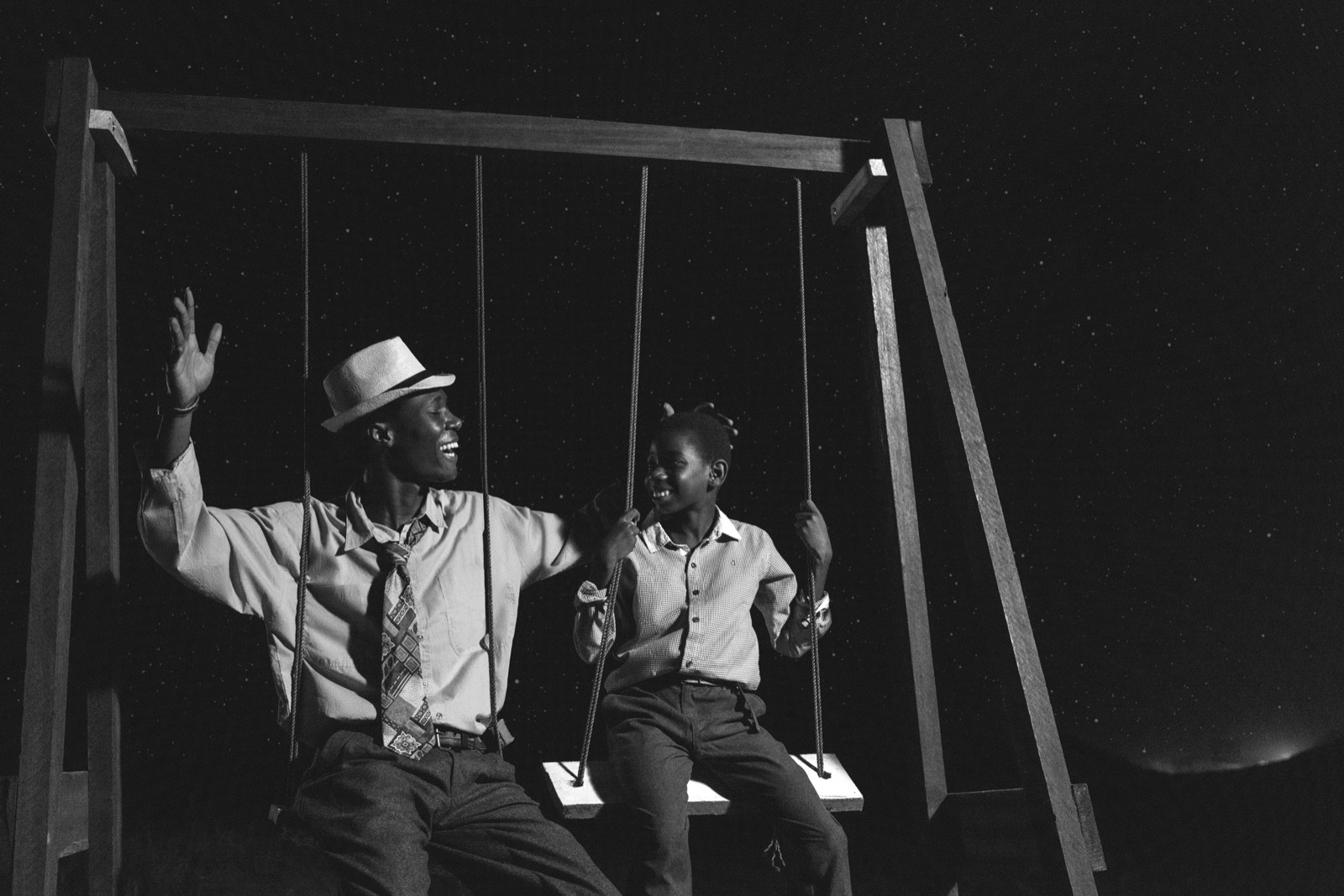
Two figures on a swing at night, and the night has been talked into cooperating: a black-and-white sky pricked with stars, a wooden frame, ropes climbing into the dark. A man in a pale shirt, tie and straw fedora throws one arm wide and laughs with his whole face; beside him a boy in a checked shirt grins back, gripping his own rope. You can almost hear the creak of the crossbeam, the particular squeak every swing in the world seems to share.
The thing about a swing is that it is always about to move, and the picture is poised in the half-second before the arc — which is really the subject: not stillness but imminent motion, the ongoing moment caught just before it goes on. Idun-Tawiah stages his tenderness rather than stumbling on it (the studio stars give the game away, cheerfully), and the staging is the point. This is memory as it should have been, wonder built to order, a night manufactured so that it can be kept.
The title is both instruction and consolation. Count your stars: count your blessings, but also, literally, look up and begin counting — the oldest game a father plays with a child against the size of the sky. From “Hero, Father, Friend” (2024), the artist’s reconstruction of a father lost too early, the image is an evening invented so that it can be attended after all; laughter that gets, this time, to be photographed.
Two figures on a swing at night, and the night has been talked into cooperating: a black-and-white sky pricked with stars, a wooden frame, ropes climbing into the dark. A man in a pale shirt, tie and straw fedora throws one arm wide and laughs with his whole face; beside him a boy in a checked shirt grins back, gripping his own rope. You can almost hear the creak of the crossbeam, the particular squeak every swing in the world seems to share.
The thing about a swing is that it is always about to move, and the picture is poised in the half-second before the arc — which is really the subject: not stillness but imminent motion, the ongoing moment caught just before it goes on. Idun-Tawiah stages his tenderness rather than stumbling on it (the studio stars give the game away, cheerfully), and the staging is the point. This is memory as it should have been, wonder built to order, a night manufactured so that it can be kept.
The title is both instruction and consolation. Count your stars: count your blessings, but also, literally, look up and begin counting — the oldest game a father plays with a child against the size of the sky. From “Hero, Father, Friend” (2024), the artist’s reconstruction of a father lost too early, the image is an evening invented so that it can be attended after all; laughter that gets, this time, to be photographed.