Hand-signed by the artist, with title, date, and edition number inscribed in ink on an archival label affixed to the reverse side of the mounted photograph.
One leaf, near the center, presses so firmly against the white fleece that it recovers its true dark green; everywhere else the plant is rumor. That single point of contact is what detains me. The branches beneath are slender, small-leaved, olive-like; they lean and scatter like handwriting under blotting paper. The gardener’s cloth, drawn over the greens somewhere in London, was meant as protection; the camera has converted it into a theory of desire. Whatever touches the veil becomes distinct; whatever withdraws, even by a centimeter, dissolves into silver breath.
I think of the herbarium, of leaves pressed between tissue pages; I think, absurdly, of a face beneath a sheet. The photograph permits both readings, tenderness and mourning, and refuses to choose between them. And the weave itself keeps interrupting: in the brightest passages I can count the threads, a tiny grid, as if the image confessed it was made of cloth all along. The picture is a quiet lesson in how little needs to be shown for everything to be felt.
Cig Harvey, British-born and long resident on the coast of Maine, photographs the domestic world at this pitch of sensation: gardens, fruit, fog, family, the loved thing seen as if for the last time. Her books, The Blue Notebook, You an Orchestra a Bomb, Blue Violet, are devoted to it, and her prints hang in American museum collections. This archival pigment print keeps the veil forever at the exact point of touch: green just arriving, white about to let go.
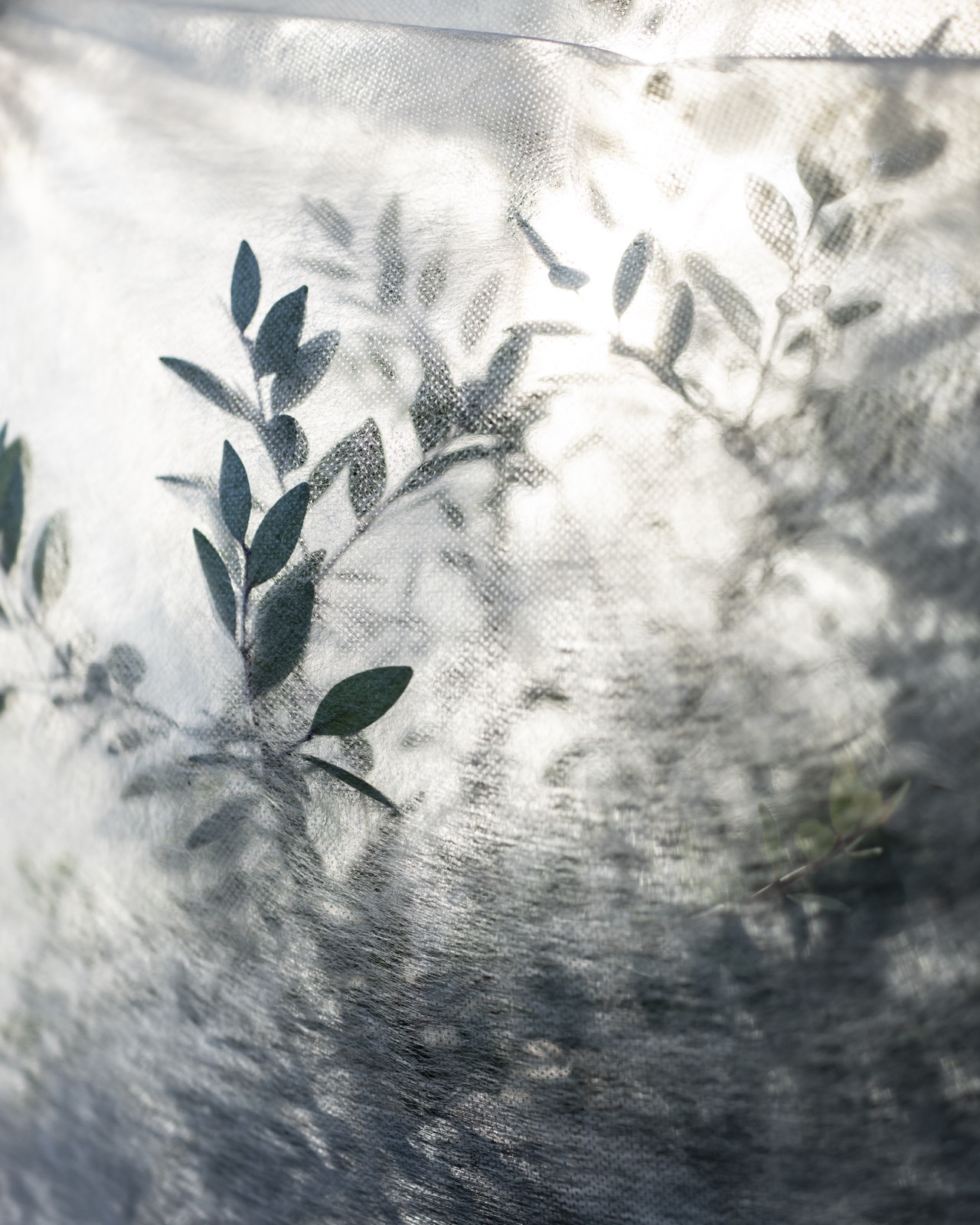

One leaf, near the center, presses so firmly against the white fleece that it recovers its true dark green; everywhere else the plant is rumor. That single point of contact is what detains me. The branches beneath are slender, small-leaved, olive-like; they lean and scatter like handwriting under blotting paper. The gardener’s cloth, drawn over the greens somewhere in London, was meant as protection; the camera has converted it into a theory of desire. Whatever touches the veil becomes distinct; whatever withdraws, even by a centimeter, dissolves into silver breath.
I think of the herbarium, of leaves pressed between tissue pages; I think, absurdly, of a face beneath a sheet. The photograph permits both readings, tenderness and mourning, and refuses to choose between them. And the weave itself keeps interrupting: in the brightest passages I can count the threads, a tiny grid, as if the image confessed it was made of cloth all along. The picture is a quiet lesson in how little needs to be shown for everything to be felt.
Cig Harvey, British-born and long resident on the coast of Maine, photographs the domestic world at this pitch of sensation: gardens, fruit, fog, family, the loved thing seen as if for the last time. Her books, The Blue Notebook, You an Orchestra a Bomb, Blue Violet, are devoted to it, and her prints hang in American museum collections. This archival pigment print keeps the veil forever at the exact point of touch: green just arriving, white about to let go.