Hand-signed by the artist, with title, date, and edition number inscribed in ink on an archival label affixed to the reverse side of the mounted photograph.
In a century that photographs its clouds by the billion, from airplane windows and weather satellites, someone has gone looking for them instead in the black water of a lake in Maine. The old inventory of the sublime, downgraded to wallpaper by sheer repetition, is here recovered by inversion: the sky drifts below, white and vaporous, in water so dark it reads as night. A pale hand enters from the right and points into it, index finger extended, hovering at the brink of touch, as if to accuse the clouds of trespassing.
The same hand pinches a fold of crimson velvet, and this is where the picture declares its allegiances. Velvet is the fabric of altarpieces and theater curtains; the pointing finger has belonged, since the Sistine ceiling, to acts of creation. The photographer is unembarrassed by such borrowed grandeur. The photograph seduces exactly as painting once did, with drapery, gesture, and darkness, and it knows that seduction is a form of argument. To touch the reflection would be to destroy it; to point is to desire without spoiling.
Cig Harvey, British-born and rooted for years in Rockport, Maine, works in exactly this key of domestic ecstasy; her books The Blue Notebook, You an Orchestra a Bomb, and Blue Violet have carried it widely, and American museums collect and exhibit her prints. This archival pigment print holds the paradox at full saturation: a sky you can almost reach into, a lake wearing the weather, red velvet burning against all that dark.
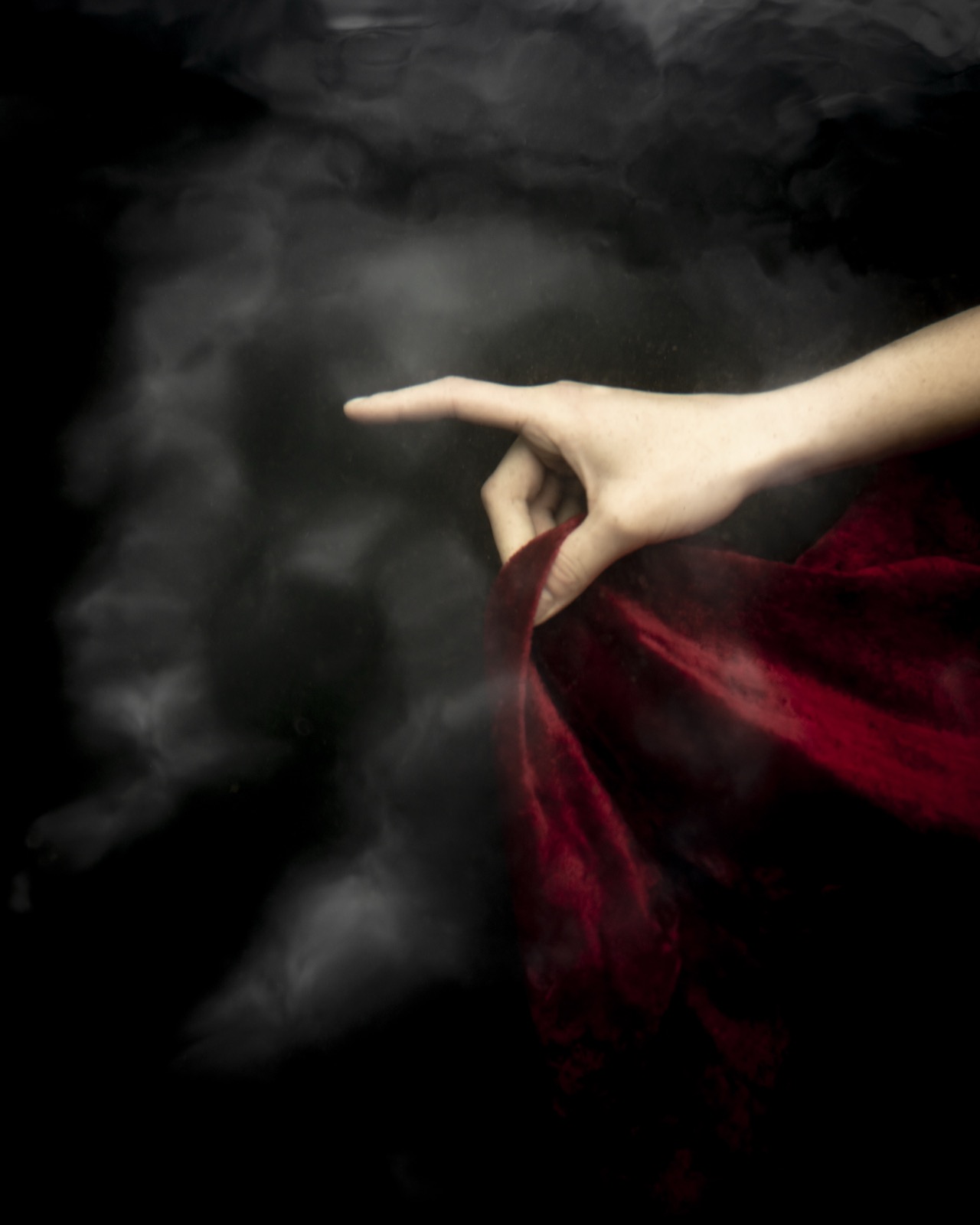
In a century that photographs its clouds by the billion, from airplane windows and weather satellites, someone has gone looking for them instead in the black water of a lake in Maine. The old inventory of the sublime, downgraded to wallpaper by sheer repetition, is here recovered by inversion: the sky drifts below, white and vaporous, in water so dark it reads as night. A pale hand enters from the right and points into it, index finger extended, hovering at the brink of touch, as if to accuse the clouds of trespassing.
The same hand pinches a fold of crimson velvet, and this is where the picture declares its allegiances. Velvet is the fabric of altarpieces and theater curtains; the pointing finger has belonged, since the Sistine ceiling, to acts of creation. The photographer is unembarrassed by such borrowed grandeur. The photograph seduces exactly as painting once did, with drapery, gesture, and darkness, and it knows that seduction is a form of argument. To touch the reflection would be to destroy it; to point is to desire without spoiling.
Cig Harvey, British-born and rooted for years in Rockport, Maine, works in exactly this key of domestic ecstasy; her books The Blue Notebook, You an Orchestra a Bomb, and Blue Violet have carried it widely, and American museums collect and exhibit her prints. This archival pigment print holds the paradox at full saturation: a sky you can almost reach into, a lake wearing the weather, red velvet burning against all that dark.