In profile, a woman with black hair pulled tight into a low knot, a gold disc at her ear, and an enormous cream satin ruffle standing up around her shoulders. She holds a plaster head against her own cheek — a classical female face, broken at the crown, its eyes blank — so that the two profiles almost touch. To the right, filling a third of the frame, stands a much larger plaster bust of a bearded man, and behind everything a wall of pale veined marble.
Three faces, then, and only one of them alive. The plaster ones are casts: reproductions taken from moulds, made in numbers, in a workshop tradition older than photography and organised on the same principle — an original nobody in this room has seen, and copies that circulate in its place. The chipped edge on the small head is the giveaway. It has been handled, and repeatedly.
What the picture does is set two reproductive technologies against each other and let the seams show. The cast is white, matte, dimensional, and holds still forever; the photograph is thin, coloured, and will shift as its pigment does. Both are copies of a face. The one being held is unmarked by any particular afternoon; the one holding it was recorded on a particular day at a particular hour, and this print is the only object in the world that remembers it.
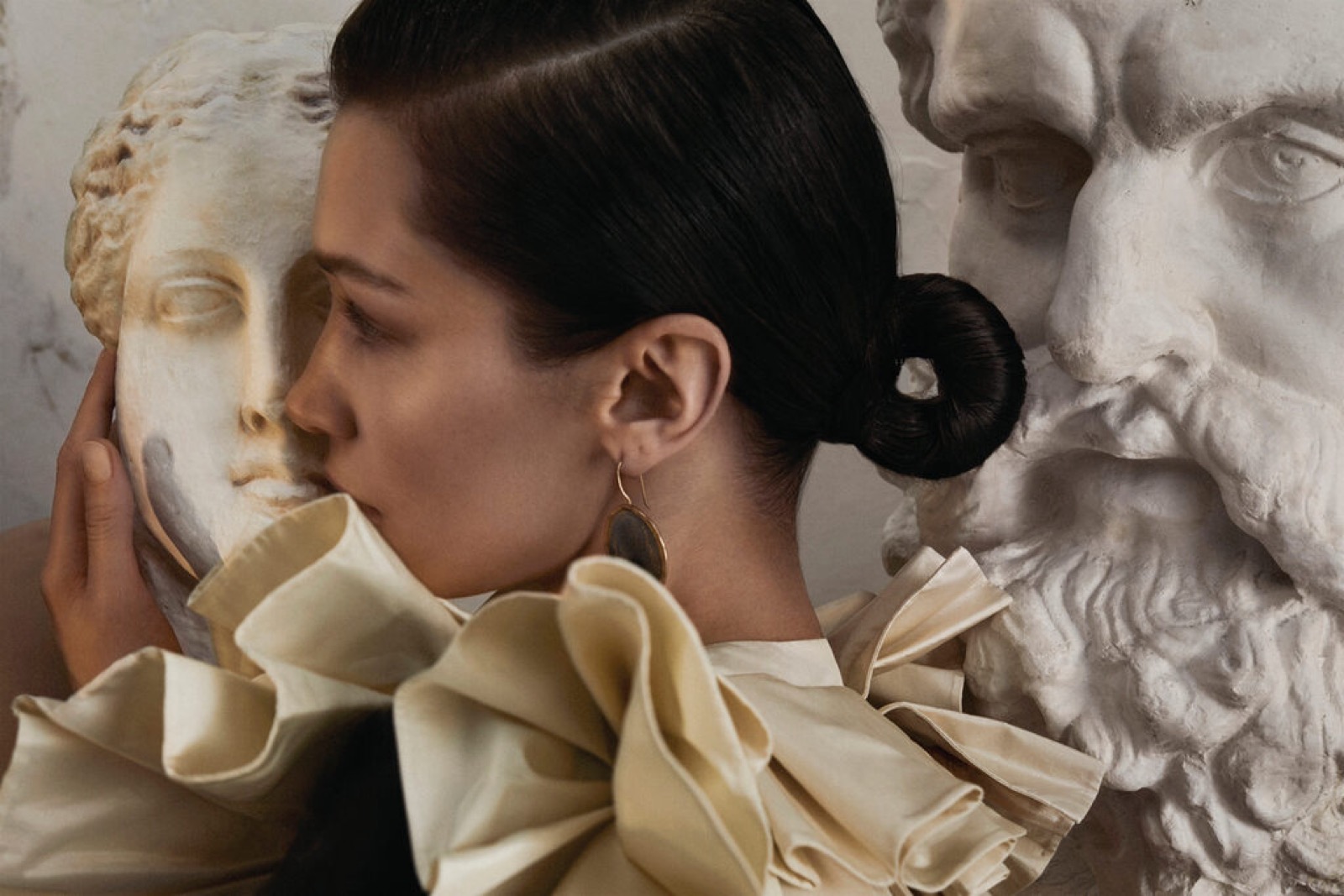

In profile, a woman with black hair pulled tight into a low knot, a gold disc at her ear, and an enormous cream satin ruffle standing up around her shoulders. She holds a plaster head against her own cheek — a classical female face, broken at the crown, its eyes blank — so that the two profiles almost touch. To the right, filling a third of the frame, stands a much larger plaster bust of a bearded man, and behind everything a wall of pale veined marble.
Three faces, then, and only one of them alive. The plaster ones are casts: reproductions taken from moulds, made in numbers, in a workshop tradition older than photography and organised on the same principle — an original nobody in this room has seen, and copies that circulate in its place. The chipped edge on the small head is the giveaway. It has been handled, and repeatedly.
What the picture does is set two reproductive technologies against each other and let the seams show. The cast is white, matte, dimensional, and holds still forever; the photograph is thin, coloured, and will shift as its pigment does. Both are copies of a face. The one being held is unmarked by any particular afternoon; the one holding it was recorded on a particular day at a particular hour, and this print is the only object in the world that remembers it.