How large must a face grow before it stops being a face and becomes weather, geography, a wall to be climbed? The picture answers by making one enormous: a woman’s countenance, eyes closed, blown up until its skin cracks into a delta of fine black lines, filling the frame edge to edge. At the base of this monument stands a living woman no taller than the giant’s lower lip, in a strapless flared dress, reaching up with both bare arms to press one palm against the vast closed mouth.
The image seduces through scale, the oldest trick of the sublime, and we should distrust it even as we submit. What is being sold is smallness, the delicious vertigo of the miniature human against the colossal idol. Yet look at the craquelure: the giant face is not flesh but paint, already aging, already a ruin, while the tiny figure below is warm and quick. The photograph quietly reverses its own hierarchy. Monuments crack; the mortal, reaching, endures a moment longer.
The small figure is Karlie Kloss; the maker is Txema Yeste, among the front rank of Spanish fashion photographers, whose work for Numéro, Harper’s Bazaar and Vogue keeps staging the human body against the elements and against art itself. Issued as a black-and-white archival pigment print, the image holds its greys in a long unbroken scale, from the depth of the closed eyes to the pale gleam of a bare shoulder. A question about size becomes, in the end, a question about time — and about which of the two faces we will still be looking at.
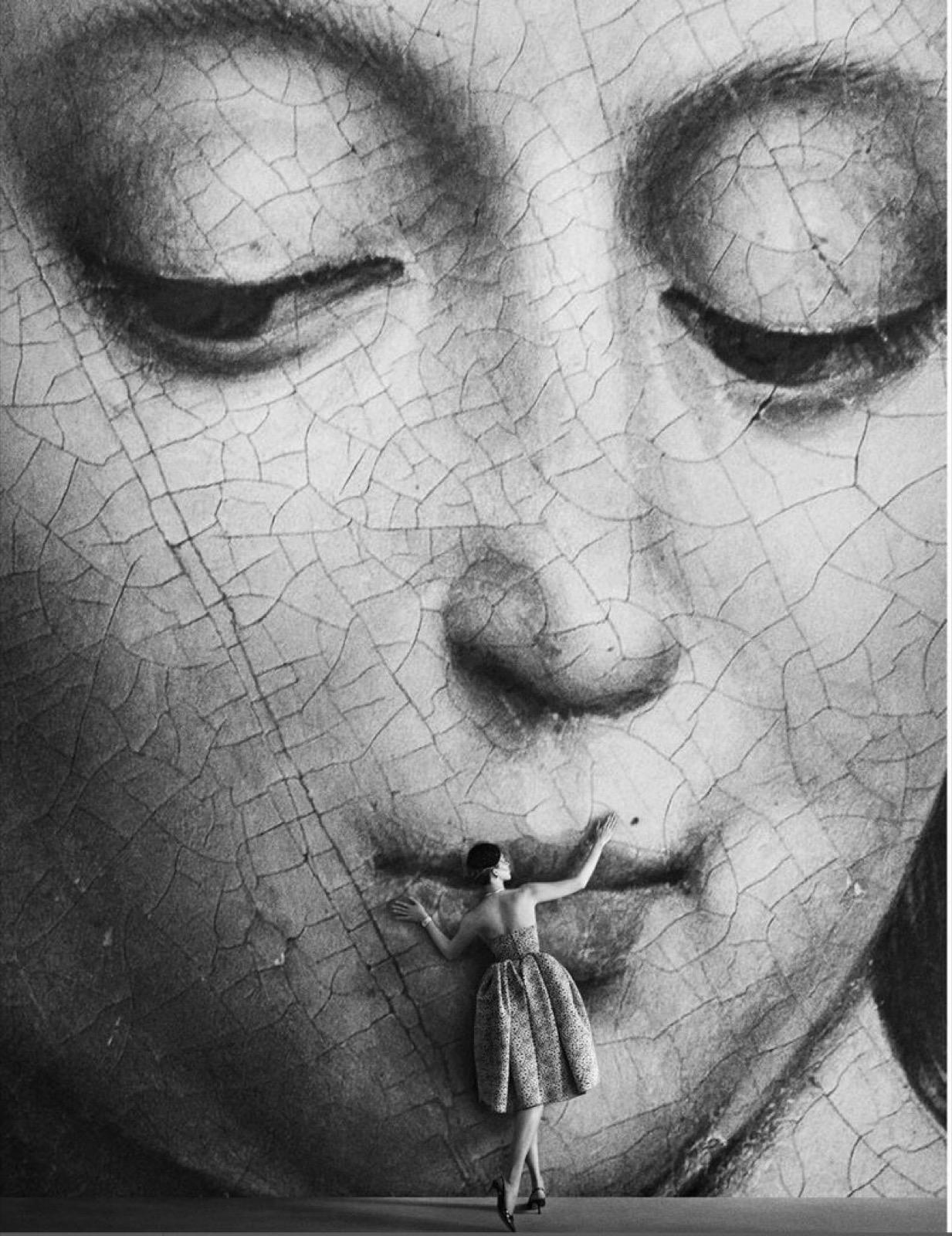

How large must a face grow before it stops being a face and becomes weather, geography, a wall to be climbed? The picture answers by making one enormous: a woman’s countenance, eyes closed, blown up until its skin cracks into a delta of fine black lines, filling the frame edge to edge. At the base of this monument stands a living woman no taller than the giant’s lower lip, in a strapless flared dress, reaching up with both bare arms to press one palm against the vast closed mouth.
The image seduces through scale, the oldest trick of the sublime, and we should distrust it even as we submit. What is being sold is smallness, the delicious vertigo of the miniature human against the colossal idol. Yet look at the craquelure: the giant face is not flesh but paint, already aging, already a ruin, while the tiny figure below is warm and quick. The photograph quietly reverses its own hierarchy. Monuments crack; the mortal, reaching, endures a moment longer.
The small figure is Karlie Kloss; the maker is Txema Yeste, among the front rank of Spanish fashion photographers, whose work for Numéro, Harper’s Bazaar and Vogue keeps staging the human body against the elements and against art itself. Issued as a black-and-white archival pigment print, the image holds its greys in a long unbroken scale, from the depth of the closed eyes to the pale gleam of a bare shoulder. A question about size becomes, in the end, a question about time — and about which of the two faces we will still be looking at.