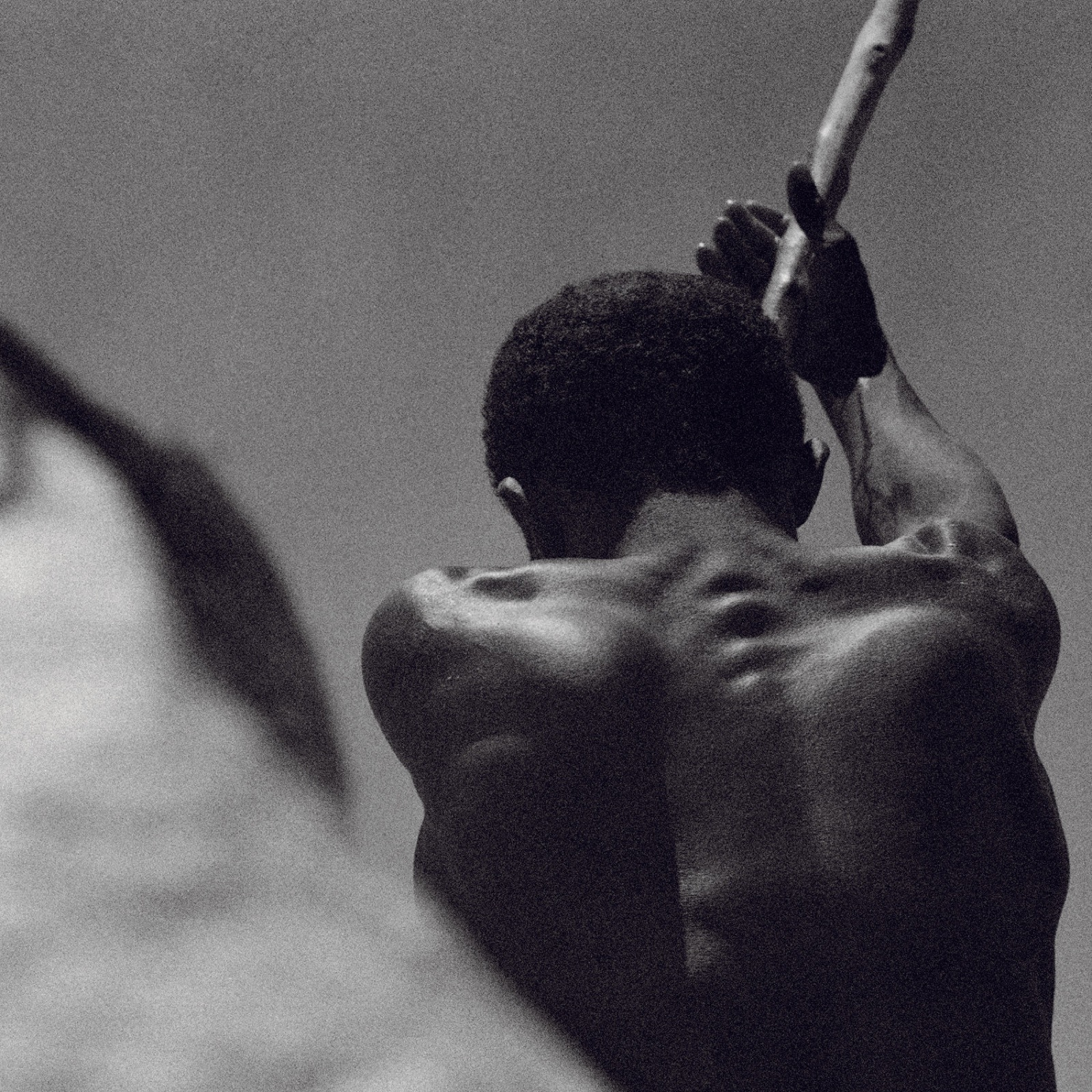
The back tells the truth the face is busy hiding. Here the man is turned entirely away, his head cropped and lowered, and everything expressive has migrated to the muscle: the wing of the shoulder blade, the long groove of the spine, the arms lifted to grip a pole that climbs out of the top corner. He is rowing, or poling, or hauling, and the effort has organized his whole body into a single upward pull.
It is a performance without an audience, or rather with only us. The light rakes across the shoulders and picks out each cord of muscle with a jeweller’s attention, glamour of the most physical kind, while a blurred shape to the left, an arm perhaps, or a second oar, keeps the frame from settling into a pose. Grain lies over everything like fine dust, giving the skin a matte, worked surface a slicker picture would have polished away. The rhythm is all diagonal, body and pole leaning the same way, caught at the top of the stroke.
What could have been a straightforward study of a nude becomes, in this handling, something closer to sculpture photographed in motion. The print is gelatin silver toned with selenium, made the year after the exposure, and the toning deepens the shadowed flank to a rich near-black while keeping the highlights along the spine crisp. Saula, who made the image and founded the gallery that shows it, keeps his vocabulary elemental, one body, one pole, one hard light, and trusts the hand-printed grain to carry the rest.
The back tells the truth the face is busy hiding. Here the man is turned entirely away, his head cropped and lowered, and everything expressive has migrated to the muscle: the wing of the shoulder blade, the long groove of the spine, the arms lifted to grip a pole that climbs out of the top corner. He is rowing, or poling, or hauling, and the effort has organized his whole body into a single upward pull.
It is a performance without an audience, or rather with only us. The light rakes across the shoulders and picks out each cord of muscle with a jeweller’s attention, glamour of the most physical kind, while a blurred shape to the left, an arm perhaps, or a second oar, keeps the frame from settling into a pose. Grain lies over everything like fine dust, giving the skin a matte, worked surface a slicker picture would have polished away. The rhythm is all diagonal, body and pole leaning the same way, caught at the top of the stroke.
What could have been a straightforward study of a nude becomes, in this handling, something closer to sculpture photographed in motion. The print is gelatin silver toned with selenium, made the year after the exposure, and the toning deepens the shadowed flank to a rich near-black while keeping the highlights along the spine crisp. Saula, who made the image and founded the gallery that shows it, keeps his vocabulary elemental, one body, one pole, one hard light, and trusts the hand-printed grain to carry the rest.