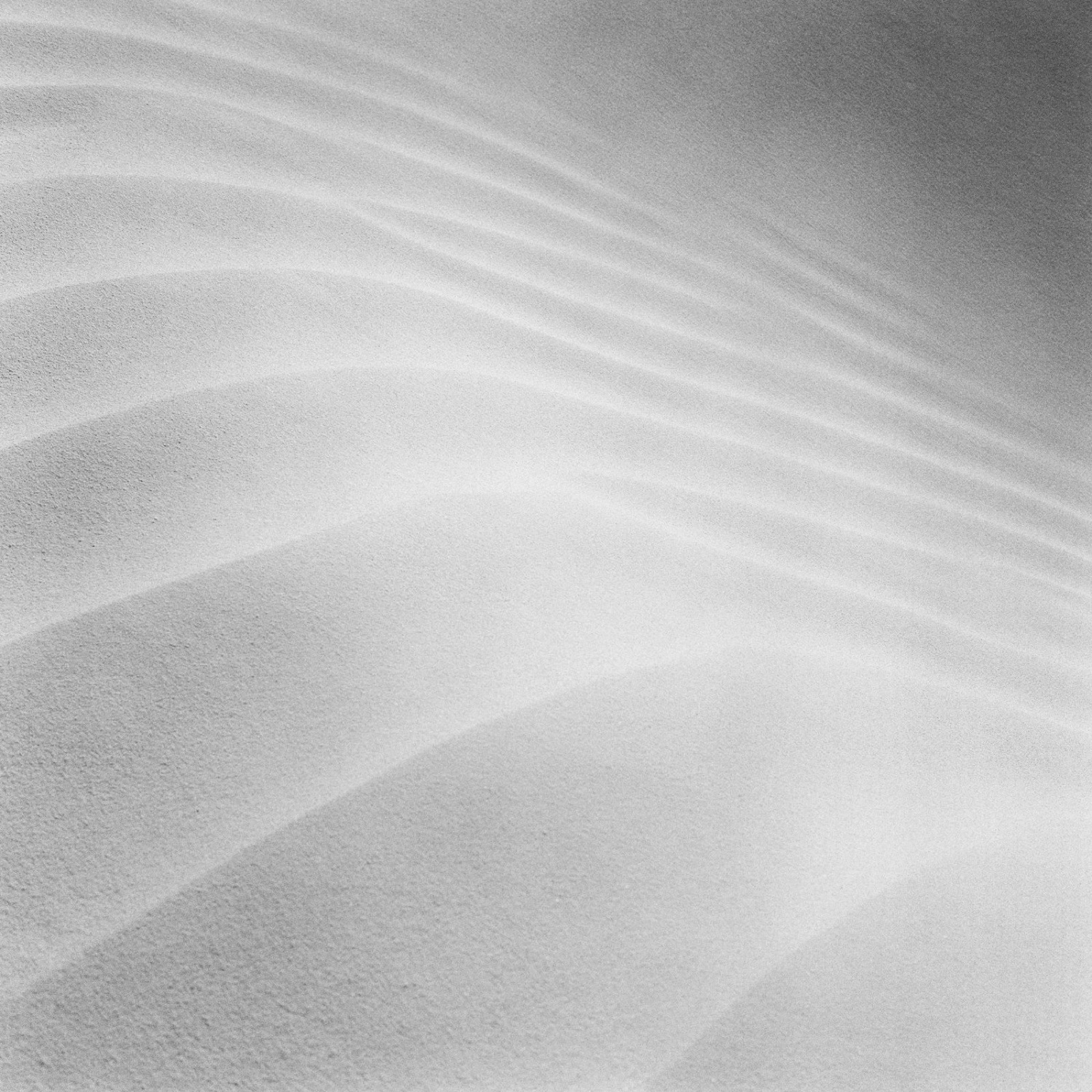
Read the sand and it looks like cursive: long looping lines the wind has scored across the dune, parallel strokes that swell and taper like a signature repeated down a page. There is no lettering here, only this drifting calligraphy, yet the surface behaves exactly like text, asking the eye to travel left to right along each curve and then drop to the next. Whoever authored it worked in a single medium, pale grain on pale grain, and signed nothing.
What a performance of restraint. The whole frame runs from chalk white at the crest to the softest pearl grey where a shoulder of sand turns from the light, and the tonal range is so narrow it feels like a dare, a photographer betting that almost nothing can hold the picture. It does. The ripples supply the rhythm a great fashion page has, that sense of a line moving with intention, and the fine tooth of the sand keeps the whole thing from tipping into mere smoothness. Glamour, it turns out, can be a matter of grain.
Printed in gelatin silver and toned with selenium the year after the negative was made, the sheet earns its whites: the process holds the delicate high values apart so the palest ripples never blow out to blank paper, while the shadowed trough gains a faint warm depth. This is where craft becomes the subject. The photographer, who founded the gallery that shows the work, has turned a patch of desert into a study of how much a print can whisper and still be heard.
Read the sand and it looks like cursive: long looping lines the wind has scored across the dune, parallel strokes that swell and taper like a signature repeated down a page. There is no lettering here, only this drifting calligraphy, yet the surface behaves exactly like text, asking the eye to travel left to right along each curve and then drop to the next. Whoever authored it worked in a single medium, pale grain on pale grain, and signed nothing.
What a performance of restraint. The whole frame runs from chalk white at the crest to the softest pearl grey where a shoulder of sand turns from the light, and the tonal range is so narrow it feels like a dare, a photographer betting that almost nothing can hold the picture. It does. The ripples supply the rhythm a great fashion page has, that sense of a line moving with intention, and the fine tooth of the sand keeps the whole thing from tipping into mere smoothness. Glamour, it turns out, can be a matter of grain.
Printed in gelatin silver and toned with selenium the year after the negative was made, the sheet earns its whites: the process holds the delicate high values apart so the palest ripples never blow out to blank paper, while the shadowed trough gains a faint warm depth. This is where craft becomes the subject. The photographer, who founded the gallery that shows the work, has turned a patch of desert into a study of how much a print can whisper and still be heard.