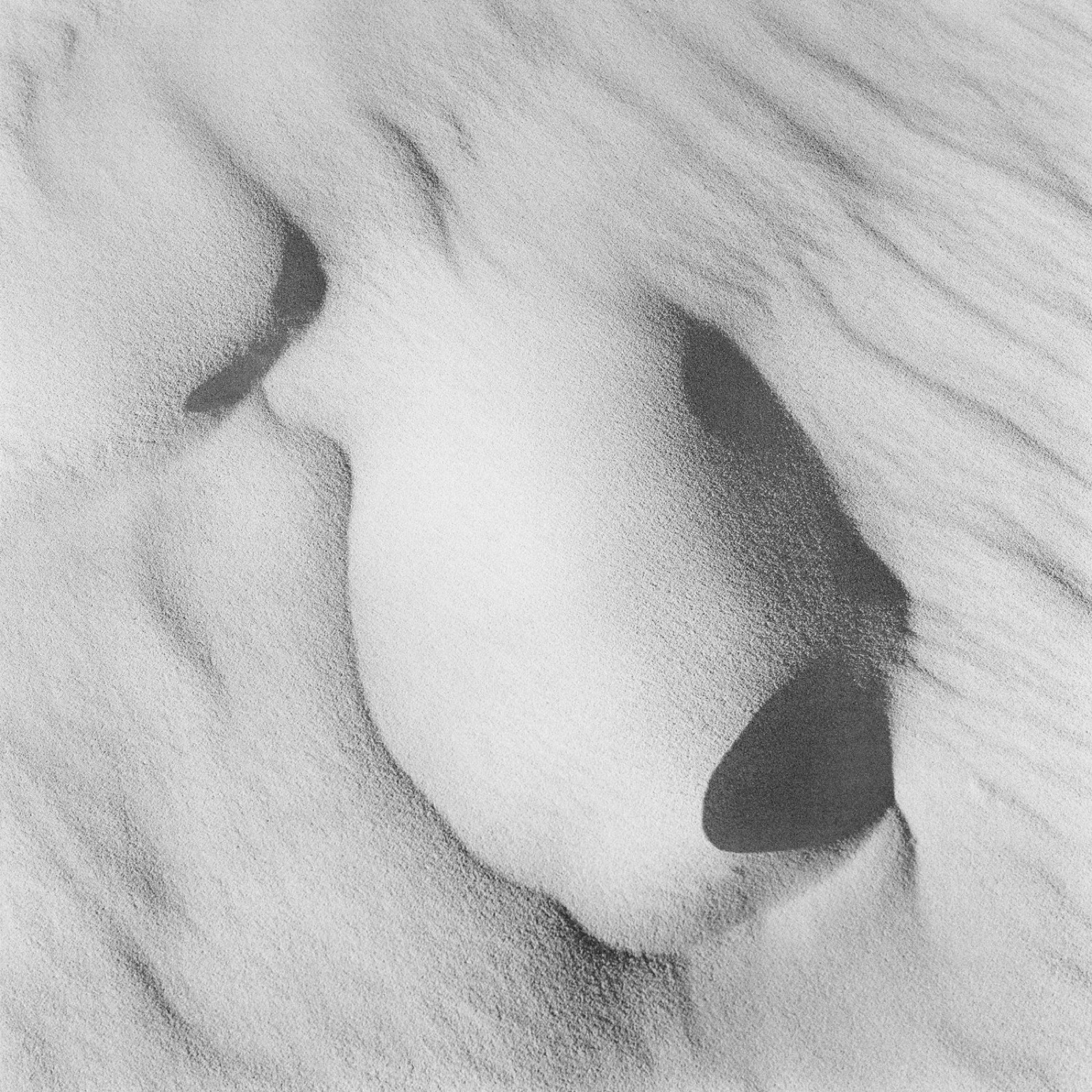
So fine-grained is the gray of this print, so evenly worked, that it keeps threatening to become a drawing: graphite rubbed into soft paper with the side of a thumb. It doesn’t stay a drawing for long. The pale swell in the middle of the frame, cushioned between two pools of shadow, is too warm for that, too obviously flesh-like: a hip, a shoulder, the back of a sleeper who has kicked off the sheet. And yet the title, with a straight face, says hills.
Scale, in any case, has absented itself. There is no horizon, no footprint, no obliging beetle to tell us whether we are hovering over a desert range or kneeling on a beach with our nose a hand’s width from the ground. Weston ran into this at Oceano: photograph dunes attentively enough and they start behaving like nudes, and vice versa, until the negatives seem almost interchangeable. The confusion is not a failure. It may be the entire point, the wind demonstrating its old habit of making bodies out of whatever loose material the world leaves lying around.
There is a nice congruence in the making. Sand is grain; so, on close inspection, is a gelatin silver print, and this one, printed by the photographer himself a year after the exposure, lets the two granularities meet as equals. Selenium toning deepens the shadows toward a cool permanence and leaves the highlights with their powdery light intact. You could look at it for a long time and still not decide what size it is. Good.
So fine-grained is the gray of this print, so evenly worked, that it keeps threatening to become a drawing: graphite rubbed into soft paper with the side of a thumb. It doesn’t stay a drawing for long. The pale swell in the middle of the frame, cushioned between two pools of shadow, is too warm for that, too obviously flesh-like: a hip, a shoulder, the back of a sleeper who has kicked off the sheet. And yet the title, with a straight face, says hills.
Scale, in any case, has absented itself. There is no horizon, no footprint, no obliging beetle to tell us whether we are hovering over a desert range or kneeling on a beach with our nose a hand’s width from the ground. Weston ran into this at Oceano: photograph dunes attentively enough and they start behaving like nudes, and vice versa, until the negatives seem almost interchangeable. The confusion is not a failure. It may be the entire point, the wind demonstrating its old habit of making bodies out of whatever loose material the world leaves lying around.
There is a nice congruence in the making. Sand is grain; so, on close inspection, is a gelatin silver print, and this one, printed by the photographer himself a year after the exposure, lets the two granularities meet as equals. Selenium toning deepens the shadows toward a cool permanence and leaves the highlights with their powdery light intact. You could look at it for a long time and still not decide what size it is. Good.