The photograph refuses me the one thing it keeps insisting on: the inhabitants. Four cars sleep under their blankets of snow, therefore bodies, therefore breath somewhere behind the brick; a window burns gold at the center of the façade; and yet no silhouette, no shadow on the curtain, not even the flicker of a television, though a great antenna stands over the roof like a ship’s rigging. The house declares occupancy and denies it in the same breath.
What undoes me is smaller. Between the curtains the light gathers into a narrow bright column, a seam of interior offered to the street, too thin to read and impossible not to read; I lean toward it as toward a keyhole and am ashamed. And then, lower, the sedan’s license plate, perfectly legible where everything human is illegible: 156 LJR. The bureaucracy of the visible! The registry knows this household; I never shall. Even the house number over the door, 627, gives me an address and withholds a life.
Hido, who grew up in Kent, Ohio, and works from the San Francisco Bay Area, has spent a career at the curbs of houses like this one, and museums have taken his nights indoors: SFMOMA, the Getty, the Whitney. The archival pigment print gives the scene its exact temperature, green-grey cold outside, one rectangle of warmth within, which lays a small gleaming double of itself on the wet pavement, the interior’s only concession to the street. Photography, they say, certifies presence. This one certifies something rarer: a presence I am shown and shall never meet.
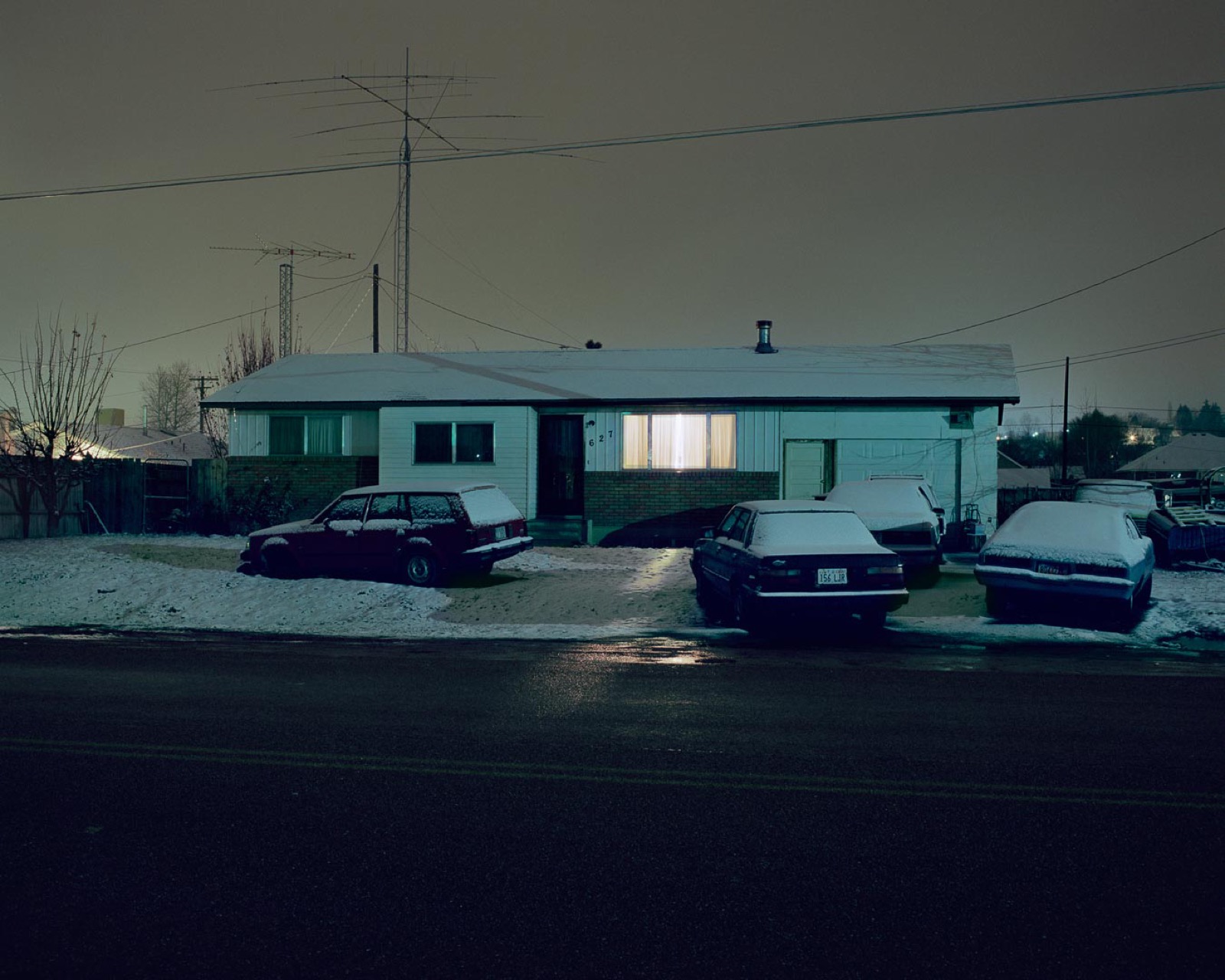

The photograph refuses me the one thing it keeps insisting on: the inhabitants. Four cars sleep under their blankets of snow, therefore bodies, therefore breath somewhere behind the brick; a window burns gold at the center of the façade; and yet no silhouette, no shadow on the curtain, not even the flicker of a television, though a great antenna stands over the roof like a ship’s rigging. The house declares occupancy and denies it in the same breath.
What undoes me is smaller. Between the curtains the light gathers into a narrow bright column, a seam of interior offered to the street, too thin to read and impossible not to read; I lean toward it as toward a keyhole and am ashamed. And then, lower, the sedan’s license plate, perfectly legible where everything human is illegible: 156 LJR. The bureaucracy of the visible! The registry knows this household; I never shall. Even the house number over the door, 627, gives me an address and withholds a life.
Hido, who grew up in Kent, Ohio, and works from the San Francisco Bay Area, has spent a career at the curbs of houses like this one, and museums have taken his nights indoors: SFMOMA, the Getty, the Whitney. The archival pigment print gives the scene its exact temperature, green-grey cold outside, one rectangle of warmth within, which lays a small gleaming double of itself on the wet pavement, the interior’s only concession to the street. Photography, they say, certifies presence. This one certifies something rarer: a presence I am shown and shall never meet.