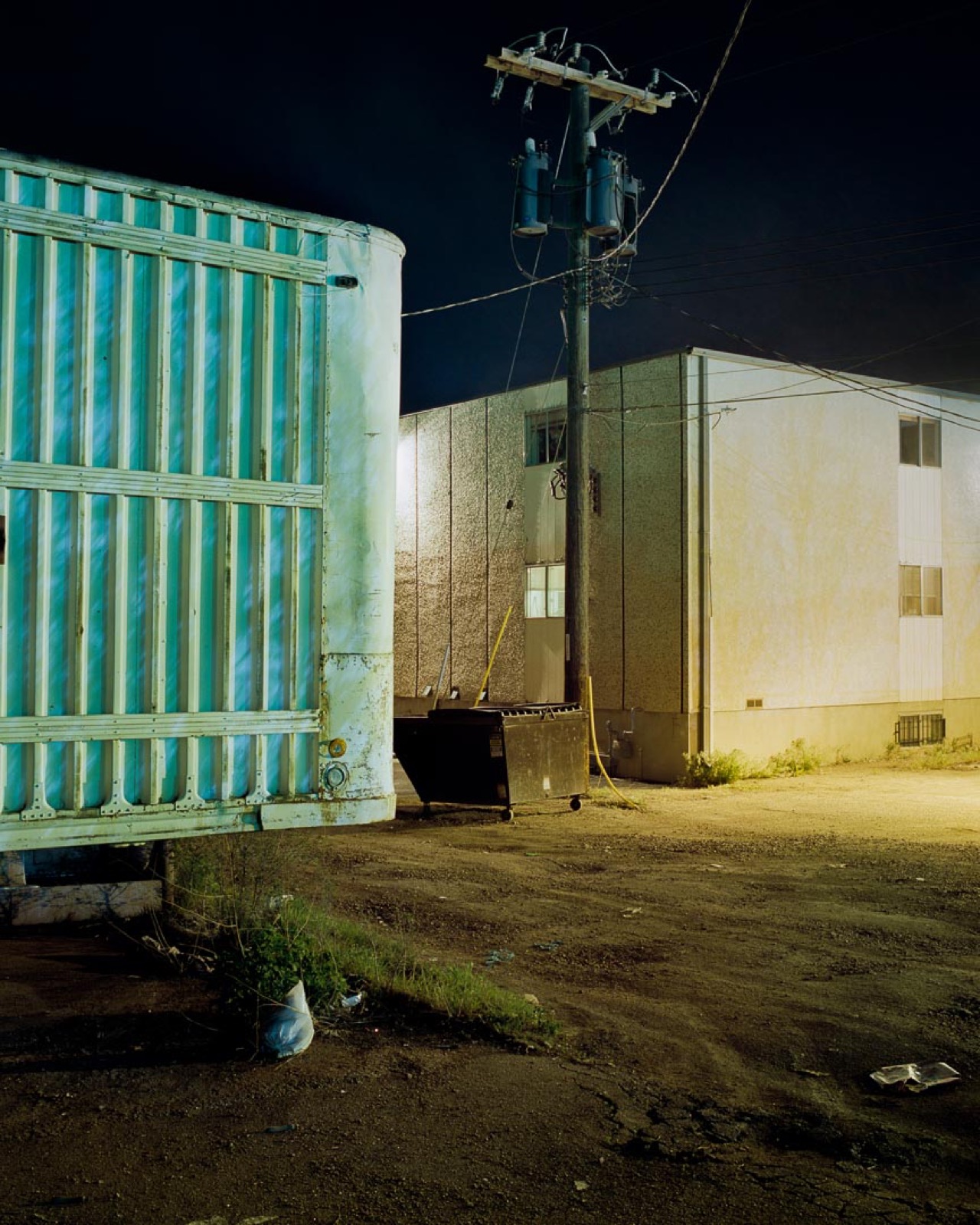
We are standing where nobody is meant to linger: the dirt apron behind an apartment block, between a dumpster and the ribbed back of a trailer, litter settling into the gravel like set dressing. It is the unphotogenic zone every building keeps out back, and it has been lit, tonight, like a production still.
The lighting plot is immaculate. A floodlight somewhere to the left washes the pebbledash wall in tungsten gold; the night fills in behind with cinema blue; and across the trailer’s mint corrugations a tree we never see throws the exact dappled pattern a gaffer would fake with a cut-metal gobo. A yellow-handled tool leans by the dumpster like a prop set down by an obsessive art director; a yellow cable trails across the dirt; wires converge on the pole with its two transformers, holding the frame taut. Nothing was arranged, which is the point: Hido works in the directorial mode without a crew, finding tableaux the world has already staged for itself.
It is a knowing about-face. Hido, born in Kent, Ohio, and based in the San Francisco Bay Area, made his name with the glowing fronts of suburban houses; here he walks around to the service side, where the same longing light falls on trash and corrugation instead of curtains. Museums including SFMOMA, the Getty, and the Whitney collect this vision, and the archival pigment print holds its two color temperatures, gold and mint-blue, without compromise. By morning the shadow foliage will have moved on. The picture keeps the take.
We are standing where nobody is meant to linger: the dirt apron behind an apartment block, between a dumpster and the ribbed back of a trailer, litter settling into the gravel like set dressing. It is the unphotogenic zone every building keeps out back, and it has been lit, tonight, like a production still.
The lighting plot is immaculate. A floodlight somewhere to the left washes the pebbledash wall in tungsten gold; the night fills in behind with cinema blue; and across the trailer’s mint corrugations a tree we never see throws the exact dappled pattern a gaffer would fake with a cut-metal gobo. A yellow-handled tool leans by the dumpster like a prop set down by an obsessive art director; a yellow cable trails across the dirt; wires converge on the pole with its two transformers, holding the frame taut. Nothing was arranged, which is the point: Hido works in the directorial mode without a crew, finding tableaux the world has already staged for itself.
It is a knowing about-face. Hido, born in Kent, Ohio, and based in the San Francisco Bay Area, made his name with the glowing fronts of suburban houses; here he walks around to the service side, where the same longing light falls on trash and corrugation instead of curtains. Museums including SFMOMA, the Getty, and the Whitney collect this vision, and the archival pigment print holds its two color temperatures, gold and mint-blue, without compromise. By morning the shadow foliage will have moved on. The picture keeps the take.