Two women stride away down the aisle of a flea market, one in a pale trouser suit swinging a white handbag, and between their retreating backs a tall arched mirror catches someone standing perfectly still. It is Maier, framed by the mirror’s carved crown as neatly as a portrait hung for sale, hat squared, twin-lens camera held at her waist, thumb on the release. The passing bodies keep moving; she has staged herself as the one fixed thing in a scene built entirely of motion.
Everything around her behaves like an accidental studio. The striped awning zigzags overhead in hard darks and whites, a backdrop no stylist could improve; a rope and white pole drop a clean vertical beside her; the cracked asphalt does for a seamless floor. To the left a blonde shopper in a knit top pauses, hand on hip, a floral bag hooked over her arm, glancing at the lens as if she too had been cast. The mirror does the directing, converting a woman among junk into a woman composed.
This is the self-portrait as fashion plate, decades before anyone thought to call it that: the photographer dressing the part of an elegant unknown and letting a secondhand mirror do the couturier’s work. Maier made hundreds of these reflected appearances, always the author, never quite the subject. The gelatin silver print, made later from her negative, holds the tent’s crisp graphic stripes and the soft grays of her suit at once. Unknown in her lifetime, she stands here poised inside a frame she has borrowed for a single second.
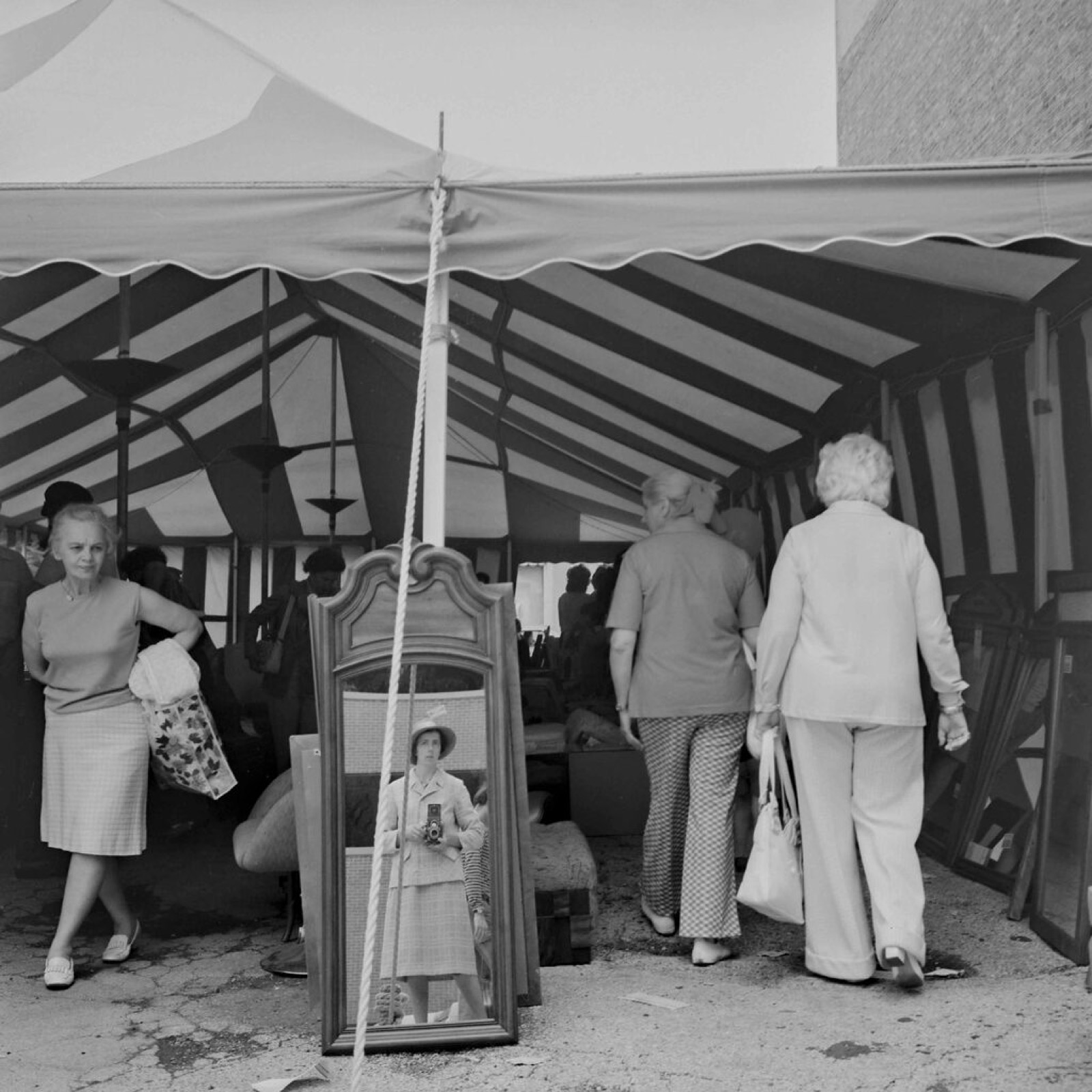
Two women stride away down the aisle of a flea market, one in a pale trouser suit swinging a white handbag, and between their retreating backs a tall arched mirror catches someone standing perfectly still. It is Maier, framed by the mirror’s carved crown as neatly as a portrait hung for sale, hat squared, twin-lens camera held at her waist, thumb on the release. The passing bodies keep moving; she has staged herself as the one fixed thing in a scene built entirely of motion.
Everything around her behaves like an accidental studio. The striped awning zigzags overhead in hard darks and whites, a backdrop no stylist could improve; a rope and white pole drop a clean vertical beside her; the cracked asphalt does for a seamless floor. To the left a blonde shopper in a knit top pauses, hand on hip, a floral bag hooked over her arm, glancing at the lens as if she too had been cast. The mirror does the directing, converting a woman among junk into a woman composed.
This is the self-portrait as fashion plate, decades before anyone thought to call it that: the photographer dressing the part of an elegant unknown and letting a secondhand mirror do the couturier’s work. Maier made hundreds of these reflected appearances, always the author, never quite the subject. The gelatin silver print, made later from her negative, holds the tent’s crisp graphic stripes and the soft grays of her suit at once. Unknown in her lifetime, she stands here poised inside a frame she has borrowed for a single second.