The sky is a blank field of light, so overexposed it reads as pure paper, and against it a swing-boat hangs at the very top of its arc. Nothing weathers here except brightness; the noon glare flattens the depth and turns two riders and their wooden gondola into a black silhouette pinned to white. It is the light, not the fairground, that stages the scene, lifting the ride out of Terrassa and into something closer to a fashion plate against a seamless backdrop.
And it looks styled, though nobody styled it. One young woman leans back with her skirt fanning loose, gripping the ropes; her companion swings below, hair streaming, the pleated hem caught in a diagonal of pure motion. Taut cables radiate from a heavy timber A-frame to hold the gondola aloft, an armature as elegant as any studio rig. Far beneath, a brick wall pasted with faded notices, a wooden palisade and a watching man in a cap return us to the ordinary carnival this really is.
Terrassa in the early fifties is where Masats began, an amateur turning toward the modern documentary that AFAL would soon make a movement, teaching Spanish photography to find its subjects in ordinary leisure. The instinct for a picture that is both reportage and pure design is already unmistakable, decades before the Premio Nacional de Fotografía confirmed it. Printed later in gelatin silver, the sheet keeps that whiteness as luminous, untextured ground and the figures as crisp black cut-outs, a contemporary graphic sensibility arriving early, on a swing, mid-air.
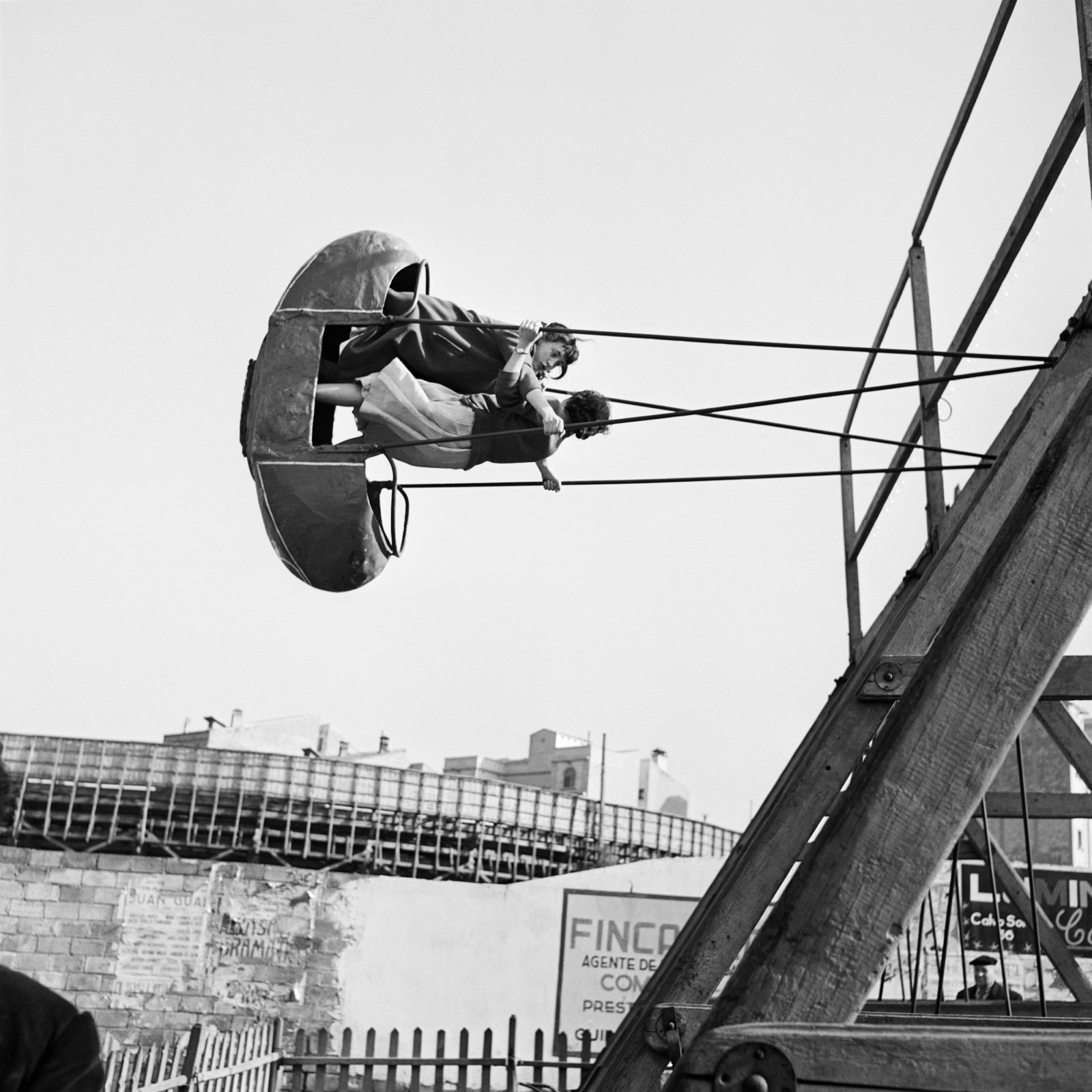
The sky is a blank field of light, so overexposed it reads as pure paper, and against it a swing-boat hangs at the very top of its arc. Nothing weathers here except brightness; the noon glare flattens the depth and turns two riders and their wooden gondola into a black silhouette pinned to white. It is the light, not the fairground, that stages the scene, lifting the ride out of Terrassa and into something closer to a fashion plate against a seamless backdrop.
And it looks styled, though nobody styled it. One young woman leans back with her skirt fanning loose, gripping the ropes; her companion swings below, hair streaming, the pleated hem caught in a diagonal of pure motion. Taut cables radiate from a heavy timber A-frame to hold the gondola aloft, an armature as elegant as any studio rig. Far beneath, a brick wall pasted with faded notices, a wooden palisade and a watching man in a cap return us to the ordinary carnival this really is.
Terrassa in the early fifties is where Masats began, an amateur turning toward the modern documentary that AFAL would soon make a movement, teaching Spanish photography to find its subjects in ordinary leisure. The instinct for a picture that is both reportage and pure design is already unmistakable, decades before the Premio Nacional de Fotografía confirmed it. Printed later in gelatin silver, the sheet keeps that whiteness as luminous, untextured ground and the figures as crisp black cut-outs, a contemporary graphic sensibility arriving early, on a swing, mid-air.