The face lifted from blackness by a single blade of light belongs to a lineage older than photography, running from Caravaggio’s tavern saints through the candlelit reveries of La Tour. Here that inheritance falls on an ordinary young woman, chin on her folded arms, resting on a white pillow at the edge of a wooden frame, her eyes turned level to the camera. A wisp of smoke or vapor curls across her brow, thin as a drawn line, and the darkness does the rest.
There is something almost too composed in this, and a wary eye should say so. The diagonal shaft gilds her forearm and the folds of the pillow while dissolving everything around her into an all-consuming black; her clasped hands catch the same light, a small still life of knuckles and cloth. A single sandal waits below in the gloom. The picture flirts with the sacred and the sensual at once, and yet the girl’s gaze refuses the pose, plain and slightly guarded, insisting she is a person and not an allegory.
That this comes from Terrassa, at the start of Masats’s career, is part of its interest: before the Sanfermines, before Neutral Corner, before the Premio Nacional de Fotografía, he was already testing how far a single source of light could carry an image. The AFAL generation he joined would pull Spanish photography into the documentary present, yet here the impulse is frankly pictorial, almost painterly. Printed later in gelatin silver, the sheet holds a full black and a luminous white with nothing timid between them, the whole drama staked on contrast.
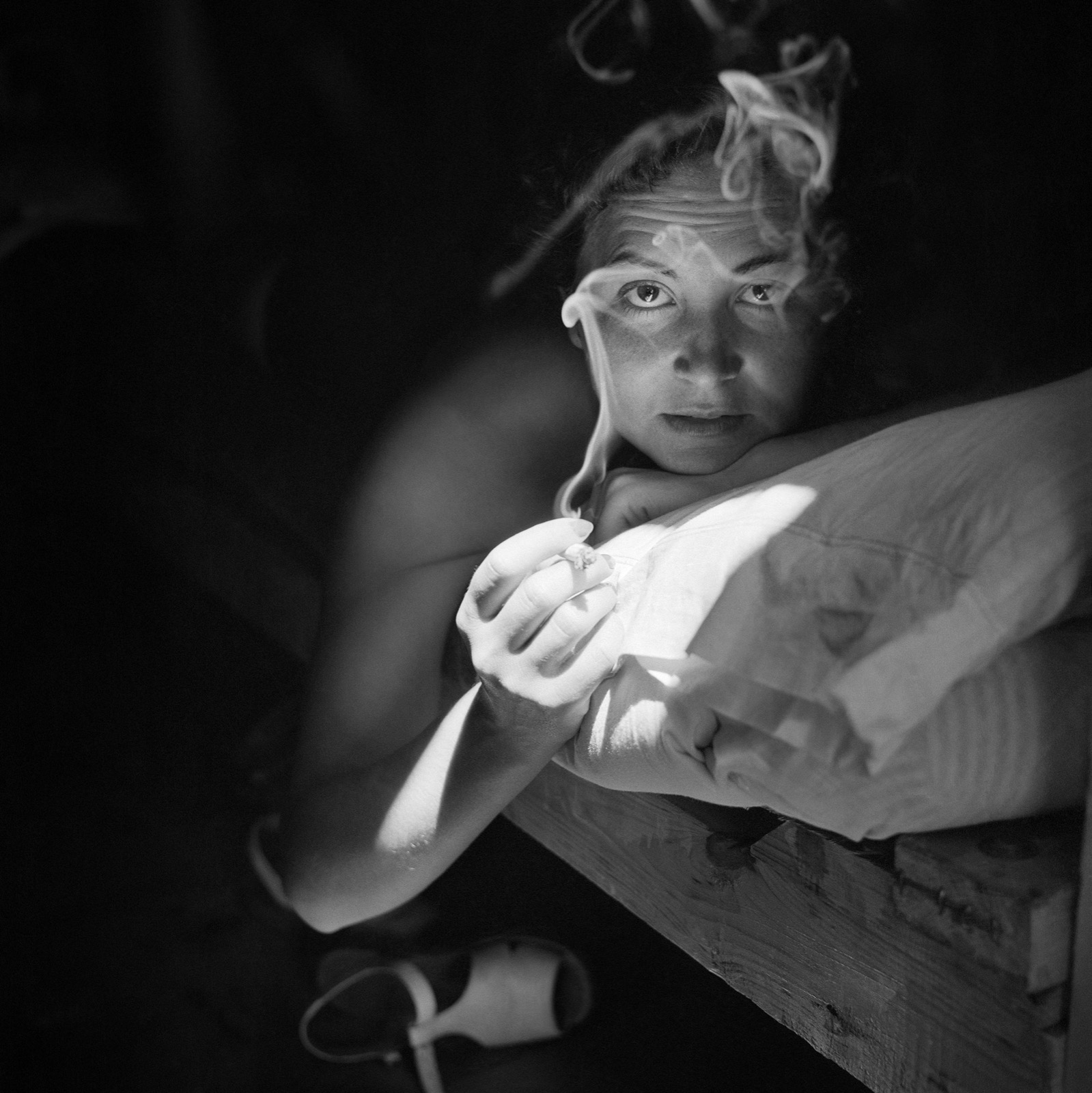

The face lifted from blackness by a single blade of light belongs to a lineage older than photography, running from Caravaggio’s tavern saints through the candlelit reveries of La Tour. Here that inheritance falls on an ordinary young woman, chin on her folded arms, resting on a white pillow at the edge of a wooden frame, her eyes turned level to the camera. A wisp of smoke or vapor curls across her brow, thin as a drawn line, and the darkness does the rest.
There is something almost too composed in this, and a wary eye should say so. The diagonal shaft gilds her forearm and the folds of the pillow while dissolving everything around her into an all-consuming black; her clasped hands catch the same light, a small still life of knuckles and cloth. A single sandal waits below in the gloom. The picture flirts with the sacred and the sensual at once, and yet the girl’s gaze refuses the pose, plain and slightly guarded, insisting she is a person and not an allegory.
That this comes from Terrassa, at the start of Masats’s career, is part of its interest: before the Sanfermines, before Neutral Corner, before the Premio Nacional de Fotografía, he was already testing how far a single source of light could carry an image. The AFAL generation he joined would pull Spanish photography into the documentary present, yet here the impulse is frankly pictorial, almost painterly. Printed later in gelatin silver, the sheet holds a full black and a luminous white with nothing timid between them, the whole drama staked on contrast.