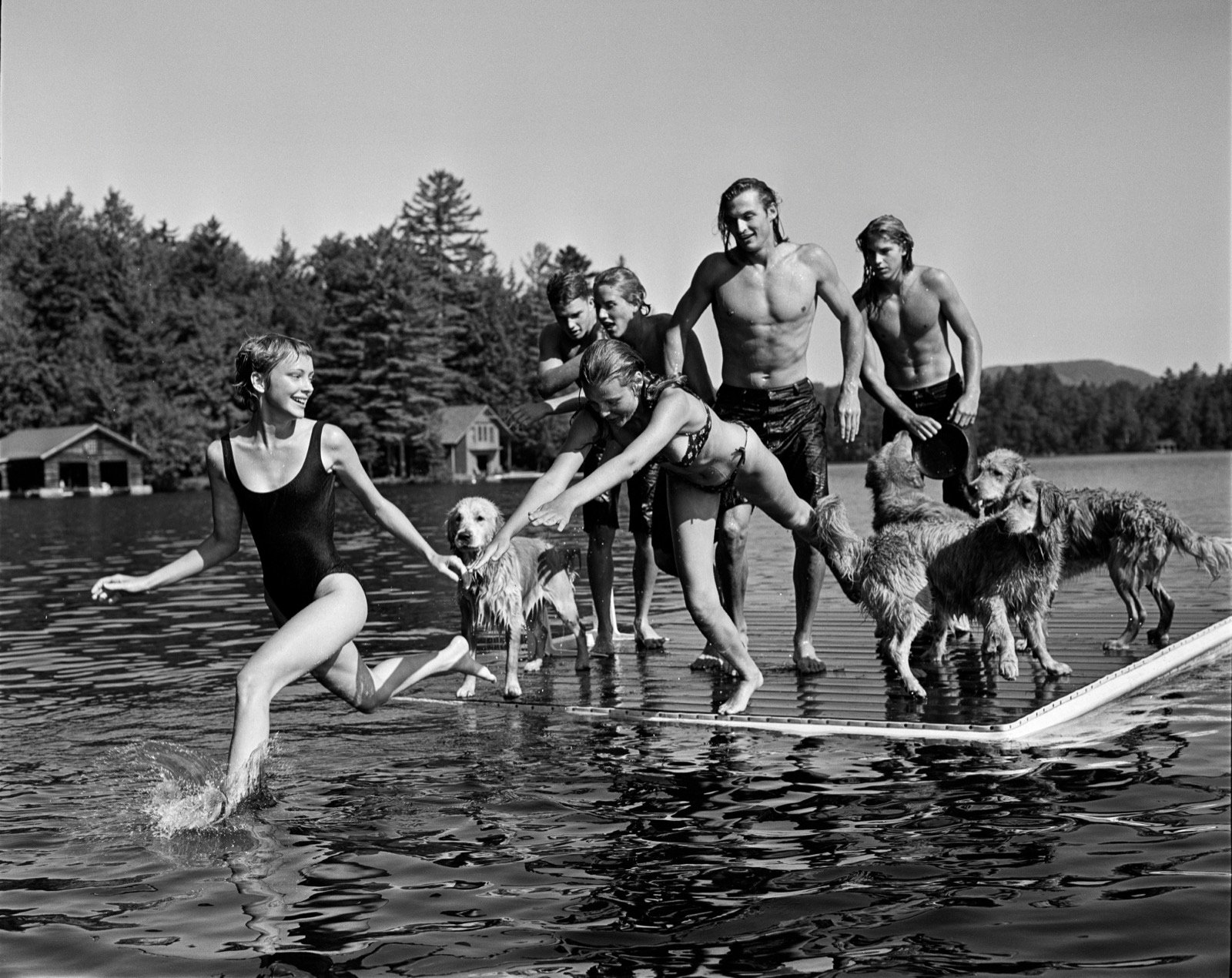
Two hands reach for each other across a gap of a few inches and do not quite meet, one girl already airborne off the dock, the other bent double trying to catch her. Everything in the photograph organizes itself around that small failed grab. She will land in the lake a half-second after the shutter, and the hand that reached will close on nothing, which is somehow the happiest thing here rather than the saddest. You can practically hear the splash that has not yet come.
Around this near-miss the rest of the afternoon carries on regardless. Four wet golden retrievers mill along the raft, shaking, dripping, thoroughly uninterested in the human drama; a row of shirtless boys with lake-slicked hair grins at the commotion; one holds what looks like a frisbee, or a dog’s dish. It is the kind of scene that could tip into cliché, all glowing youth and summer water, except that Weber lets it stay slightly chaotic, nobody quite posed, the dogs ruining the symmetry beautifully, which is the point.
Behind them a shingled boathouse and a wall of Adirondack pines place the whole thing in the world of the Great Camps, old money at leisure on a clear northern lake. Weber, who spent decades photographing exactly this Americana, treats it with more tenderness than satire. The gelatin silver print holds the range from black swimsuit to bright sky and gives the water its particular Adirondack darkness, cold-looking even in full sun, the kind of water that shocks you awake.
Two hands reach for each other across a gap of a few inches and do not quite meet, one girl already airborne off the dock, the other bent double trying to catch her. Everything in the photograph organizes itself around that small failed grab. She will land in the lake a half-second after the shutter, and the hand that reached will close on nothing, which is somehow the happiest thing here rather than the saddest. You can practically hear the splash that has not yet come.
Around this near-miss the rest of the afternoon carries on regardless. Four wet golden retrievers mill along the raft, shaking, dripping, thoroughly uninterested in the human drama; a row of shirtless boys with lake-slicked hair grins at the commotion; one holds what looks like a frisbee, or a dog’s dish. It is the kind of scene that could tip into cliché, all glowing youth and summer water, except that Weber lets it stay slightly chaotic, nobody quite posed, the dogs ruining the symmetry beautifully, which is the point.
Behind them a shingled boathouse and a wall of Adirondack pines place the whole thing in the world of the Great Camps, old money at leisure on a clear northern lake. Weber, who spent decades photographing exactly this Americana, treats it with more tenderness than satire. The gelatin silver print holds the range from black swimsuit to bright sky and gives the water its particular Adirondack darkness, cold-looking even in full sun, the kind of water that shocks you awake.