Leaning out toward the dusk, the porch opens its long throat of fir planks and lets the eye walk down it. Meyerowitz has caught Provincetown at the hour when two lights quarrel and neither wins: behind the screen door, on the left, the interior glows orange, domestic, a lamp burning over an unseen chair; in front, beyond the white columns and the slender turned balusters, the bay lies flat and slate-blue under a bruised sky. The wooden partition at the center, a low gate painted pale with its black iron latch, divides the two worlds and refuses to choose between them.
I keep returning to one mark on the right. A vein of lightning has opened the sky and stands there, white, rigid, an electric crack against the violet. It is not decoration; it is an event, frozen mid-fall, answering the lamp indoors as if warmth and violence were one currency paid in different rooms. The columns receive its glow and turn, for one second, the colour of honey. Everything else holds still—the railing, the boards, the closed glass—while that single filament does the trembling for the whole photograph.
What moves me is the latch on the little gate: a small studied iron shape, half spade, half keyhole, the only manufactured ornament in a scene otherwise made of weather and wood. It says someone lives here, someone fastens this at night, someone has felt the storm arrive across the water and stayed indoors to watch it. The porch is empty of bodies yet thick with the gestures of a vanished occupant. I read the scene and find, in that black hasp against the pale wood, the proof that this dusk was inhabited, that the lamp was lit for a reason I will never be told.
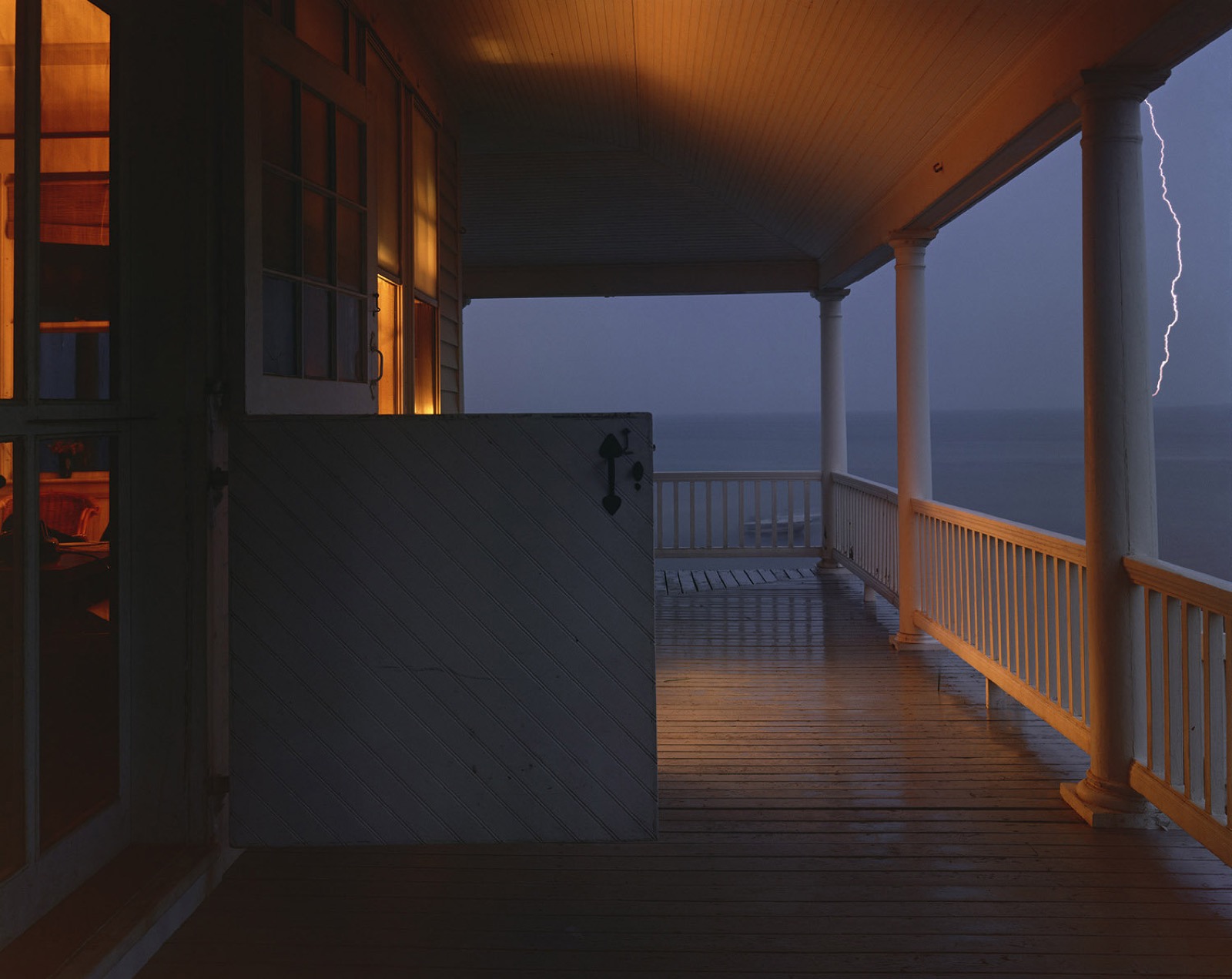

Leaning out toward the dusk, the porch opens its long throat of fir planks and lets the eye walk down it. Meyerowitz has caught Provincetown at the hour when two lights quarrel and neither wins: behind the screen door, on the left, the interior glows orange, domestic, a lamp burning over an unseen chair; in front, beyond the white columns and the slender turned balusters, the bay lies flat and slate-blue under a bruised sky. The wooden partition at the center, a low gate painted pale with its black iron latch, divides the two worlds and refuses to choose between them.
I keep returning to one mark on the right. A vein of lightning has opened the sky and stands there, white, rigid, an electric crack against the violet. It is not decoration; it is an event, frozen mid-fall, answering the lamp indoors as if warmth and violence were one currency paid in different rooms. The columns receive its glow and turn, for one second, the colour of honey. Everything else holds still—the railing, the boards, the closed glass—while that single filament does the trembling for the whole photograph.
What moves me is the latch on the little gate: a small studied iron shape, half spade, half keyhole, the only manufactured ornament in a scene otherwise made of weather and wood. It says someone lives here, someone fastens this at night, someone has felt the storm arrive across the water and stayed indoors to watch it. The porch is empty of bodies yet thick with the gestures of a vanished occupant. I read the scene and find, in that black hasp against the pale wood, the proof that this dusk was inhabited, that the lamp was lit for a reason I will never be told.