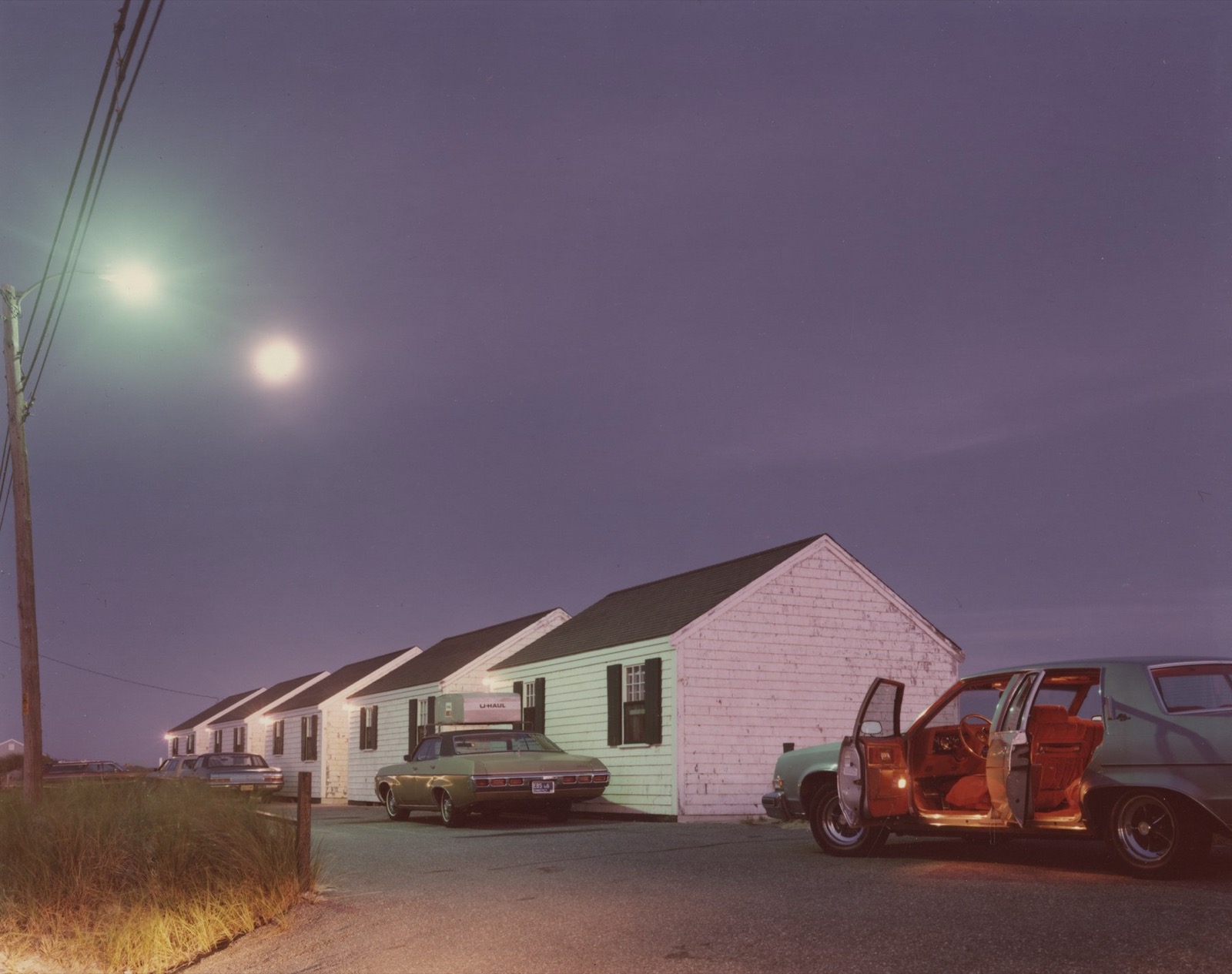
Provincetown after dark, a row of identical cottages strung along a sandy lot at the edge of the dunes. A streetlamp burns a cold green halo into the violet sky; beside it, lower and softer, the moon repeats the gesture in pale gold. The cottages stand white and gabled, their black shutters shut, their clapboard washed by that mercury light until the nearest wall glows a faint aquatic green. Cars are parked nose-in along the row—an older sedan, a station wagon with a U-Haul box squatting on its roof—patient as the houses themselves under a sky that has not yet decided to be black.
The eye is pulled, finally, to the right, where one car door hangs open and the interior burns a deep upholstered red. It is the single warm wound in the picture, a small furnace of domesticity left exposed to the night. Everything else here is exterior, sealed, asleep; this one cabin of red light insists that someone is present, that the scene is inhabited and not merely arranged. The contrast is almost moral: the public coldness of the lamp against the private heat of an opened door.
There is melancholy in such evenness—six little houses that promise rest and offer only repetition, the seasonal architecture of a place that empties and refills. Meyerowitz lets the long exposure do its quiet work, holding the dusk at the exact pitch where color is most generous and least describable. The photograph does not mourn and does not celebrate; it simply keeps the hour open a moment longer, the red door glowing, the moon climbing, the dune grass burning gold in the corner like a small unattended fire.
Provincetown after dark, a row of identical cottages strung along a sandy lot at the edge of the dunes. A streetlamp burns a cold green halo into the violet sky; beside it, lower and softer, the moon repeats the gesture in pale gold. The cottages stand white and gabled, their black shutters shut, their clapboard washed by that mercury light until the nearest wall glows a faint aquatic green. Cars are parked nose-in along the row—an older sedan, a station wagon with a U-Haul box squatting on its roof—patient as the houses themselves under a sky that has not yet decided to be black.
The eye is pulled, finally, to the right, where one car door hangs open and the interior burns a deep upholstered red. It is the single warm wound in the picture, a small furnace of domesticity left exposed to the night. Everything else here is exterior, sealed, asleep; this one cabin of red light insists that someone is present, that the scene is inhabited and not merely arranged. The contrast is almost moral: the public coldness of the lamp against the private heat of an opened door.
There is melancholy in such evenness—six little houses that promise rest and offer only repetition, the seasonal architecture of a place that empties and refills. Meyerowitz lets the long exposure do its quiet work, holding the dusk at the exact pitch where color is most generous and least describable. The photograph does not mourn and does not celebrate; it simply keeps the hour open a moment longer, the red door glowing, the moon climbing, the dune grass burning gold in the corner like a small unattended fire.