This was made in a moment when photographs had become quick, bright and numberless, and it answers that condition with a black moor, a dun sky, and a single seam of pale light where they meet. Nothing here asks to be noticed. The picture proposes an older bargain, the one landscape photography began with: stand still long enough and the land will show you what the hour is doing.
The organization could not be simpler or less forgiving. The horizon sits in the lower fifth of the frame, a long silhouette that lifts slightly right of center and settles again; the cloud thins just above it, brightest toward the left, so the sky reads as a lid not quite closed. The camera stands level on the same dark ground it describes, no elevation, no foreground incident, no path in. What varies is tone alone, brown-gray sliding to black, and the eye learns to read a half-stop of difference as landscape. It is the kind of picture in which one wrong value would be fatal, and none is.
Hido came to open country from the suburbs, where his houses at night taught him that a small amount of light, correctly placed, will carry a great deal of darkness. The lesson holds here. As an archival pigment print the picture keeps its lowest tones breathing, moor distinct from sky, cloud from cloud, and rewards the patience it asks for. It is a modest-looking thing that turns out to be exact, which is a fair definition of the photographer’s craft.
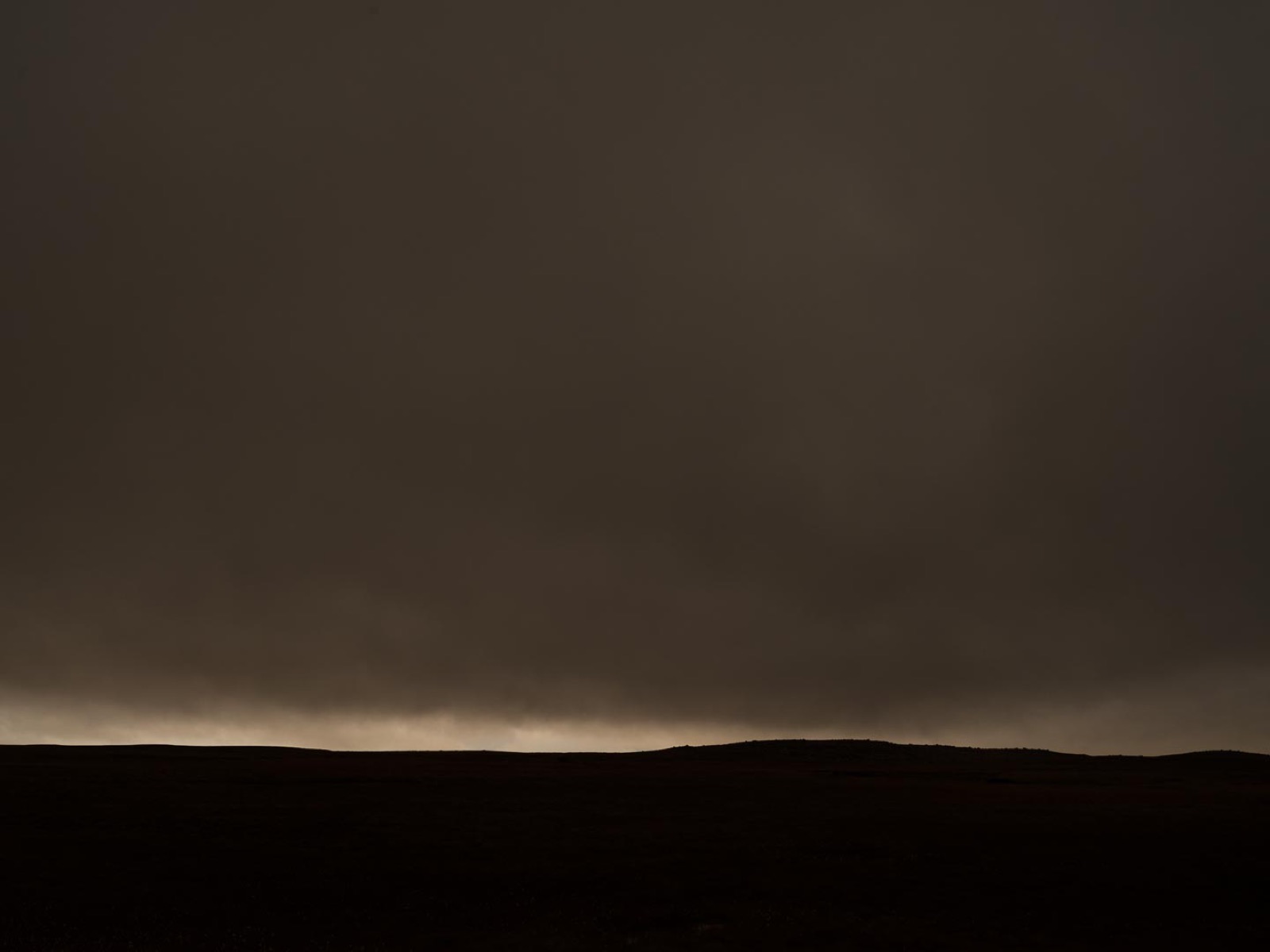

This was made in a moment when photographs had become quick, bright and numberless, and it answers that condition with a black moor, a dun sky, and a single seam of pale light where they meet. Nothing here asks to be noticed. The picture proposes an older bargain, the one landscape photography began with: stand still long enough and the land will show you what the hour is doing.
The organization could not be simpler or less forgiving. The horizon sits in the lower fifth of the frame, a long silhouette that lifts slightly right of center and settles again; the cloud thins just above it, brightest toward the left, so the sky reads as a lid not quite closed. The camera stands level on the same dark ground it describes, no elevation, no foreground incident, no path in. What varies is tone alone, brown-gray sliding to black, and the eye learns to read a half-stop of difference as landscape. It is the kind of picture in which one wrong value would be fatal, and none is.
Hido came to open country from the suburbs, where his houses at night taught him that a small amount of light, correctly placed, will carry a great deal of darkness. The lesson holds here. As an archival pigment print the picture keeps its lowest tones breathing, moor distinct from sky, cloud from cloud, and rewards the patience it asks for. It is a modest-looking thing that turns out to be exact, which is a fair definition of the photographer’s craft.