One small knuckle of rock interrupts the pass at the bottom of this picture, a low silhouette between the two great slopes, and it quietly redraws everything around it. Without it the black V would read as a void; with it the valley acquires depth, a beyond, a suggestion that the route continues past what we are shown. Small facts do this in photographs: they turn shape back into place, and geometry back into geography.
Above, a white disc burns through the overcast, sun or moon, the picture declines to specify, and the clouds bank and roll into the opening like a slow tide coming in. The tonal scale is the real performance: from the disc’s bleached core through pearl, slate and smoke to the two mountainsides, which are held at an unbroken black. In the 1920s Stieglitz photographed veiled suns and drifting cloud as equivalents of feeling, cut loose from the ground. This frame takes up that conviction and returns it to earth, letting the serrated left ridge tether the sky’s drama to actual rock.
Todd Hido’s reputation rests on the American night, suburban houses glowing like lanterns, and institutions from SFMOMA to the Getty and the Whitney hold his prints. His landscape work is less known and, to my eye, more austere: the same patience, stripped of shelter. This archival pigment print preserves what matters most here, the long unforced gradation around the disc and the density of those flanking blacks, a range that survives translation to pigment ink remarkably intact.
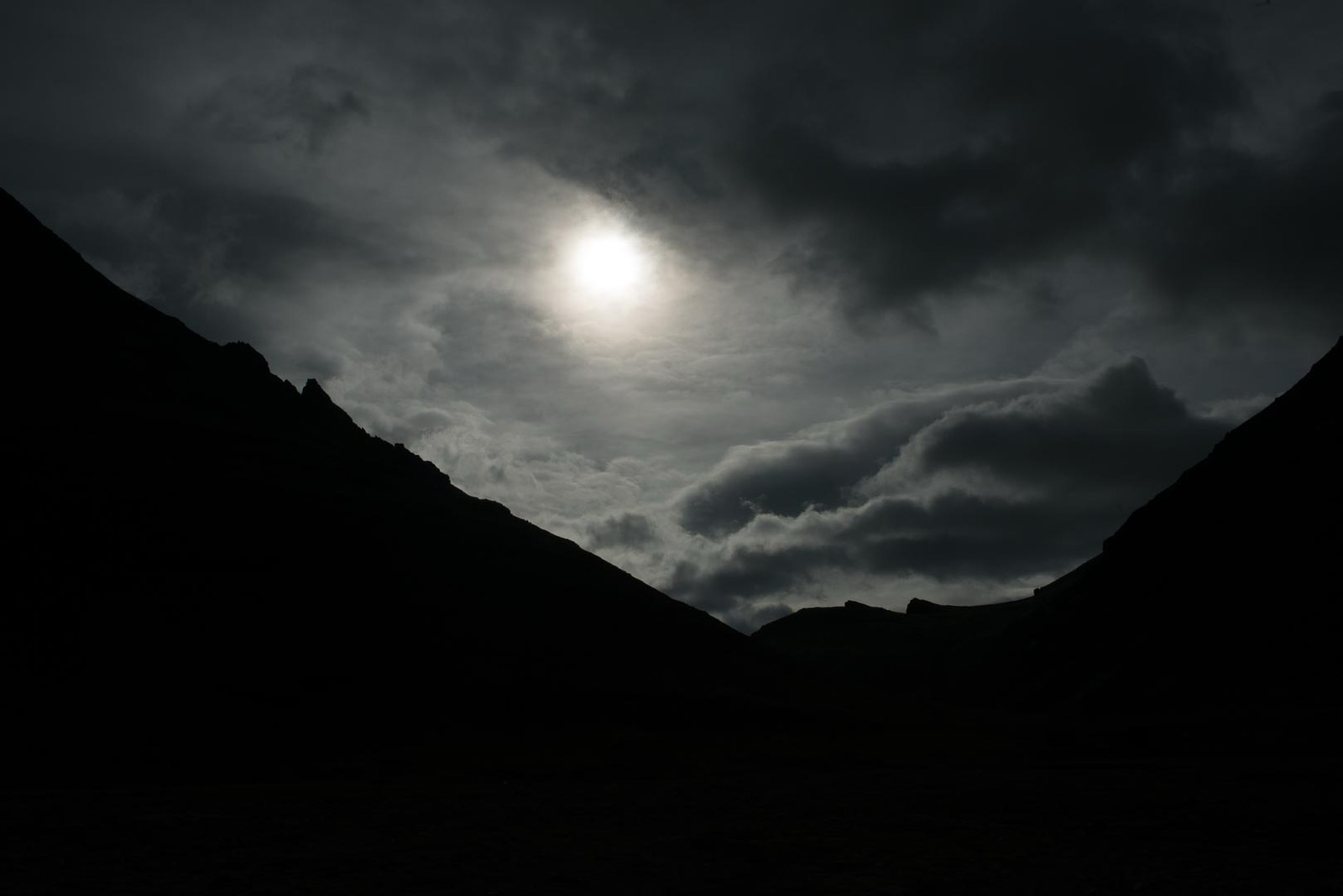

One small knuckle of rock interrupts the pass at the bottom of this picture, a low silhouette between the two great slopes, and it quietly redraws everything around it. Without it the black V would read as a void; with it the valley acquires depth, a beyond, a suggestion that the route continues past what we are shown. Small facts do this in photographs: they turn shape back into place, and geometry back into geography.
Above, a white disc burns through the overcast, sun or moon, the picture declines to specify, and the clouds bank and roll into the opening like a slow tide coming in. The tonal scale is the real performance: from the disc’s bleached core through pearl, slate and smoke to the two mountainsides, which are held at an unbroken black. In the 1920s Stieglitz photographed veiled suns and drifting cloud as equivalents of feeling, cut loose from the ground. This frame takes up that conviction and returns it to earth, letting the serrated left ridge tether the sky’s drama to actual rock.
Todd Hido’s reputation rests on the American night, suburban houses glowing like lanterns, and institutions from SFMOMA to the Getty and the Whitney hold his prints. His landscape work is less known and, to my eye, more austere: the same patience, stripped of shelter. This archival pigment print preserves what matters most here, the long unforced gradation around the disc and the density of those flanking blacks, a range that survives translation to pigment ink remarkably intact.