Somewhere in Missouri, a diner has been pinned to silver. The place announces itself first as a wall of prices, hand-lettered and hung above the counter like the inventory of a vanished economy: T-Bone Steak $13.50, Hamburgers six for $6.90, Chile $2.80, hash browns and hot tamales. These figures were current on the day the shutter opened and are now relics, accidental archaeology. Jessica Lange photographs the room the way one might photograph a reliquary, letting the menu board do the work of a tombstone inscription, recording what a meal was worth before the number drifted out of true.
Below the lettering, a working kitchen is laid out with the neutrality of a still life: stacked white plates, a microwave, a toaster, a refrigerator, napkin dispensers and salt cellars ranked along the counter's edge. The Formica surface in the foreground stretches almost the full width of the frame, scuffed and reflective, an emptiness the photograph cannot help but dignify. It is the most material thing here, worn smooth by decades of forearms and plates, and Lange gives it pride of place, as though the print were itself a surface that remembers contact.
The waitress leans into that surface from the far side, uniformed, her gaze meeting the lens without performance or apology. She belongs to the room and outlasts none of it; the gelatin grain that holds her also holds the refrigerator's gleam and the chalked decimals, flattening person and price list into the same fragile emulsion. What survives is not the diner but its photographic afterlife, kept the way one keeps a receipt long after the transaction is forgotten, because somebody once stood there and was seen.
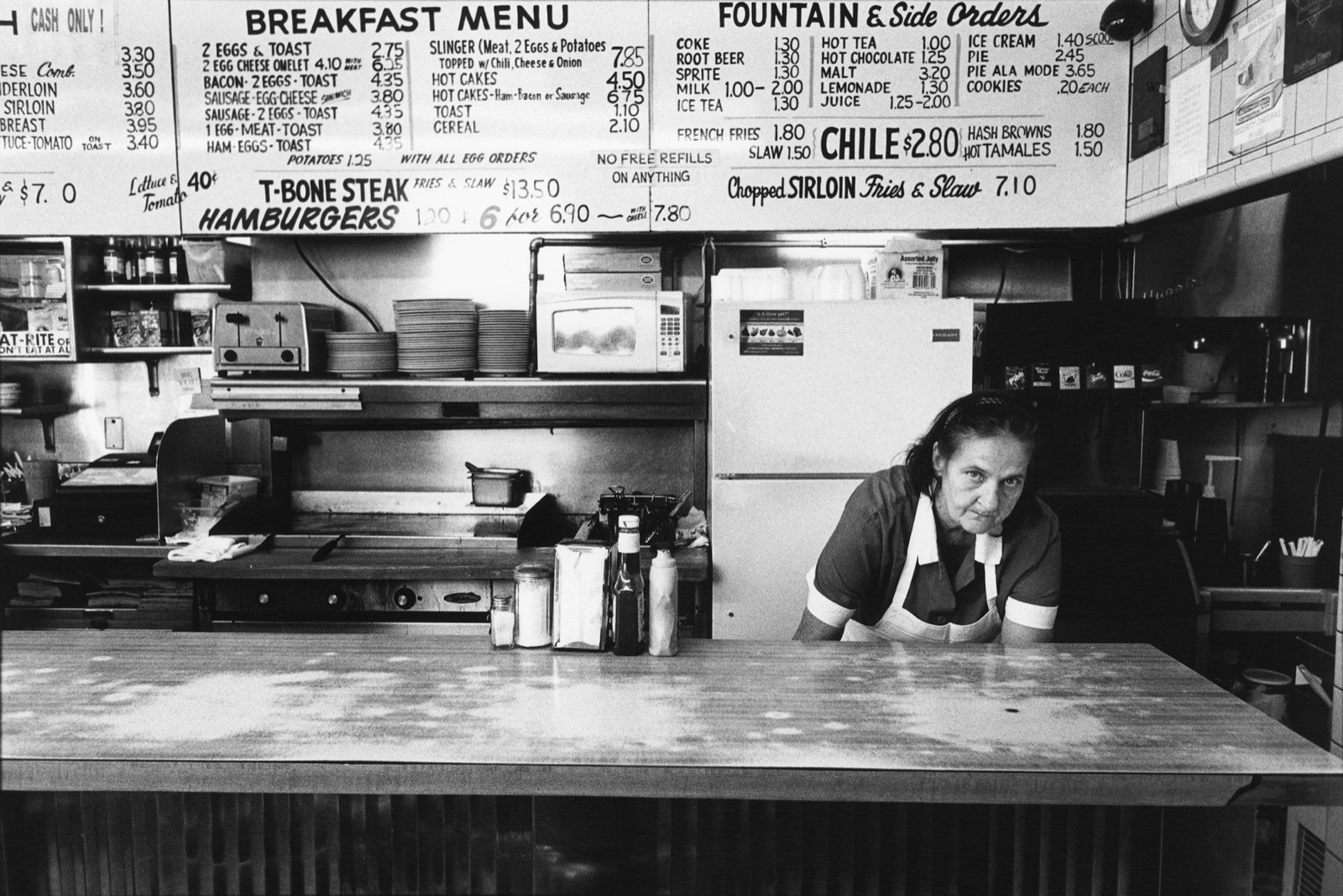

Somewhere in Missouri, a diner has been pinned to silver. The place announces itself first as a wall of prices, hand-lettered and hung above the counter like the inventory of a vanished economy: T-Bone Steak $13.50, Hamburgers six for $6.90, Chile $2.80, hash browns and hot tamales. These figures were current on the day the shutter opened and are now relics, accidental archaeology. Jessica Lange photographs the room the way one might photograph a reliquary, letting the menu board do the work of a tombstone inscription, recording what a meal was worth before the number drifted out of true.
Below the lettering, a working kitchen is laid out with the neutrality of a still life: stacked white plates, a microwave, a toaster, a refrigerator, napkin dispensers and salt cellars ranked along the counter's edge. The Formica surface in the foreground stretches almost the full width of the frame, scuffed and reflective, an emptiness the photograph cannot help but dignify. It is the most material thing here, worn smooth by decades of forearms and plates, and Lange gives it pride of place, as though the print were itself a surface that remembers contact.
The waitress leans into that surface from the far side, uniformed, her gaze meeting the lens without performance or apology. She belongs to the room and outlasts none of it; the gelatin grain that holds her also holds the refrigerator's gleam and the chalked decimals, flattening person and price list into the same fragile emulsion. What survives is not the diner but its photographic afterlife, kept the way one keeps a receipt long after the transaction is forgotten, because somebody once stood there and was seen.