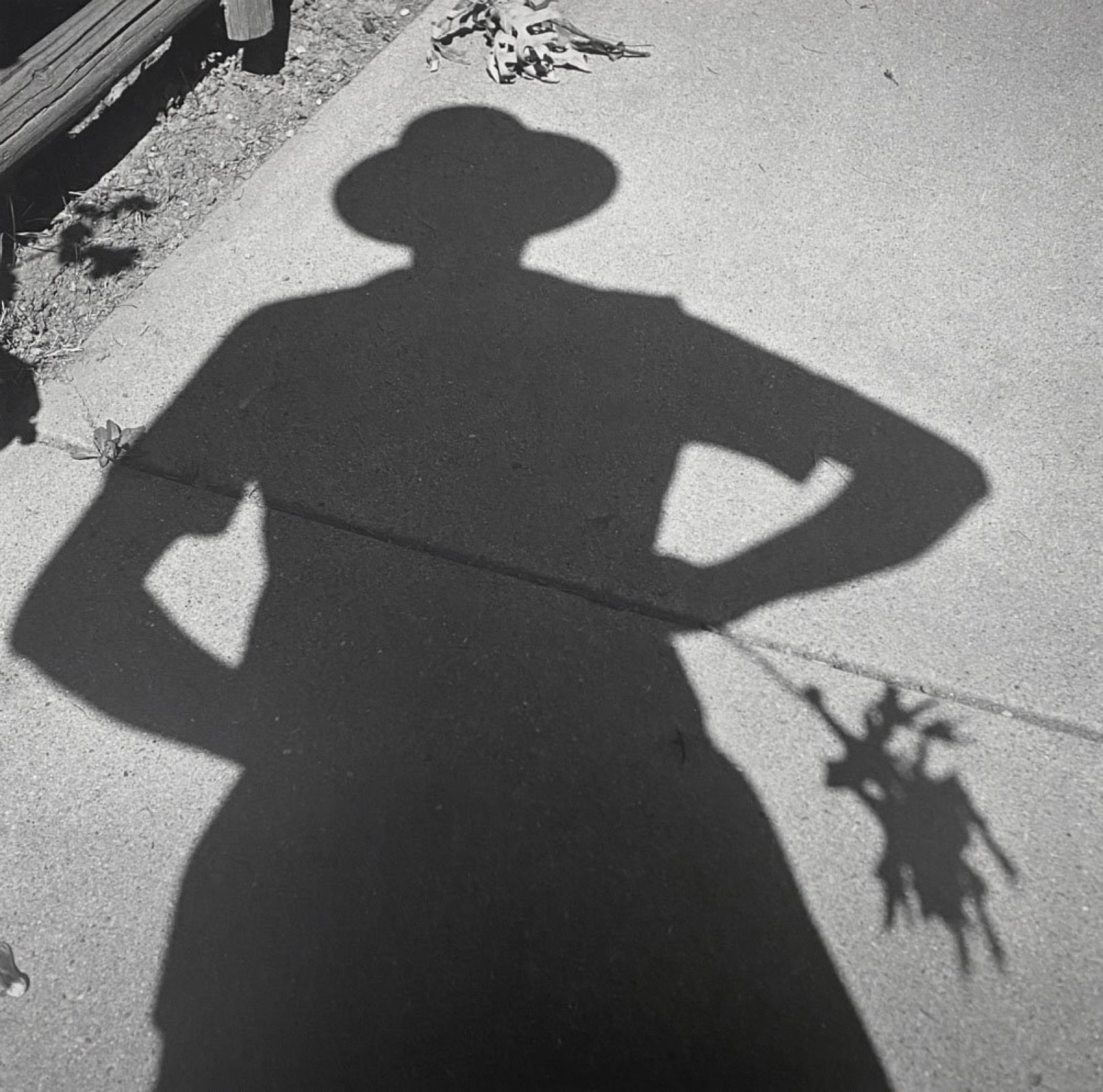
A shadow is photography's first draft. Before lenses and chemistry there was simply a body interrupting light and a surface receiving its outline; every photograph since has been a scheme for keeping such outlines. In 1956 Vivian Maier aimed her camera at the pavement and found the drawing already made: hat brim, squared elbows, hands set on hips, a figure of complete self-possession laid down in grey on sunlit concrete.
The result is a trace of a trace, doubly indexical. The sun drew her; the negative fixed the drawing; and this gelatin silver print, made in 2021, fixes it once more, sixty-five years after the shadow slid off the pavement. Incident sharpens the geometry: a seam in the concrete crosses her waist like a drawn belt, split timber and dry scrub hold the upper corner, and a spray of plant shadow rises at her hip as though the silhouette had gathered flowers on its way.
Maier, who kept most of her photographs to herself, here pictures that very condition: presence withheld, evidence offered. The woman is unmistakably there — planted, hatted, arms akimbo — and entirely absent, a hole in the light wearing her shape. That the print postdates the moment by decades completes the thought rather than diluting it. The shadow has outlived its caster; this object is how.
A shadow is photography's first draft. Before lenses and chemistry there was simply a body interrupting light and a surface receiving its outline; every photograph since has been a scheme for keeping such outlines. In 1956 Vivian Maier aimed her camera at the pavement and found the drawing already made: hat brim, squared elbows, hands set on hips, a figure of complete self-possession laid down in grey on sunlit concrete.
The result is a trace of a trace, doubly indexical. The sun drew her; the negative fixed the drawing; and this gelatin silver print, made in 2021, fixes it once more, sixty-five years after the shadow slid off the pavement. Incident sharpens the geometry: a seam in the concrete crosses her waist like a drawn belt, split timber and dry scrub hold the upper corner, and a spray of plant shadow rises at her hip as though the silhouette had gathered flowers on its way.
Maier, who kept most of her photographs to herself, here pictures that very condition: presence withheld, evidence offered. The woman is unmistakably there — planted, hatted, arms akimbo — and entirely absent, a hole in the light wearing her shape. That the print postdates the moment by decades completes the thought rather than diluting it. The shadow has outlived its caster; this object is how.