What is he doing up there, the man in the suit? He has climbed onto some platform or hoarding above the street and taken hold of a fistful of slack cable, calm as a commuter gripping a strap, as if the whole improvised rigging of Manhattan might be steered from where he stands. Behind him the old Times Tower rises like a white cliff, still wearing its ornamental stonework, and the sky is crossed and recrossed by wires, poles, guy-lines — a city held together, it seems, by string.
In the corner, a billboard promises VistaVision — "Motion Picture High Fidelity" — and a spectacular presentation of James Stewart. Hollywood, that year, was straining to make the screen wider, the image bigger, the experience more overwhelming. Meanwhile a nanny on her day off pointed her twin-lens reflex upward from waist height — which is why the buildings loom the way they do, why the man becomes silhouette, monument, punctuation — and got the truly spectacular presentation for free. The wires sag across the frame like the staves of some enormous score, and he is the single note written on them.
Nobody saw it at the time, of course. Vivian Maier printed little, showed less, and left the work in storage lockers where it stayed until after 2007, when the archive surfaced and rearranged the history of American street photography to make room for her. Museums have been catching up ever since. A gelatin silver print like this one is the rare, tangible end of all that secrecy: the moment she kept, finally keeping company.
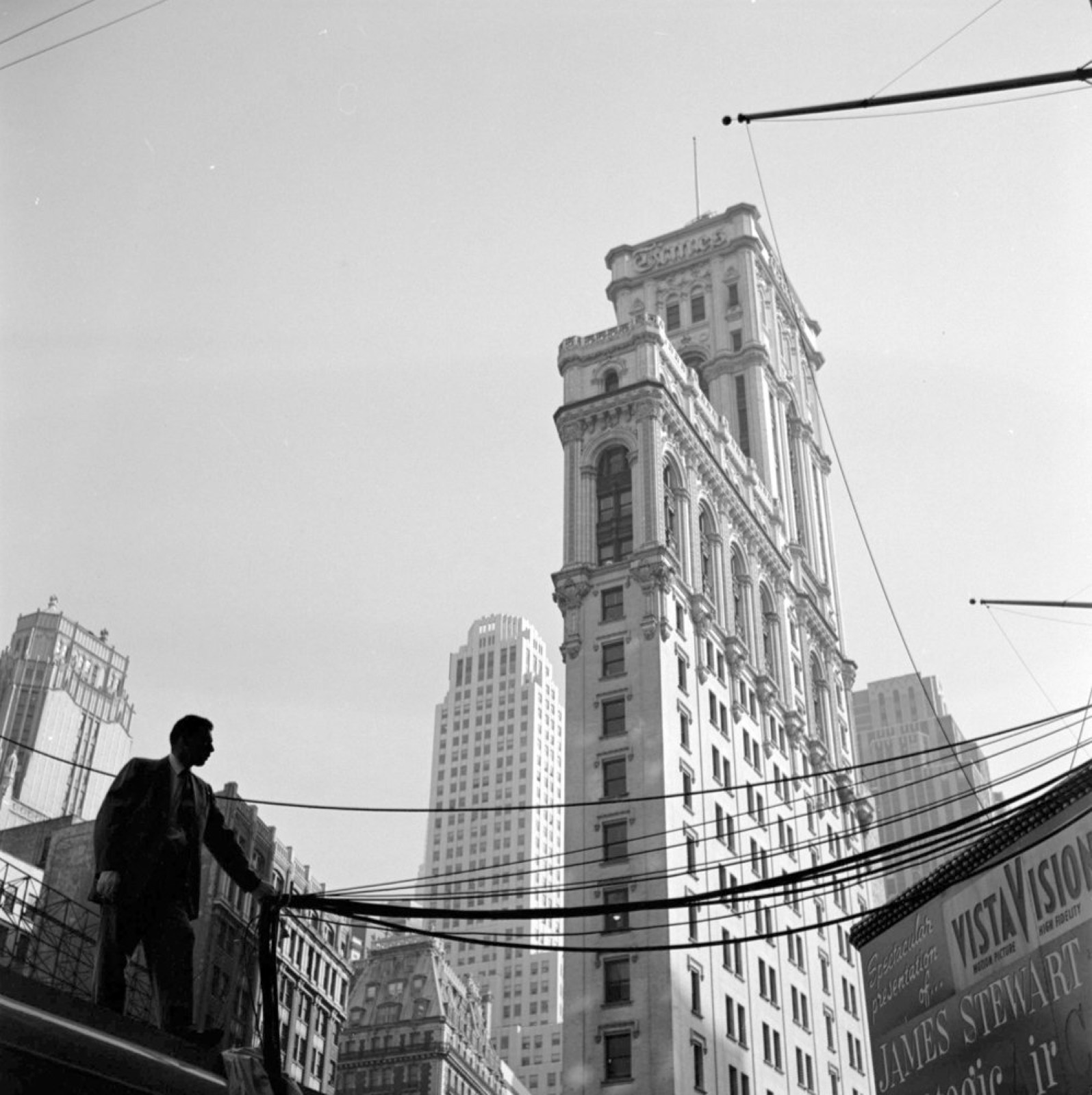

What is he doing up there, the man in the suit? He has climbed onto some platform or hoarding above the street and taken hold of a fistful of slack cable, calm as a commuter gripping a strap, as if the whole improvised rigging of Manhattan might be steered from where he stands. Behind him the old Times Tower rises like a white cliff, still wearing its ornamental stonework, and the sky is crossed and recrossed by wires, poles, guy-lines — a city held together, it seems, by string.
In the corner, a billboard promises VistaVision — "Motion Picture High Fidelity" — and a spectacular presentation of James Stewart. Hollywood, that year, was straining to make the screen wider, the image bigger, the experience more overwhelming. Meanwhile a nanny on her day off pointed her twin-lens reflex upward from waist height — which is why the buildings loom the way they do, why the man becomes silhouette, monument, punctuation — and got the truly spectacular presentation for free. The wires sag across the frame like the staves of some enormous score, and he is the single note written on them.
Nobody saw it at the time, of course. Vivian Maier printed little, showed less, and left the work in storage lockers where it stayed until after 2007, when the archive surfaced and rearranged the history of American street photography to make room for her. Museums have been catching up ever since. A gelatin silver print like this one is the rare, tangible end of all that secrecy: the moment she kept, finally keeping company.