The room in Poughkeepsie has been stripped to essentials, a clawfoot tub whose enamel has flaked from the iron into a dark continent of blotches, and the two young men who fill it. One sits with his knees folded, a starburst tattoo inked on his shoulder blade; the other tips his lathered chin toward a razor, throat offered to a friend’s steady hand. Around the tub the floor is strewn with denim and a single pair of boots, the ordinary debris of undressing.
To shave another man is to be trusted with his throat, and the picture knows it. The gesture is tender and faintly perilous, the blade held close to the skin, the foam thick as meringue along the jaw. Nothing here is hurried. Weber lets the scene breathe as domestic fact rather than provocation, two people at ease in the same small water. The eye is invited to look and also, quietly, asked how to look, which is the harder request.
Weber, who reshaped American fashion in the 1980s and gave the male body a language of ease it had rarely enjoyed, was always drawn to the unposed rituals of men together, bathing, boxing, sleeping. This gelatin silver print carries the full range of that attention, the wet sheen of skin, the corroded gleam of the old tub, the pale bloom of shaving cream against a grey wall. It is intimacy printed as if it were the most natural subject in the world, which, he insisted, it is.
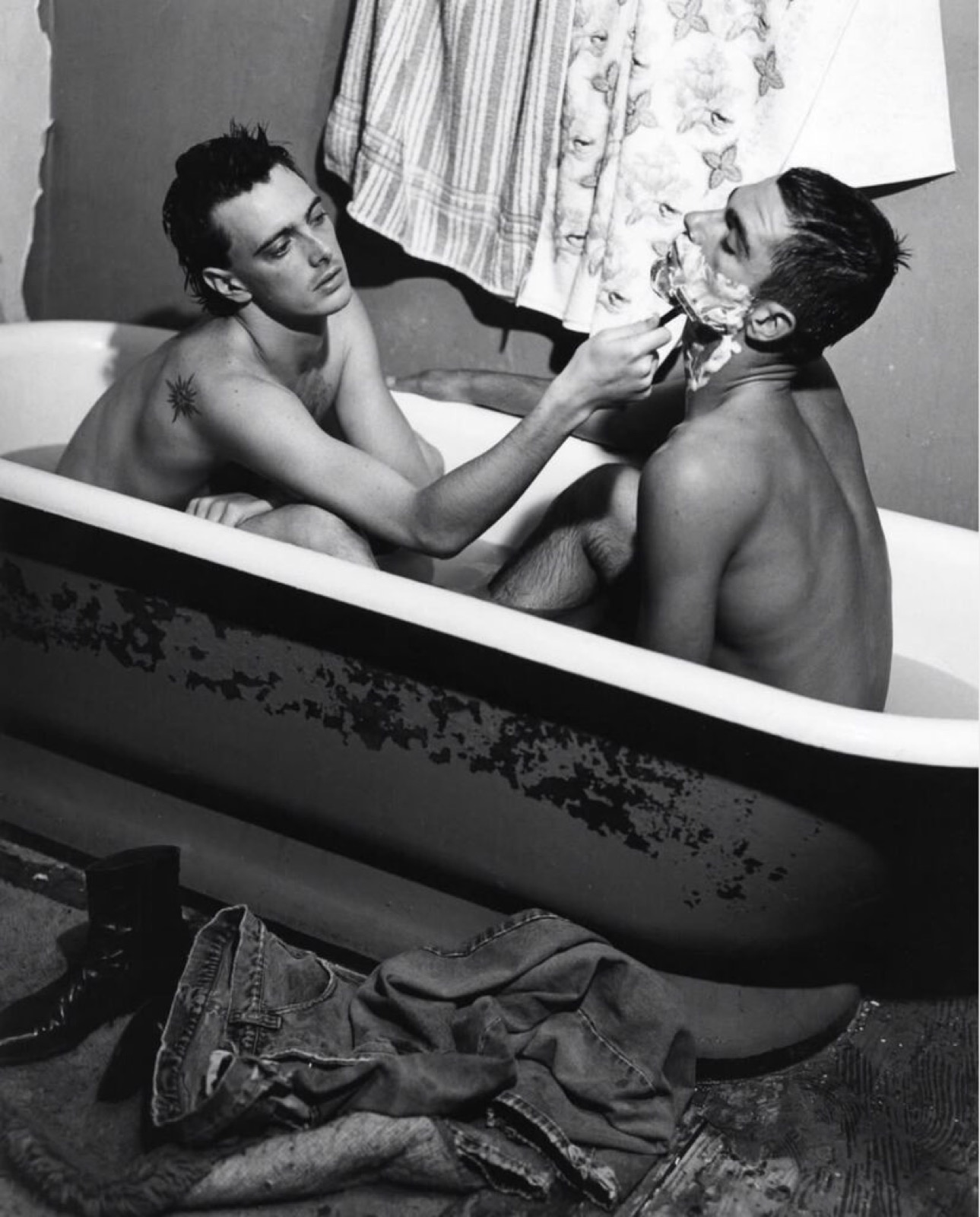

The room in Poughkeepsie has been stripped to essentials, a clawfoot tub whose enamel has flaked from the iron into a dark continent of blotches, and the two young men who fill it. One sits with his knees folded, a starburst tattoo inked on his shoulder blade; the other tips his lathered chin toward a razor, throat offered to a friend’s steady hand. Around the tub the floor is strewn with denim and a single pair of boots, the ordinary debris of undressing.
To shave another man is to be trusted with his throat, and the picture knows it. The gesture is tender and faintly perilous, the blade held close to the skin, the foam thick as meringue along the jaw. Nothing here is hurried. Weber lets the scene breathe as domestic fact rather than provocation, two people at ease in the same small water. The eye is invited to look and also, quietly, asked how to look, which is the harder request.
Weber, who reshaped American fashion in the 1980s and gave the male body a language of ease it had rarely enjoyed, was always drawn to the unposed rituals of men together, bathing, boxing, sleeping. This gelatin silver print carries the full range of that attention, the wet sheen of skin, the corroded gleam of the old tub, the pale bloom of shaving cream against a grey wall. It is intimacy printed as if it were the most natural subject in the world, which, he insisted, it is.