
Ramón Masats
Spanish, 1931–2024Romería del Rocío, Almonte, Huelva, 1959
Gelatin Silver Print. Printed Later.
Image: 24.5 x 37.5 cm / 9 5/8 x 14 3/4 in / Paper: 30 x 40 cm / 11 3/4 x 15 3/4 in
Image: 37.5 x 56.5 cm / 14 3/4 x 22 1/4 in / Paper: 50 x 60 cm / 19 3/4 x 23 5/8 in
Ramón Masats Estate dry stamp, signed and authenticated by Sonia Masats with title and edition number in pencil on label affixed to print verso
Edition of 15 — Image: 24.5 x 37.5 cm / 9 5/8 x 14 3/4 in / Paper: 30 x 40 cm / 11 3/4 x 15 3/4 in
Edition of 5 — Image: 37.5 x 56.5 cm / 14 3/4 x 22 1/4 in / Paper: 50 x 60 cm / 19 3/4 x 23 5/8 in
© The Artist
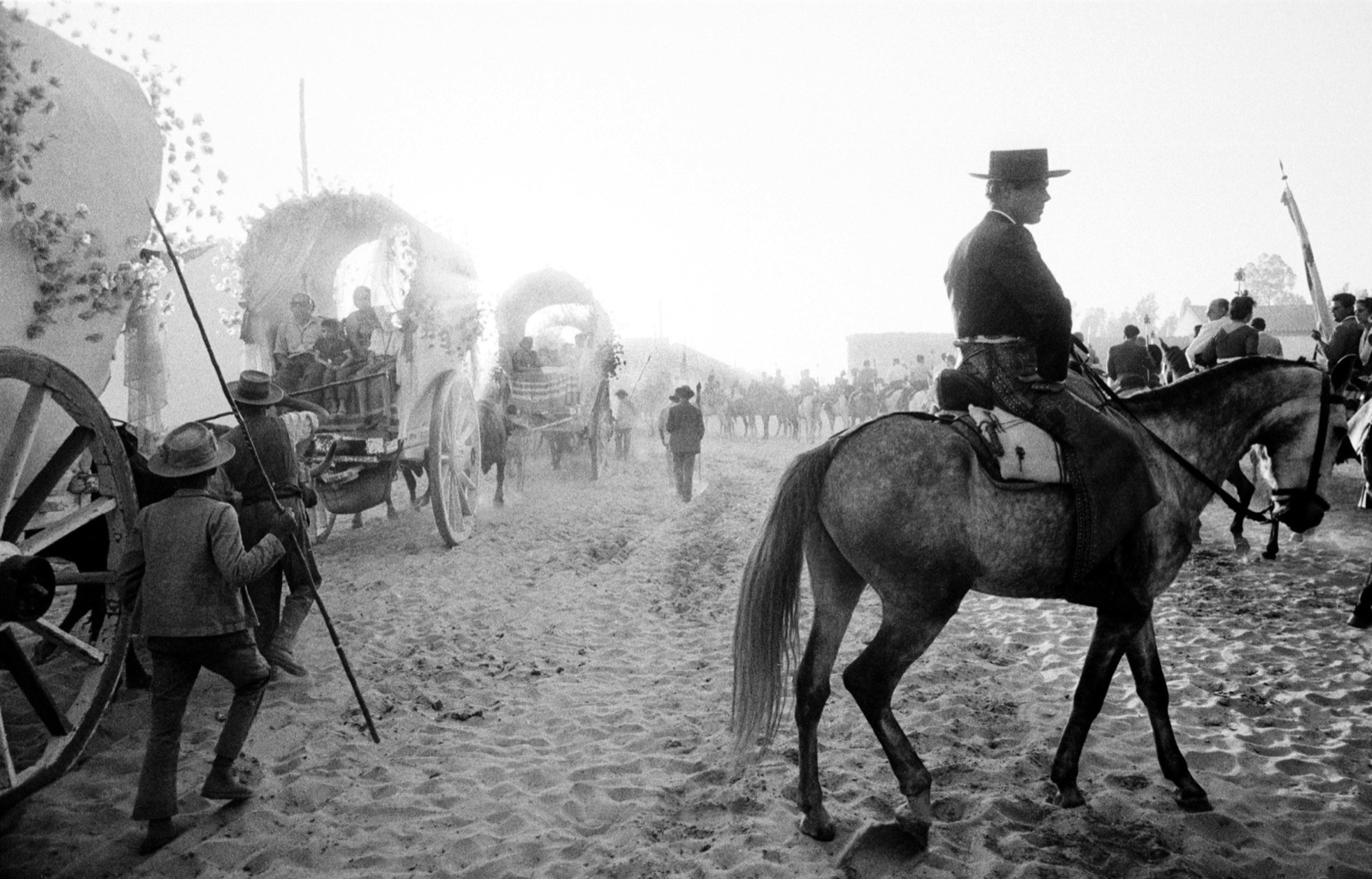
The pilgrimage to El Rocío was already a centuries-old rite when Masats fell in with it, and what he found was less a spectacle than a slow machinery of devotion: flower-hung carts crawling across the sand, a caballero halted mid-stride on his dappled grey, the whole procession dissolving into a low sun that bleaches the far houses to nothing. Spain in these years was closed and watched, yet here the folk life the regime liked to advertise turns out to be genuinely strange, granular, alive with dust.
Everything in the frame is being handled. A man in a pale jacket leans his whole weight against a spoked wheel, a pole braced in his fist; boots sink into churned sand; the horse’s flank and the rider’s short jacket hold the only true blacks, so that the picture seems to condense out of glare toward those two dark masses. Masats does not compose the crowd so much as let it thicken and thin, the wagons receding into a haze that is half sunlight, half kicked-up grit.
Masats belonged to the AFAL group that dragged Spanish photography into modern time from the late 1950s, and his eye for such ordinary consecrations, as much as his Sanfermines and boxing pictures, earned him the Premio Nacional in 2004. This gelatin silver print, made later from the negative, keeps the tonal reach he wanted: the milky sky, the pewter horse, the near-white sand pocked with hoofprints. It is a devotional image without piety, an object that carries a vanished afternoon in its grain.