A street sign, lit an electric green against the fog, spells the name HEATHER above a crossing whose name the mist has half-erased. Below and to the left, the gable of a grey clapboard house rises into a lavender dusk, its single upstairs window dark and shuttered. The camera looks up, the way a child or a stranger looks up, unsure of the address and slightly cowed by it.
Hido has described these Ohio suburbs as the ground of his own biography, and the picture behaves like a found relic of that terrain—the standardised municipal sign, the mass-produced siding, the anonymous house made briefly particular by a name. It is the stuff of the everyday American town, the kind of scene that fills family snapshots and forgotten postcards, ordinarily beneath notice.
The photograph, fixed in pigment on aluminium, converts this fleeting civic fact into something durable and strange. The green of the sign, unnaturally saturated by the exposure, reads almost as a spectral apparition floating over the roofline. What is preserved is not a house but a coordinate—a name, a corner, a moment of fog—the raw material from which memory, later and less reliably, will try to build a home.
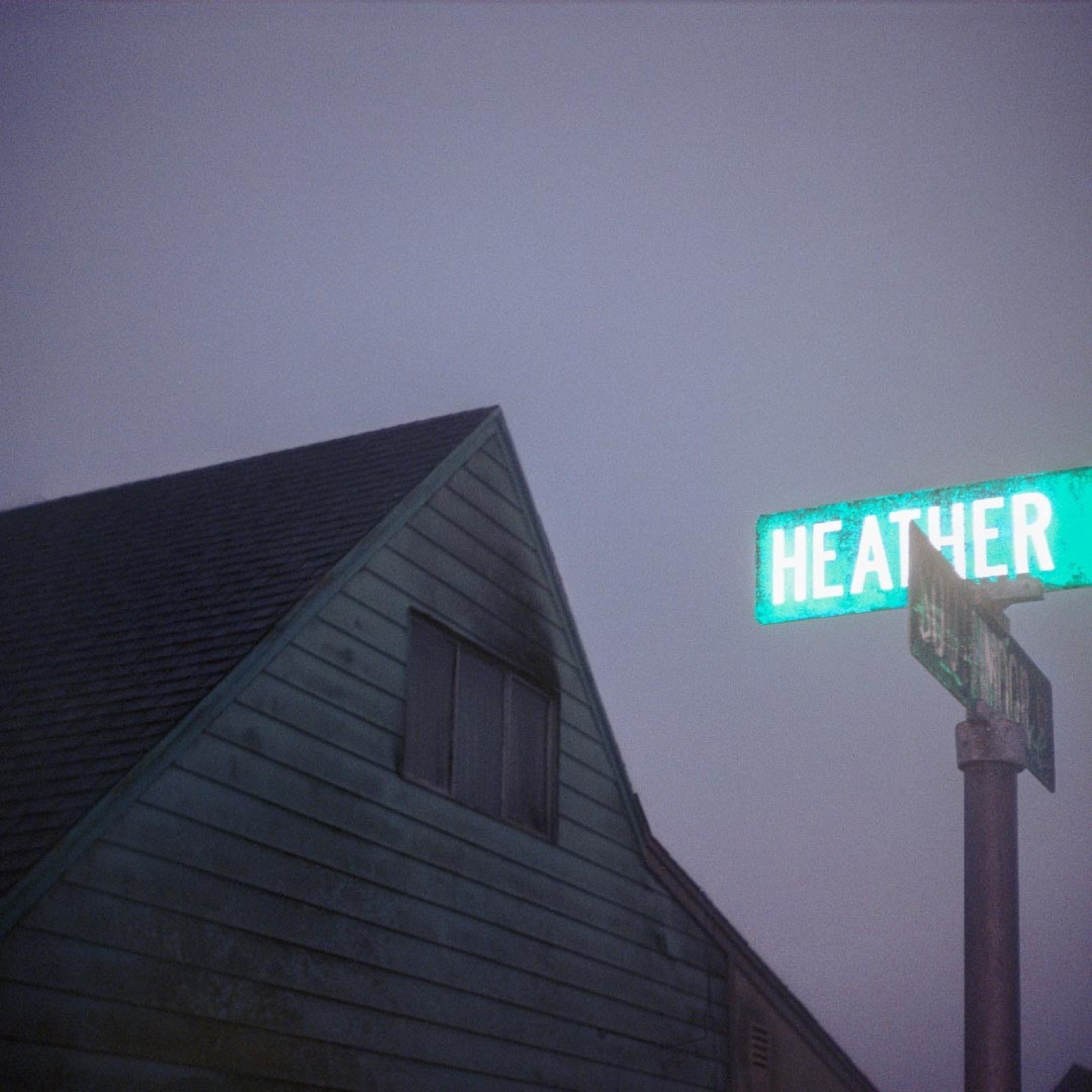

A street sign, lit an electric green against the fog, spells the name HEATHER above a crossing whose name the mist has half-erased. Below and to the left, the gable of a grey clapboard house rises into a lavender dusk, its single upstairs window dark and shuttered. The camera looks up, the way a child or a stranger looks up, unsure of the address and slightly cowed by it.
Hido has described these Ohio suburbs as the ground of his own biography, and the picture behaves like a found relic of that terrain—the standardised municipal sign, the mass-produced siding, the anonymous house made briefly particular by a name. It is the stuff of the everyday American town, the kind of scene that fills family snapshots and forgotten postcards, ordinarily beneath notice.
The photograph, fixed in pigment on aluminium, converts this fleeting civic fact into something durable and strange. The green of the sign, unnaturally saturated by the exposure, reads almost as a spectral apparition floating over the roofline. What is preserved is not a house but a coordinate—a name, a corner, a moment of fog—the raw material from which memory, later and less reliably, will try to build a home.