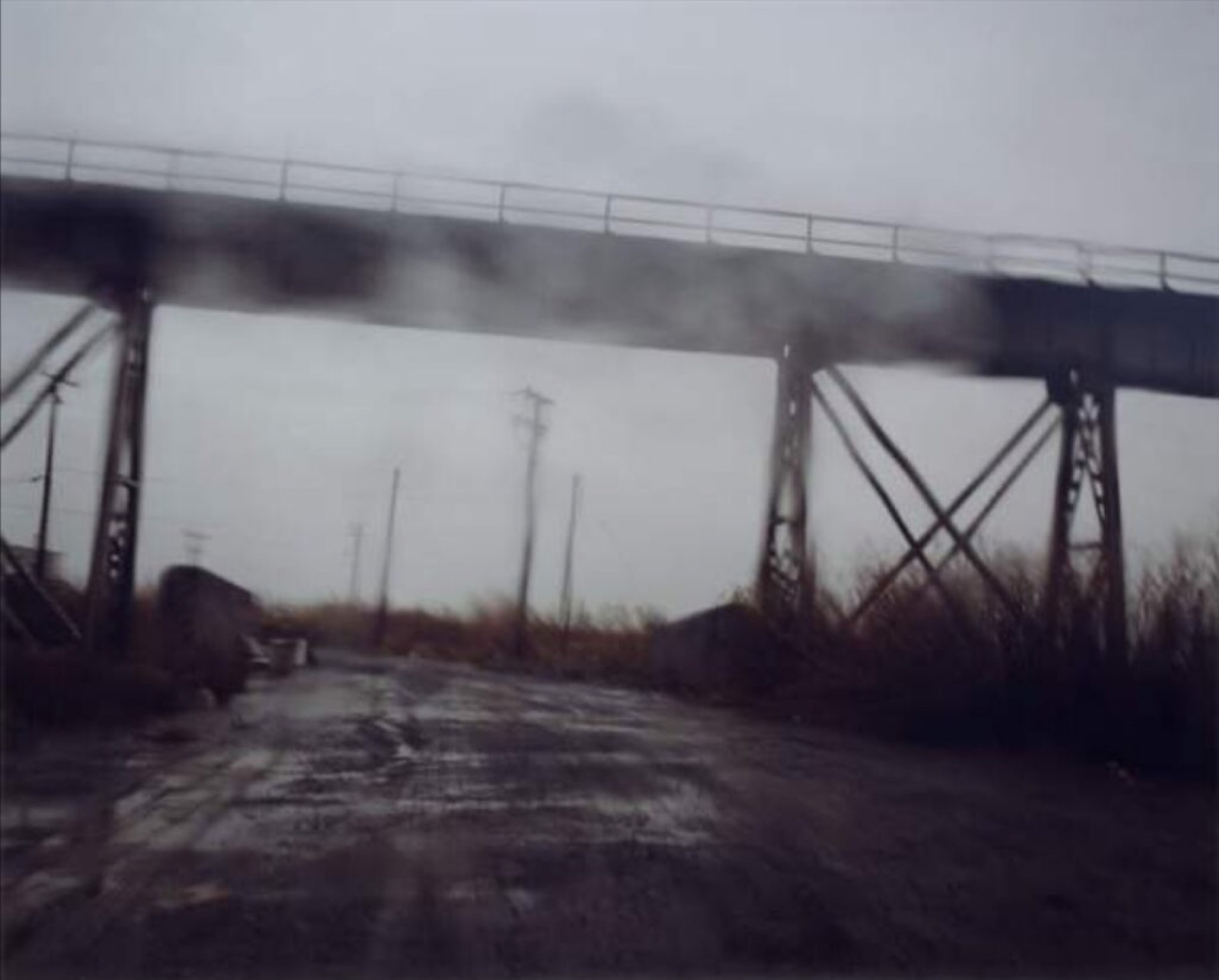
The brightest things in this picture lie in the mud: a few puddles catching the overcast, small shards of sky relocated underfoot. Find them and the whole scene reorganizes itself around their pale shine; the wet lot is no longer dark ground under a dark bridge but a mirror-field, trading light with the weather above.
Overhead the trestle runs its long black bar across the frame, edged with one thin handrail, and the camera has caught it through a rain-streaked pane, so that the steel smears like wet ink. In the survey photographs of the 1860s such structures were pictured as triumphs, timber and iron striding west; a century of images taught us to read the trestle as promise. Hido reads it in the past tense: rusted bents, brown weeds beneath, telephone poles standing here and there in the middle distance, a truck shape sunk in blur at the left.
The blur is not carelessness; it is the picture’s tonal argument, pulling girder, weeds, and sky into one mauve-grey register, closer to a soft-ground etching than to the crisp descriptions we expect of documents. As an archival pigment print the image holds that fragile unity, the near-black of the steel kept just short of opacity, the greys graduated like breath on glass. Hido, born in Kent, Ohio, and long based in the San Francisco Bay Area, often works from the driver’s seat, rain and glass interceding; SFMOMA, the Getty, and the Whitney all hold his prints. The surveys promised where the line would go. This picture asks what the line left behind.
The brightest things in this picture lie in the mud: a few puddles catching the overcast, small shards of sky relocated underfoot. Find them and the whole scene reorganizes itself around their pale shine; the wet lot is no longer dark ground under a dark bridge but a mirror-field, trading light with the weather above.
Overhead the trestle runs its long black bar across the frame, edged with one thin handrail, and the camera has caught it through a rain-streaked pane, so that the steel smears like wet ink. In the survey photographs of the 1860s such structures were pictured as triumphs, timber and iron striding west; a century of images taught us to read the trestle as promise. Hido reads it in the past tense: rusted bents, brown weeds beneath, telephone poles standing here and there in the middle distance, a truck shape sunk in blur at the left.
The blur is not carelessness; it is the picture’s tonal argument, pulling girder, weeds, and sky into one mauve-grey register, closer to a soft-ground etching than to the crisp descriptions we expect of documents. As an archival pigment print the image holds that fragile unity, the near-black of the steel kept just short of opacity, the greys graduated like breath on glass. Hido, born in Kent, Ohio, and long based in the San Francisco Bay Area, often works from the driver’s seat, rain and glass interceding; SFMOMA, the Getty, and the Whitney all hold his prints. The surveys promised where the line would go. This picture asks what the line left behind.