There was a stretch, early in the new millennium, when the most charged pictures in American photography were being made from the driver’s seat: roads like this one, black asphalt streaked with snow, a crooked telephone pole propping up a mauve-grey sky. The road movie had migrated into art photography, minus the movie star, minus the plot.
Hido’s version is quietly directorial. Nothing here is staged, yet everything behaves as though it were: the road rises to a crest and withholds its destination; a second pole waits at the horizon like a marker in a storyboard; russet grasses blur at the edges where the lens gives up its grip. The softness is not nostalgia but a decision, the deliberate opposite of the crisp, all-knowing documentary frame. Made through a car window, the scene is art-directed by glass and weather, and the result sits somewhere between evidence and cinema, a still from a film that never needed to exist.
That balancing act is why Todd Hido matters to the story of contemporary photography. Born in Kent, Ohio, and based in the San Francisco Bay Area, he built a language out of suburban windows at night and winter roads seen at speed, titling his works with numbers so that the pictures stay open, castable, ours to inhabit. SFMOMA, the Getty and the Whitney hold his prints. As an archival pigment print, this one preserves the exact temperature of that overcast, the lavender in the grey, the rust burning through the snow, colors a set designer would struggle to fake.
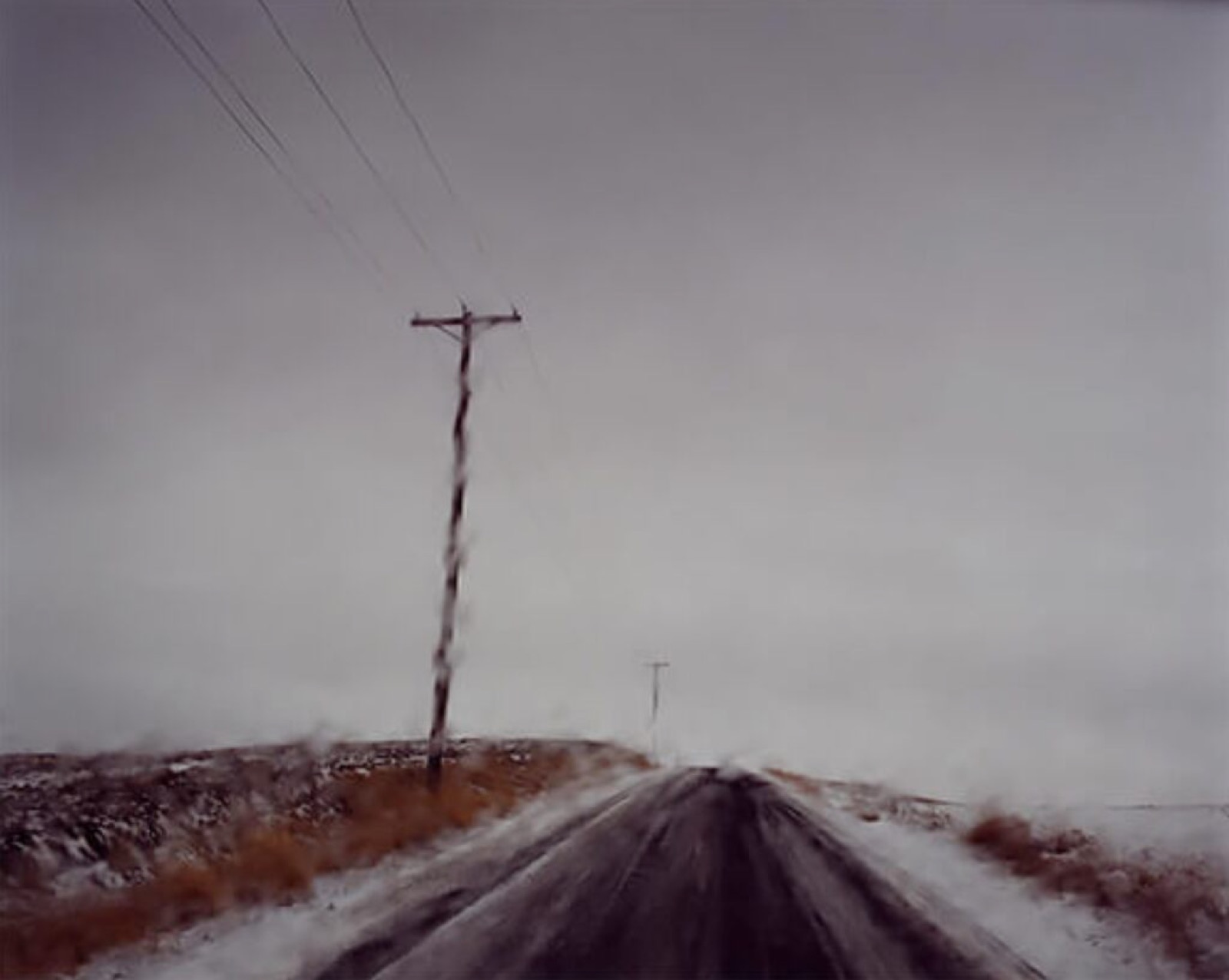

There was a stretch, early in the new millennium, when the most charged pictures in American photography were being made from the driver’s seat: roads like this one, black asphalt streaked with snow, a crooked telephone pole propping up a mauve-grey sky. The road movie had migrated into art photography, minus the movie star, minus the plot.
Hido’s version is quietly directorial. Nothing here is staged, yet everything behaves as though it were: the road rises to a crest and withholds its destination; a second pole waits at the horizon like a marker in a storyboard; russet grasses blur at the edges where the lens gives up its grip. The softness is not nostalgia but a decision, the deliberate opposite of the crisp, all-knowing documentary frame. Made through a car window, the scene is art-directed by glass and weather, and the result sits somewhere between evidence and cinema, a still from a film that never needed to exist.
That balancing act is why Todd Hido matters to the story of contemporary photography. Born in Kent, Ohio, and based in the San Francisco Bay Area, he built a language out of suburban windows at night and winter roads seen at speed, titling his works with numbers so that the pictures stay open, castable, ours to inhabit. SFMOMA, the Getty and the Whitney hold his prints. As an archival pigment print, this one preserves the exact temperature of that overcast, the lavender in the grey, the rust burning through the snow, colors a set designer would struggle to fake.