The road enters at the lower left, curves once, and leaves the frame wet and dark. It divides the picture cleanly: bare hillside and dead grass on the right, open plain and a receding line of poles on the left, a low grey horizon set between them. A railroad crossbuck and a small sign reading thirty stand at the bend, the only vertical incidents in an otherwise horizontal field.
The sky takes the upper two-thirds, a smooth grey overcast with no sun to fix the hour. Because the light is flat and shadowless, the picture is built almost entirely from tone and from the road's diagonal, which carries the eye back toward the poles and then stops. Hido made the exposure from the driver's seat, and the framing keeps the casual authority of a glance through a windshield rather than the deliberation of a tripod. The mud and the puddles record recent weather; nothing else records anything.
What the photograph withholds is any event. No train, no car, no figure — only the standing apparatus that governs a crossing that no one, at this moment, is using. Printed as archival pigment on Dibond, the muted browns and greys hold together without a hint of drama. Part of Roaming, it belongs to a plain American tradition that trusts the described world to be sufficient in itself, and here, plainly, it is.
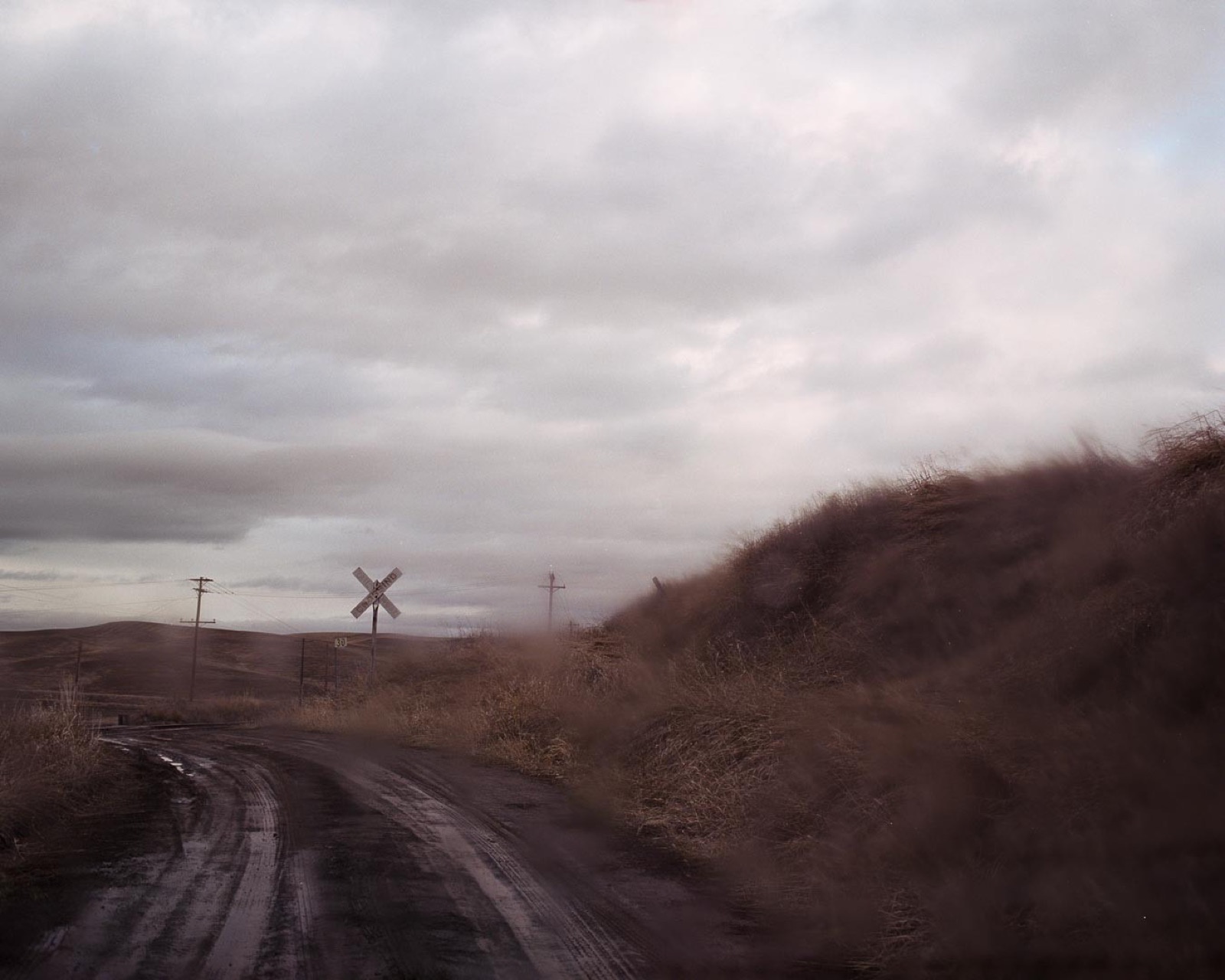

The road enters at the lower left, curves once, and leaves the frame wet and dark. It divides the picture cleanly: bare hillside and dead grass on the right, open plain and a receding line of poles on the left, a low grey horizon set between them. A railroad crossbuck and a small sign reading thirty stand at the bend, the only vertical incidents in an otherwise horizontal field.
The sky takes the upper two-thirds, a smooth grey overcast with no sun to fix the hour. Because the light is flat and shadowless, the picture is built almost entirely from tone and from the road's diagonal, which carries the eye back toward the poles and then stops. Hido made the exposure from the driver's seat, and the framing keeps the casual authority of a glance through a windshield rather than the deliberation of a tripod. The mud and the puddles record recent weather; nothing else records anything.
What the photograph withholds is any event. No train, no car, no figure — only the standing apparatus that governs a crossing that no one, at this moment, is using. Printed as archival pigment on Dibond, the muted browns and greys hold together without a hint of drama. Part of Roaming, it belongs to a plain American tradition that trusts the described world to be sufficient in itself, and here, plainly, it is.