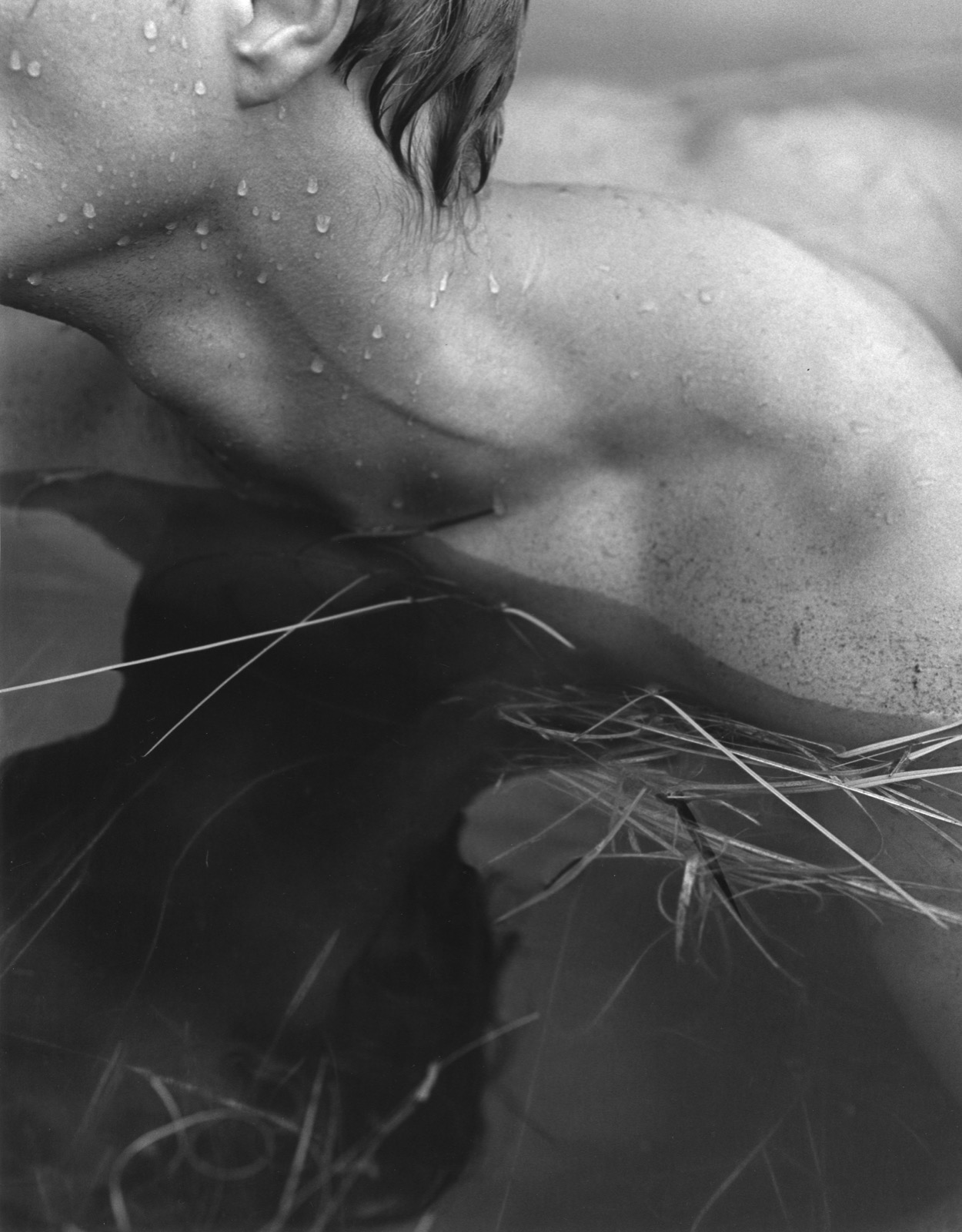
A dozen beads of water stand along the slope of a shoulder, and the eye finds them before it finds the boy. The frame has cut him at the ear and again at the ribs, so what Weber hands us is not a portrait but a fragment: a nape, a fall of wet hair, the long lit muscle of a back, and the black water he is half sunk into. He is turned away; the face is withheld. The studium is easily told — a young man bathing in a northern lake in the summer of 1989, somewhere in the Adirondack Park. What pierces is smaller and off to one side: a single blade of reed laid across the dark surface like a scratch scored into the print itself.
Below the waterline his body meets its own shadow, skin above and dissolution beneath, the surface working as a horizon that halves him. The photograph is built entirely around a touch it will never deliver — each droplet an argument for a fingertip that cannot arrive. Desire is set out and then refused, which is the only way Weber ever lets it remain desire. Even the grain of the film behaves like a second skin: granular, warm, close enough to feel.
And then the old ache of every photograph: this has been. This afternoon at Bear Pond occurred, the water was exactly this cold, the reeds drifted precisely here, and none of it will occur again. The print does not preserve the boy; it certifies that he was once wet and breathing inside this rectangle and is now somewhere beyond it. He never turns around. That is the picture's discretion, and its small cruelty.

A dozen beads of water stand along the slope of a shoulder, and the eye finds them before it finds the boy. The frame has cut him at the ear and again at the ribs, so what Weber hands us is not a portrait but a fragment: a nape, a fall of wet hair, the long lit muscle of a back, and the black water he is half sunk into. He is turned away; the face is withheld. The studium is easily told — a young man bathing in a northern lake in the summer of 1989, somewhere in the Adirondack Park. What pierces is smaller and off to one side: a single blade of reed laid across the dark surface like a scratch scored into the print itself.
Below the waterline his body meets its own shadow, skin above and dissolution beneath, the surface working as a horizon that halves him. The photograph is built entirely around a touch it will never deliver — each droplet an argument for a fingertip that cannot arrive. Desire is set out and then refused, which is the only way Weber ever lets it remain desire. Even the grain of the film behaves like a second skin: granular, warm, close enough to feel.
And then the old ache of every photograph: this has been. This afternoon at Bear Pond occurred, the water was exactly this cold, the reeds drifted precisely here, and none of it will occur again. The print does not preserve the boy; it certifies that he was once wet and breathing inside this rectangle and is now somewhere beyond it. He never turns around. That is the picture's discretion, and its small cruelty.