What is a beaded evening gown doing on the shingled roof of a boathouse, at the edge of a black lake in the Adirondack woods? Weber gives no explanation, and the refusal is the point. A woman in a strapless, glittering column of a dress stands at the ridge where the cedar shingles meet the treeline, arms lifted to grip the branches overhead, as if she had grown there among the pines. The gown catches what light the canopy allows and turns it to a scatter of sparks.
The picture belongs to fashion, but it borrows the grammar of the tableau vivant. Everything is arranged: the diagonal of the roof sliding down to the water, the dark mouth of the boathouse below, the model’s raised arms echoing the vertical trunks. Weber sets glamour against wilderness so that each sharpens the other, the shimmer of sequins pressed to the rough grain of weathered shingle and bark. It is styling as argument, a claim that couture can be at home anywhere its wearer decides to stand.
This is the territory Weber made his own in the 1980s, when he moved American fashion out of the studio and into the country of summer camps, lakes and old-money Americana. Here the wildness is genuine and the elegance imported, and the friction is the story. Printed in gelatin silver, the image holds a long tonal range, from the deep water to the bright leaves, and keeps the beadwork legible as texture rather than glare. The result reads less as advertisement than as fable staged for the camera.
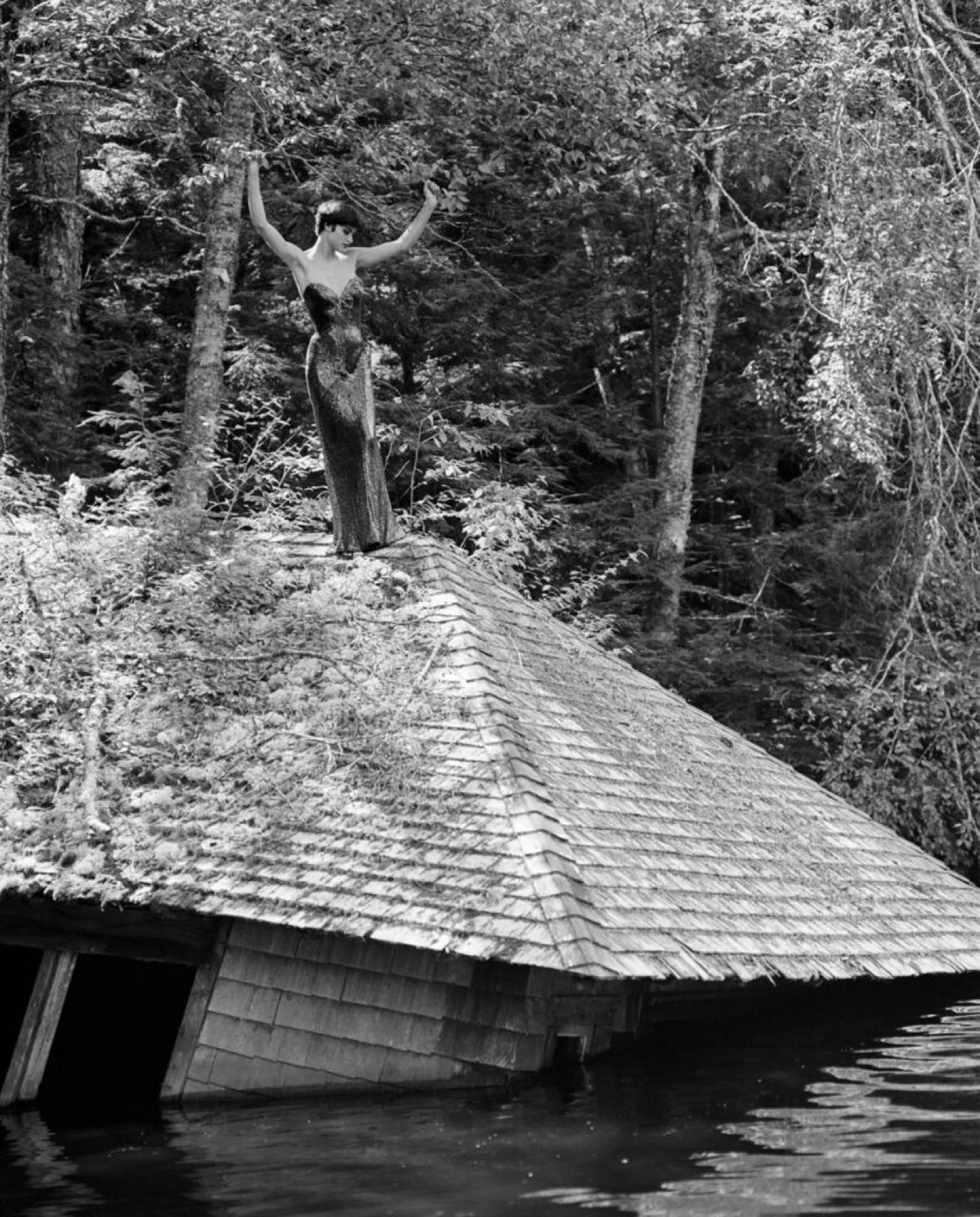

What is a beaded evening gown doing on the shingled roof of a boathouse, at the edge of a black lake in the Adirondack woods? Weber gives no explanation, and the refusal is the point. A woman in a strapless, glittering column of a dress stands at the ridge where the cedar shingles meet the treeline, arms lifted to grip the branches overhead, as if she had grown there among the pines. The gown catches what light the canopy allows and turns it to a scatter of sparks.
The picture belongs to fashion, but it borrows the grammar of the tableau vivant. Everything is arranged: the diagonal of the roof sliding down to the water, the dark mouth of the boathouse below, the model’s raised arms echoing the vertical trunks. Weber sets glamour against wilderness so that each sharpens the other, the shimmer of sequins pressed to the rough grain of weathered shingle and bark. It is styling as argument, a claim that couture can be at home anywhere its wearer decides to stand.
This is the territory Weber made his own in the 1980s, when he moved American fashion out of the studio and into the country of summer camps, lakes and old-money Americana. Here the wildness is genuine and the elegance imported, and the friction is the story. Printed in gelatin silver, the image holds a long tonal range, from the deep water to the bright leaves, and keeps the beadwork legible as texture rather than glare. The result reads less as advertisement than as fable staged for the camera.