The boy at the center gives nothing back. His hands have vanished inside two mahogany-dark gloves too big for him, his arms hanging slack, and his face — fixed on some middle distance past the lens — refuses the whole production being mounted around him. He won't clench, won't grin, won't play. That withholding is the picture: a slight kid in a plaid shirt being dressed for a fight he didn't pick, one mate's hand flat on his shoulder, another fussing at his collar, a fourth lounging off to the right with hands in his pockets, already bored, already the critic. A chalk ring scratched onto the Lambeth pavement makes the pantomime official. Nobody's throwing a punch. The drama is entirely in the costuming.
Horvat caught this in 1955, fresh off two years working Asia for Life, Réalités and Picture Post, and you can feel the reporter's instinct in how he refuses to sentimentalize. The light is hard South London morning, raking the cobbles, throwing four long shadows that double the boys into a second, ghostlier gang. It's all there in the styling — the cinched waists, the rolled cuffs, the brick terrace behind — a working-class boyhood photographed without a single condescending note. He sees the swagger as performance, which is exactly what swagger is.
What makes it Horvat and not merely charming is the social choreography: who touches whom, who watches, who's been chosen. The gloves turn one kid into a spectacle and the rest into a chorus. It's a fashion sitting in miniature, the youngest model reluctantly fitted, the stylists circling. From a photographer who'd go on to remake fashion's grammar, this early street frame already knows the truth that dressing someone is never neutral.
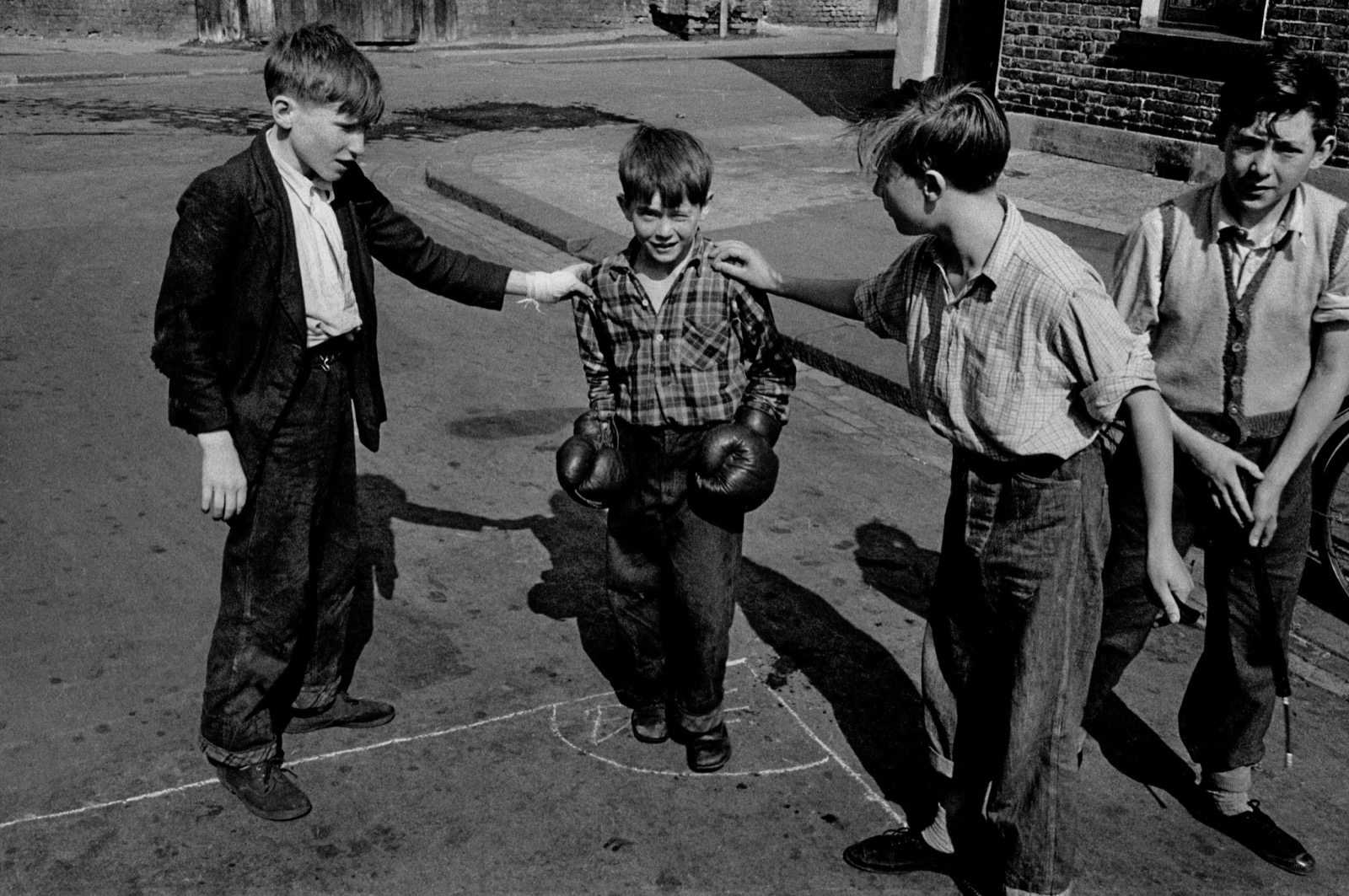

The boy at the center gives nothing back. His hands have vanished inside two mahogany-dark gloves too big for him, his arms hanging slack, and his face — fixed on some middle distance past the lens — refuses the whole production being mounted around him. He won't clench, won't grin, won't play. That withholding is the picture: a slight kid in a plaid shirt being dressed for a fight he didn't pick, one mate's hand flat on his shoulder, another fussing at his collar, a fourth lounging off to the right with hands in his pockets, already bored, already the critic. A chalk ring scratched onto the Lambeth pavement makes the pantomime official. Nobody's throwing a punch. The drama is entirely in the costuming.
Horvat caught this in 1955, fresh off two years working Asia for Life, Réalités and Picture Post, and you can feel the reporter's instinct in how he refuses to sentimentalize. The light is hard South London morning, raking the cobbles, throwing four long shadows that double the boys into a second, ghostlier gang. It's all there in the styling — the cinched waists, the rolled cuffs, the brick terrace behind — a working-class boyhood photographed without a single condescending note. He sees the swagger as performance, which is exactly what swagger is.
What makes it Horvat and not merely charming is the social choreography: who touches whom, who watches, who's been chosen. The gloves turn one kid into a spectacle and the rest into a chorus. It's a fashion sitting in miniature, the youngest model reluctantly fitted, the stylists circling. From a photographer who'd go on to remake fashion's grammar, this early street frame already knows the truth that dressing someone is never neutral.