Photographed from a moving car, this picture wears its method openly: the foreground smears into streaks of ice and wet ground, while the middle distance, a stand of bare trees along what looks like a lakeshore at dusk, holds just still enough to read. The sun sits low and diffuse behind the trunks, washing the sky a tender pink, and two forlorn basketball hoops mark the edge of an empty park.
The Roaming series grew out of Hido's long drives through the American landscape, camera on the passenger seat, the country scrolling past a window. It belongs to a deep tradition, Robert Frank and Walker Evans before him, of understanding the road as the truest route into the national character. What distinguishes Hido is his willingness to let motion win, to accept the blur as honest testimony to how most of us actually see the land: in passing, half-attending, on our way elsewhere.
Rendered as an archival pigment print on aluminium, the colour stays low and wintry, closer to memory than to fact. There is real feeling in this restraint. A lesser photographer would have stopped the car and sharpened the trees; Hido keeps driving, and the picture is warmer for it, alive to the loneliness and the strange consolation of the passing view.
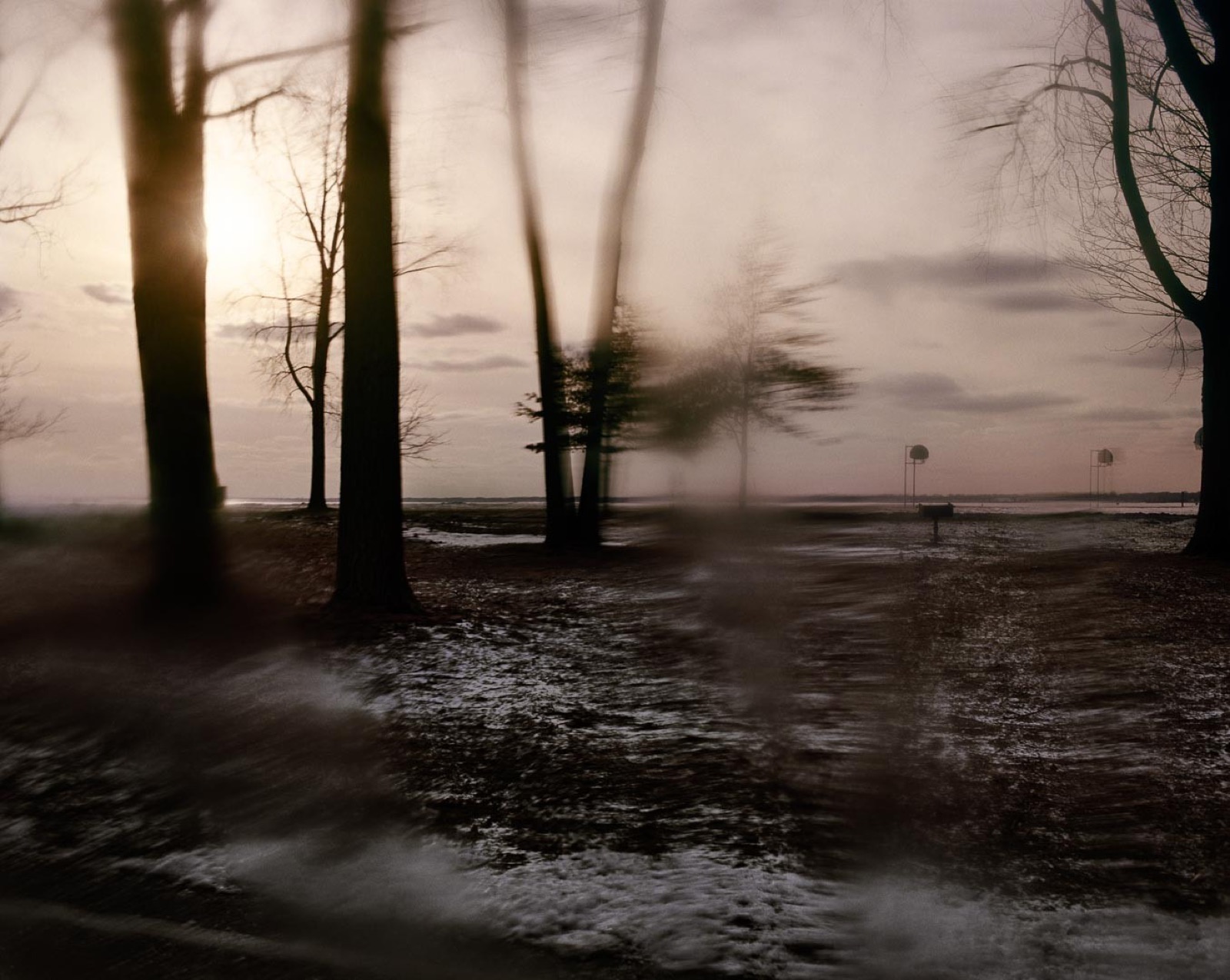

Photographed from a moving car, this picture wears its method openly: the foreground smears into streaks of ice and wet ground, while the middle distance, a stand of bare trees along what looks like a lakeshore at dusk, holds just still enough to read. The sun sits low and diffuse behind the trunks, washing the sky a tender pink, and two forlorn basketball hoops mark the edge of an empty park.
The Roaming series grew out of Hido's long drives through the American landscape, camera on the passenger seat, the country scrolling past a window. It belongs to a deep tradition, Robert Frank and Walker Evans before him, of understanding the road as the truest route into the national character. What distinguishes Hido is his willingness to let motion win, to accept the blur as honest testimony to how most of us actually see the land: in passing, half-attending, on our way elsewhere.
Rendered as an archival pigment print on aluminium, the colour stays low and wintry, closer to memory than to fact. There is real feeling in this restraint. A lesser photographer would have stopped the car and sharpened the trees; Hido keeps driving, and the picture is warmer for it, alive to the loneliness and the strange consolation of the passing view.