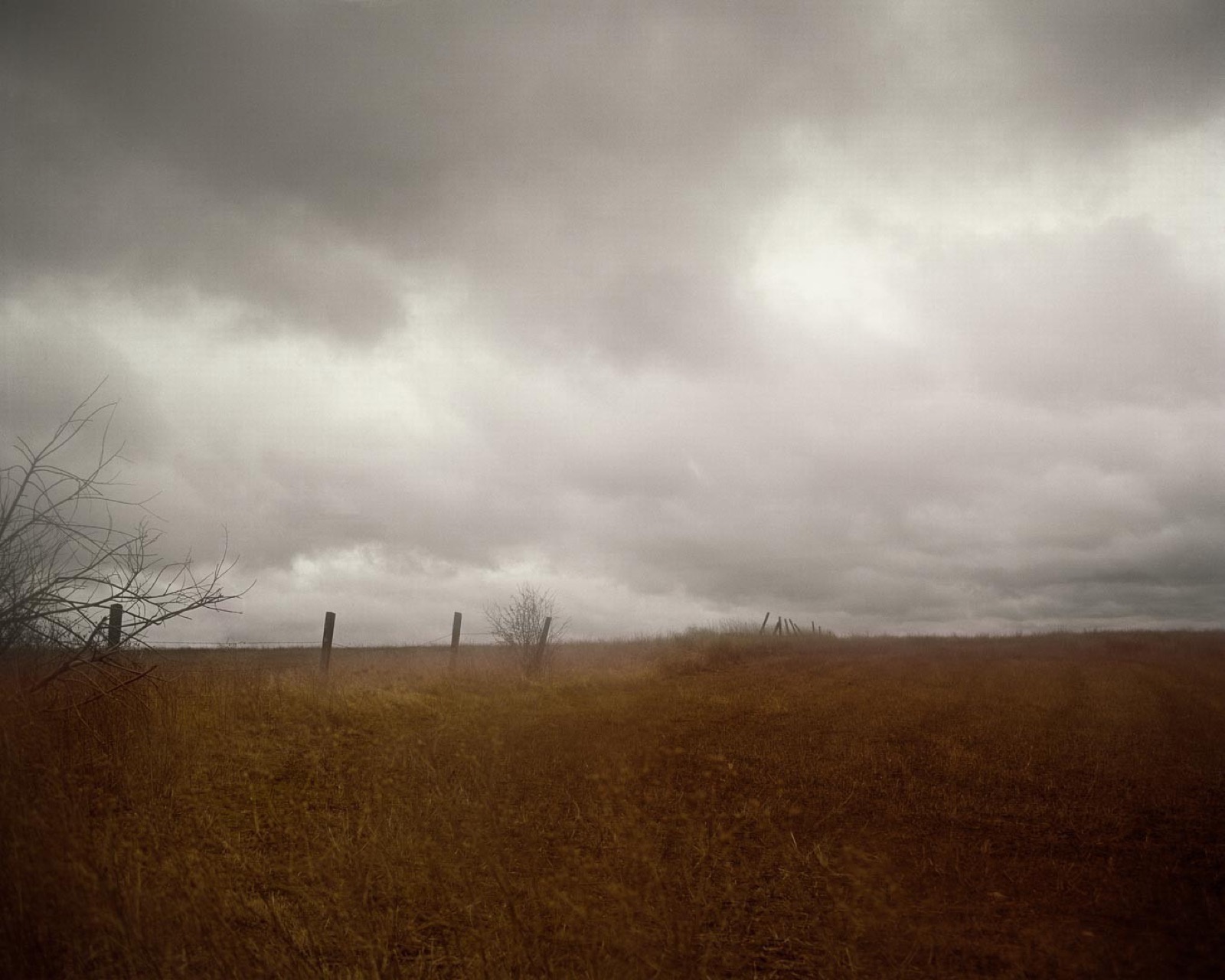
To photograph a bleak field is to make an argument about attention: that the overlooked deserves the same gravity we reserve for the sublime. Hido gives us a plain rise of dead ochre grass under a sky bloated with grey cloud, a few leaning fence posts strung with slack wire, a bare bush clawing at the frame's left edge. There is nothing to see, which is precisely the point, and precisely the difficulty.
Such pictures teach a moral patience. The landscape refuses spectacle and offers instead the melancholy of the ordinary—land that has been used and left, weather that will not resolve into event, a horizon dissolving into its own haze. To dwell on it is to practice a kind of secular reverence for the depleted and the passed-over, to insist that even the emptied places deserve a witness.
Photographs of emptiness are never quite empty; they are full of the photographer's decision to stop here rather than a mile on. On Dibond the print holds the grass in a warm, exhausted amber against the cold grey sky, a chromatic quarrel that keeps the eye from settling anywhere for long. What we are shown, finally, is the temperament of looking itself—the willingness to find, in a wet and unremarkable field, a fit subject for grief.
To photograph a bleak field is to make an argument about attention: that the overlooked deserves the same gravity we reserve for the sublime. Hido gives us a plain rise of dead ochre grass under a sky bloated with grey cloud, a few leaning fence posts strung with slack wire, a bare bush clawing at the frame's left edge. There is nothing to see, which is precisely the point, and precisely the difficulty.
Such pictures teach a moral patience. The landscape refuses spectacle and offers instead the melancholy of the ordinary—land that has been used and left, weather that will not resolve into event, a horizon dissolving into its own haze. To dwell on it is to practice a kind of secular reverence for the depleted and the passed-over, to insist that even the emptied places deserve a witness.
Photographs of emptiness are never quite empty; they are full of the photographer's decision to stop here rather than a mile on. On Dibond the print holds the grass in a warm, exhausted amber against the cold grey sky, a chromatic quarrel that keeps the eye from settling anywhere for long. What we are shown, finally, is the temperament of looking itself—the willingness to find, in a wet and unremarkable field, a fit subject for grief.