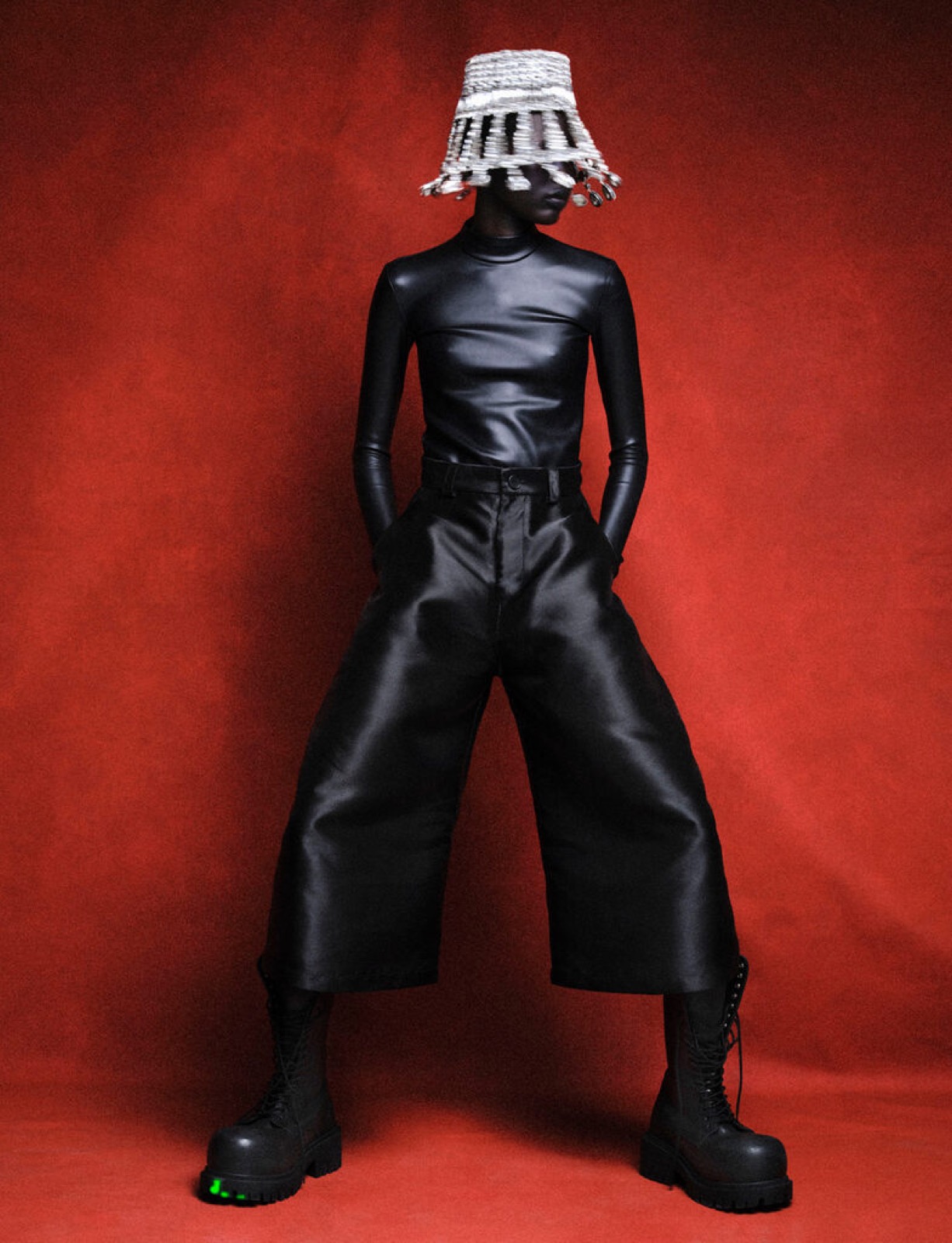
A figure stands frontally against a red ground, legs planted wide, hands behind the back. The body is black throughout: a high-necked leather bodysuit, long leather gloves, wide cropped trousers with a deep hem, lace-up boots with thick lugged soles. On the head sits a woven white hat, cylindrical, with a fringe of hanging cords and small metal weights that falls to the level of the eyes and cuts them out. Only the mouth and jaw remain visible.
The hat is the only thing in the picture that is not black, and also the only thing that appears to have been made by hand. Its structure is legible — coiled fibre, wrapped, weighted along the fringe — where the rest of the outfit is smooth, seamless and industrial. Two entirely different economies of making are stacked on one body, and the picture puts the handmade object on top, at the level of the head, and lets it do the hiding.
I think about what it means to build a photograph around a covered face. There is the obvious reading: the fashion image as anonymity, the model as mannequin. But the stance argues against it — legs wide, hands behind the back, weight even, shoulders square. This is not a body being posed so much as one holding a position, and the effect is less of a person erased than of a person who has decided not to be looked at in the usual way, and who stands there, quite deliberately, letting us look anyway.
A figure stands frontally against a red ground, legs planted wide, hands behind the back. The body is black throughout: a high-necked leather bodysuit, long leather gloves, wide cropped trousers with a deep hem, lace-up boots with thick lugged soles. On the head sits a woven white hat, cylindrical, with a fringe of hanging cords and small metal weights that falls to the level of the eyes and cuts them out. Only the mouth and jaw remain visible.
The hat is the only thing in the picture that is not black, and also the only thing that appears to have been made by hand. Its structure is legible — coiled fibre, wrapped, weighted along the fringe — where the rest of the outfit is smooth, seamless and industrial. Two entirely different economies of making are stacked on one body, and the picture puts the handmade object on top, at the level of the head, and lets it do the hiding.
I think about what it means to build a photograph around a covered face. There is the obvious reading: the fashion image as anonymity, the model as mannequin. But the stance argues against it — legs wide, hands behind the back, weight even, shoulders square. This is not a body being posed so much as one holding a position, and the effect is less of a person erased than of a person who has decided not to be looked at in the usual way, and who stands there, quite deliberately, letting us look anyway.