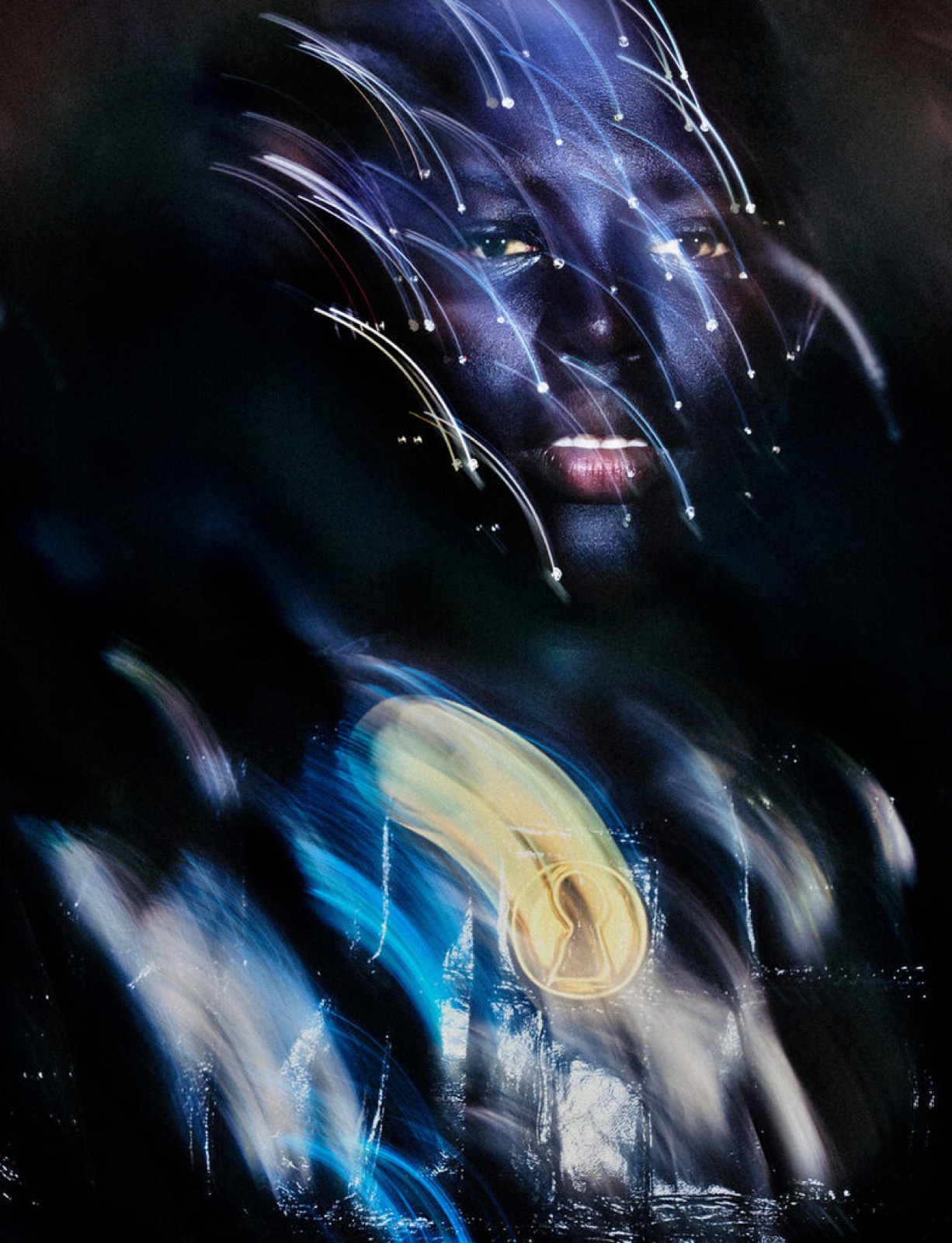
A dark face emerges from a dark ground, lit blue, with slender filaments radiating from around the head — each ending in a small bright bead of light, so that the upper half of the picture is scored with thin luminous arcs. Below the chin the image dissolves entirely: streaks of blue and cream sweep across the lower half, and out of them a gold disc resolves, a brooch or medallion, the one recognisable object in the blur. The eyes and mouth stay sharp. Everything else is moving.
The arcs are the exposure itself made visible. The shutter stayed open long enough for the small lights to draw their own paths, and camera or sitter shifted while it did, so the picture holds two different lengths of time at once: a face kept still, and a body that was not. Nothing has been added afterwards. The streaks are a record of duration, which is the one thing a photograph registers that the eye cannot.
This is very old technology used well. Light drawing its own trace on a sensitised surface is what the medium was before it was anything else — before portraits, before fashion, before any of the uses we have since found for it — and the effect belongs to the same family as the earliest experiments in which light was left to inscribe itself directly. The gold brooch will still be gold tomorrow. Those arcs existed nowhere except during the seconds the shutter was open, and this print is the only evidence that they did.
A dark face emerges from a dark ground, lit blue, with slender filaments radiating from around the head — each ending in a small bright bead of light, so that the upper half of the picture is scored with thin luminous arcs. Below the chin the image dissolves entirely: streaks of blue and cream sweep across the lower half, and out of them a gold disc resolves, a brooch or medallion, the one recognisable object in the blur. The eyes and mouth stay sharp. Everything else is moving.
The arcs are the exposure itself made visible. The shutter stayed open long enough for the small lights to draw their own paths, and camera or sitter shifted while it did, so the picture holds two different lengths of time at once: a face kept still, and a body that was not. Nothing has been added afterwards. The streaks are a record of duration, which is the one thing a photograph registers that the eye cannot.
This is very old technology used well. Light drawing its own trace on a sensitised surface is what the medium was before it was anything else — before portraits, before fashion, before any of the uses we have since found for it — and the effect belongs to the same family as the earliest experiments in which light was left to inscribe itself directly. The gold brooch will still be gold tomorrow. Those arcs existed nowhere except during the seconds the shutter was open, and this print is the only evidence that they did.