Two figures stand on a low rise at the edge of the road, an adult and a child, small and dark against an immensity of fog. They are turned from us, or perhaps toward something we cannot see, and the mist has swallowed everything beyond them—no horizon, no destination, only a soft grey wall of weather. Todd Hido photographed them through his windshield, and the faint circular blooms on the glass drift across the sky like a light snow that never quite falls.
The picture gives almost all its space to emptiness. The pair occupy a sliver of the lower frame; above them the fog rises, vast and untroubled, until it meets a dark treeline at the far right. There is a tenderness in the scale, the way two human silhouettes can anchor so much nothing. I think of every roadside where a family has paused, the ordinary geography of American waiting, and how rarely we look at it long enough to feel its weight.
Hido works in the register of the overlooked, and this is one of his most spare and affecting images, part of the loose autobiography he assembles in Excerpts from Silver Meadows. Printed as archival pigment on Dibond, the grey holds infinite gradation, fog upon fog. What stays with me is the not-knowing—who they are, what they watch, whether they are leaving or arriving—and the sense that the fog is not an obstacle to the picture but its true subject, the medium of memory itself.
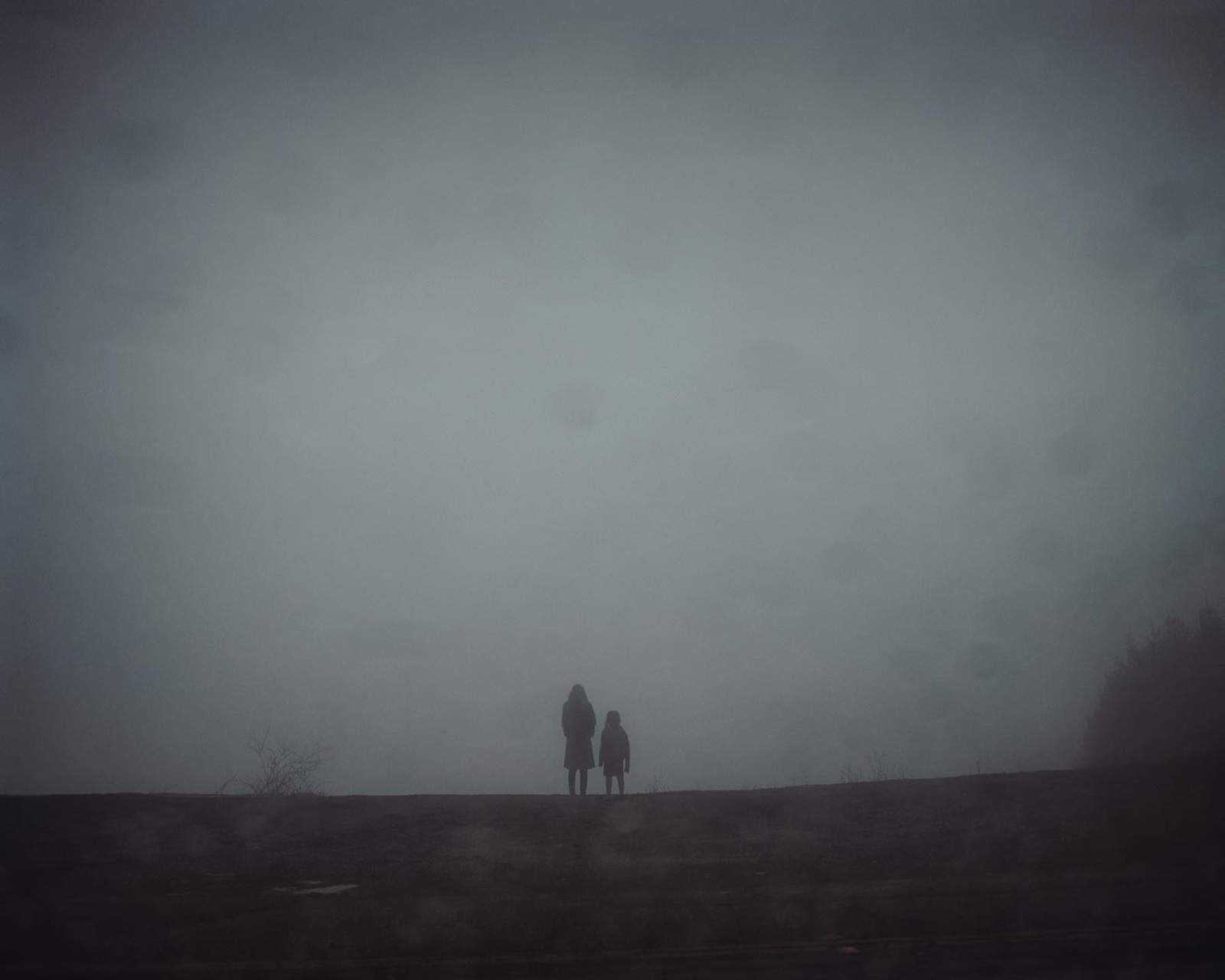

Two figures stand on a low rise at the edge of the road, an adult and a child, small and dark against an immensity of fog. They are turned from us, or perhaps toward something we cannot see, and the mist has swallowed everything beyond them—no horizon, no destination, only a soft grey wall of weather. Todd Hido photographed them through his windshield, and the faint circular blooms on the glass drift across the sky like a light snow that never quite falls.
The picture gives almost all its space to emptiness. The pair occupy a sliver of the lower frame; above them the fog rises, vast and untroubled, until it meets a dark treeline at the far right. There is a tenderness in the scale, the way two human silhouettes can anchor so much nothing. I think of every roadside where a family has paused, the ordinary geography of American waiting, and how rarely we look at it long enough to feel its weight.
Hido works in the register of the overlooked, and this is one of his most spare and affecting images, part of the loose autobiography he assembles in Excerpts from Silver Meadows. Printed as archival pigment on Dibond, the grey holds infinite gradation, fog upon fog. What stays with me is the not-knowing—who they are, what they watch, whether they are leaving or arriving—and the sense that the fog is not an obstacle to the picture but its true subject, the medium of memory itself.