The wind is busy taking the hill apart. Along the crest, snow lifts and streams sideways, a slow smoke of ice that blurs the line where land should end, while overhead the sun labors behind cloud, reduced to a warm smear that lights the haze without piercing it. Everything in the frame is in transit: cloud dragging past, spindrift going wherever spindrift goes, blue shadow pooling in the hollows where rock breaks through the white.
Photography is supposed to be good at stopping motion; this picture is wiser than that. It lets the weather stay weather. The exposure doesn’t freeze the blowing snow so much as register it as atmosphere, a veil across the middle distance, so the photograph reads as duration rather than instant — you can feel the seconds in it. Landscape pictures have promised mastery since the nineteenth century: the surveyed ridge, the named summit. This one offers the opposite, a terrain in the act of becoming illegible, and it trusts you to find that generous rather than withholding.
Hido is best known for suburban houses glowing at night and for roads seen through weathered windshields; SFMOMA, the Getty and the Whitney hold his prints. Out here he needs no architecture at all. A number stands in for a title, which feels right: names would pin down what the picture works to keep loose. As an archival pigment print it holds the faint warmth in the cloud and the cold blue of the snowfield in the same breath — the balance the scene itself was striking.
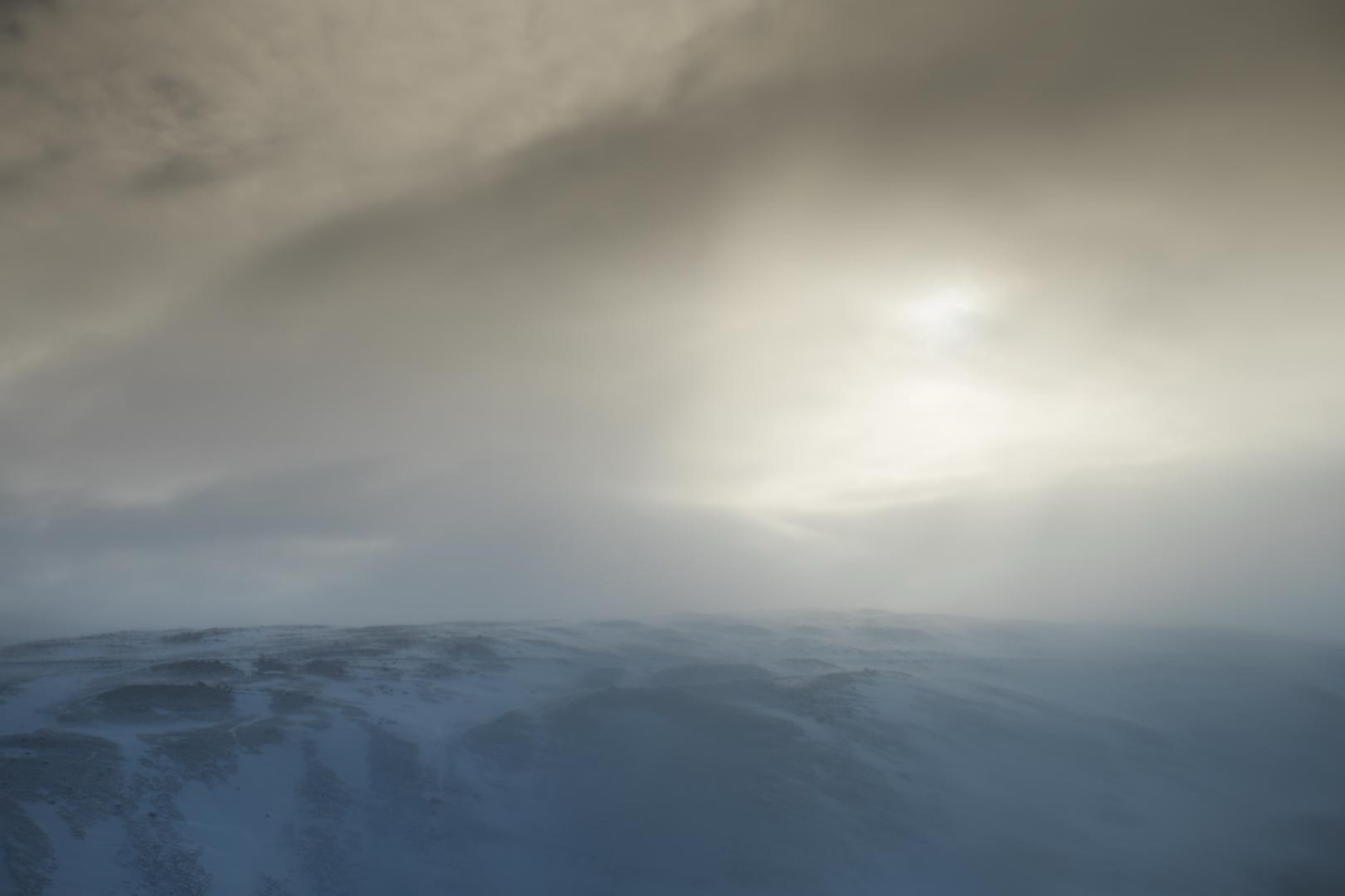

The wind is busy taking the hill apart. Along the crest, snow lifts and streams sideways, a slow smoke of ice that blurs the line where land should end, while overhead the sun labors behind cloud, reduced to a warm smear that lights the haze without piercing it. Everything in the frame is in transit: cloud dragging past, spindrift going wherever spindrift goes, blue shadow pooling in the hollows where rock breaks through the white.
Photography is supposed to be good at stopping motion; this picture is wiser than that. It lets the weather stay weather. The exposure doesn’t freeze the blowing snow so much as register it as atmosphere, a veil across the middle distance, so the photograph reads as duration rather than instant — you can feel the seconds in it. Landscape pictures have promised mastery since the nineteenth century: the surveyed ridge, the named summit. This one offers the opposite, a terrain in the act of becoming illegible, and it trusts you to find that generous rather than withholding.
Hido is best known for suburban houses glowing at night and for roads seen through weathered windshields; SFMOMA, the Getty and the Whitney hold his prints. Out here he needs no architecture at all. A number stands in for a title, which feels right: names would pin down what the picture works to keep loose. As an archival pigment print it holds the faint warmth in the cloud and the cold blue of the snowfield in the same breath — the balance the scene itself was striking.