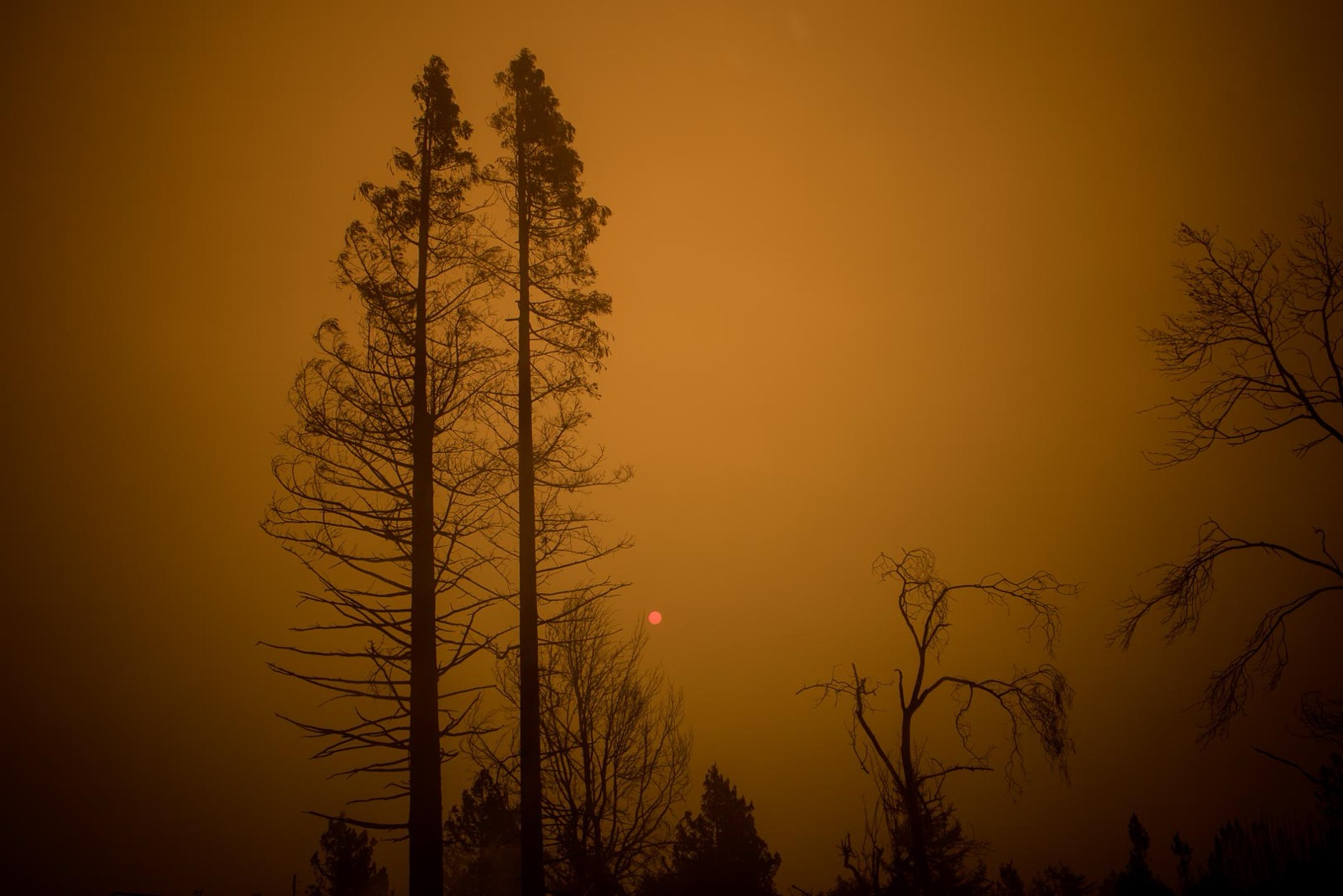
When photography was new it was called sun-writing, and its inventors imagined the sun as a tireless draughtsman. Here the draughtsman has been reduced to a pink pill of light, hanging in a sky steeped the color of strong tea, barely able to sign its own work. Smoke has replaced atmosphere. Two tall conifers stand at the left like burnt wicks, their lower branches stripped, while at the right the bare limbs of other trees claw at the amber with nothing left to offer it.
The photograph itself is seduced by what should appall it. Smoke is a catastrophe, and, optically, a gift: it turns the world monochrome in orange, flattens depth into layered silhouettes, makes the sun photographable at last. Every tone here, from the deep umber of the treeline to the honeyed haze above, is a measure of particulate air, a record of matter suspended between lens and star. Think of the earliest heliographs, hours-long exposures in which the sun moved and blurred; this time the sun sits still and the planet does the smudging.
Hido has spent his career on light that misbehaves — window glow at night, fog thickening a road — and museums from the Getty to the Whitney to SFMOMA, near his Bay Area home, hold the results. This picture extends the fascination to a sky in crisis. And there is a quiet material joke in it: an archival pigment print is finely divided pigment settled onto paper, so this image of suspended particles is itself made of suspended particles, governed now, permanent now. The print keeps its amber long after any sky has cleared.
When photography was new it was called sun-writing, and its inventors imagined the sun as a tireless draughtsman. Here the draughtsman has been reduced to a pink pill of light, hanging in a sky steeped the color of strong tea, barely able to sign its own work. Smoke has replaced atmosphere. Two tall conifers stand at the left like burnt wicks, their lower branches stripped, while at the right the bare limbs of other trees claw at the amber with nothing left to offer it.
The photograph itself is seduced by what should appall it. Smoke is a catastrophe, and, optically, a gift: it turns the world monochrome in orange, flattens depth into layered silhouettes, makes the sun photographable at last. Every tone here, from the deep umber of the treeline to the honeyed haze above, is a measure of particulate air, a record of matter suspended between lens and star. Think of the earliest heliographs, hours-long exposures in which the sun moved and blurred; this time the sun sits still and the planet does the smudging.
Hido has spent his career on light that misbehaves — window glow at night, fog thickening a road — and museums from the Getty to the Whitney to SFMOMA, near his Bay Area home, hold the results. This picture extends the fascination to a sky in crisis. And there is a quiet material joke in it: an archival pigment print is finely divided pigment settled onto paper, so this image of suspended particles is itself made of suspended particles, governed now, permanent now. The print keeps its amber long after any sky has cleared.