This picture withholds most of itself. The wet road sets off confidently from the lower corner and is repossessed by fog before it arrives anywhere; a single green-crowned tree marks the last point at which the world consents to be seen. Beyond it there is no horizon, no hill, no sky distinct from ground, only a warm putty-colored blankness claiming two-thirds of the frame. What remains visible is the edge of visibility itself.
It is tempting to treat the fog as subject matter, but it behaves like a material condition of the photograph. Every photograph is a thin skin of image bonded to a physical support, and this one seems caught half-formed: the greens of the verge swim as if still in solution, the road gleams like wet chemistry, and the softened edges admit a pane of rain-flecked glass between camera and world. In landscape form, the image rehearses photography’s oldest suspense, the interval in which something is either about to appear or about to be lost, and never resolves it.
The photographer, born in Kent, Ohio, and working from the San Francisco Bay Area, made pictures like this one through the window of his car, and the practice sits alongside his night-lit suburban houses in the collections of SFMOMA, the Getty and the Whitney. As an object, the archival pigment print answers the fog with permanence: stable pigment settled into paper, a fixed rendering of an unfixed world. Hung on a wall, it will go on performing its vanishing act daily, and daily failing to complete it, which is exactly what one wants from a picture of fog.
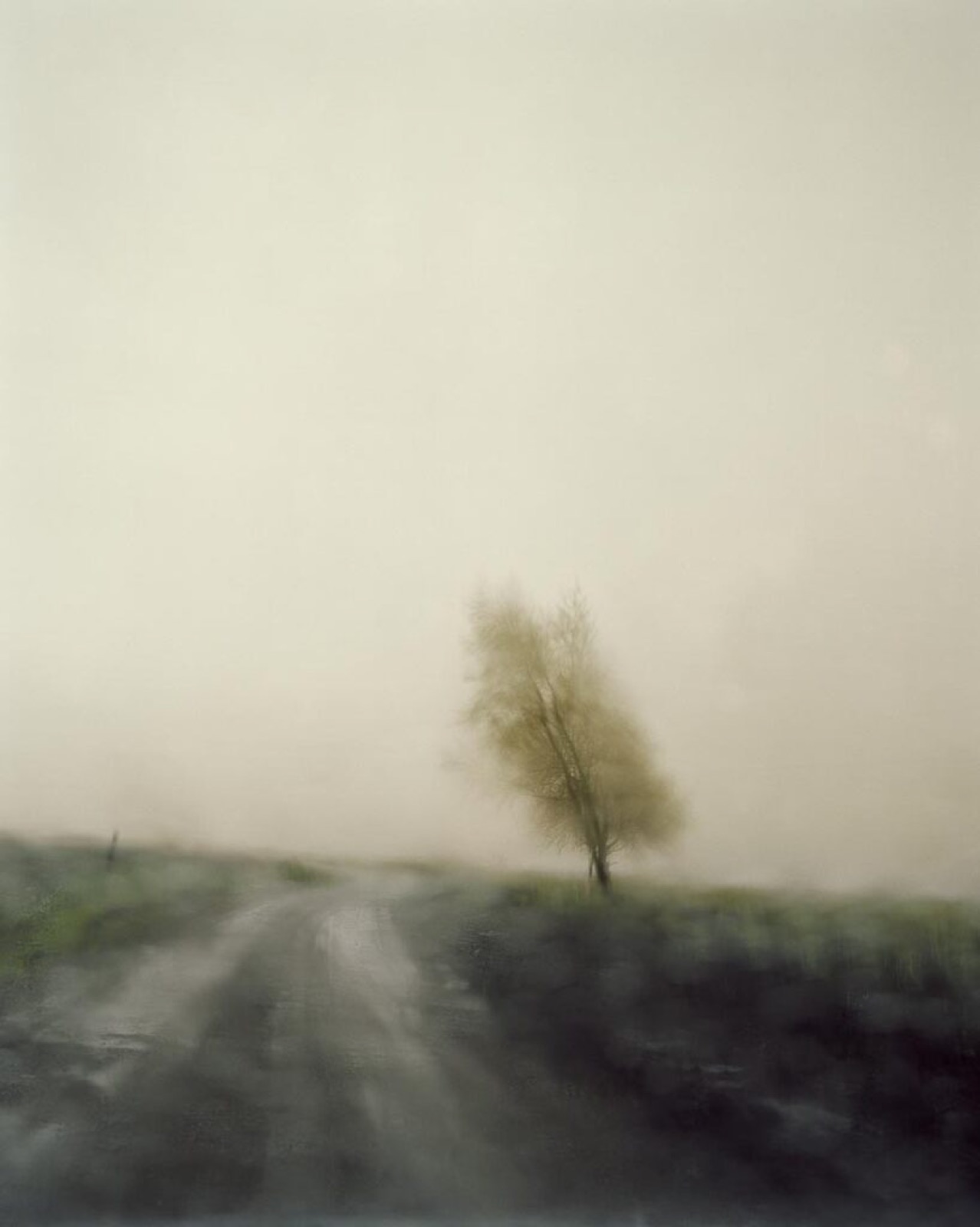

This picture withholds most of itself. The wet road sets off confidently from the lower corner and is repossessed by fog before it arrives anywhere; a single green-crowned tree marks the last point at which the world consents to be seen. Beyond it there is no horizon, no hill, no sky distinct from ground, only a warm putty-colored blankness claiming two-thirds of the frame. What remains visible is the edge of visibility itself.
It is tempting to treat the fog as subject matter, but it behaves like a material condition of the photograph. Every photograph is a thin skin of image bonded to a physical support, and this one seems caught half-formed: the greens of the verge swim as if still in solution, the road gleams like wet chemistry, and the softened edges admit a pane of rain-flecked glass between camera and world. In landscape form, the image rehearses photography’s oldest suspense, the interval in which something is either about to appear or about to be lost, and never resolves it.
The photographer, born in Kent, Ohio, and working from the San Francisco Bay Area, made pictures like this one through the window of his car, and the practice sits alongside his night-lit suburban houses in the collections of SFMOMA, the Getty and the Whitney. As an object, the archival pigment print answers the fog with permanence: stable pigment settled into paper, a fixed rendering of an unfixed world. Hung on a wall, it will go on performing its vanishing act daily, and daily failing to complete it, which is exactly what one wants from a picture of fog.