The picture is built on a collision of two flat planes: the pale cinderblock wall of a low house and the equally pale flank of a 1970s sedan parked before it, the two whites pressed together beneath a sky of saturated, cloudless blue. A barred window, a boxy air-conditioning unit, a hedge crowding the right corner, gravel below — the components of an ordinary American exterior, arranged with a deliberateness that borders on the sculptural.
Made as an archival pigment print on Dibond, the image follows the strategy that runs through Hido's daytime work: he finds rather than fabricates his tableaux, but frames them so squarely that the found world begins to look staged. The car's cropped body reads almost as a monolith; the security bars turn domestic anxiety into pattern. Nothing is added, yet everything feels chosen.
This is the constructedness of the deadpan — a mode Hido shares with a generation who learned that describing suburban surfaces with cool exactitude is itself a form of authorship. The harsh, even light refuses drama and, in refusing it, produces a quieter unease. We are left to wonder who lives behind the bars, and why the plainness of the scene should feel so much like a set awaiting its actors.
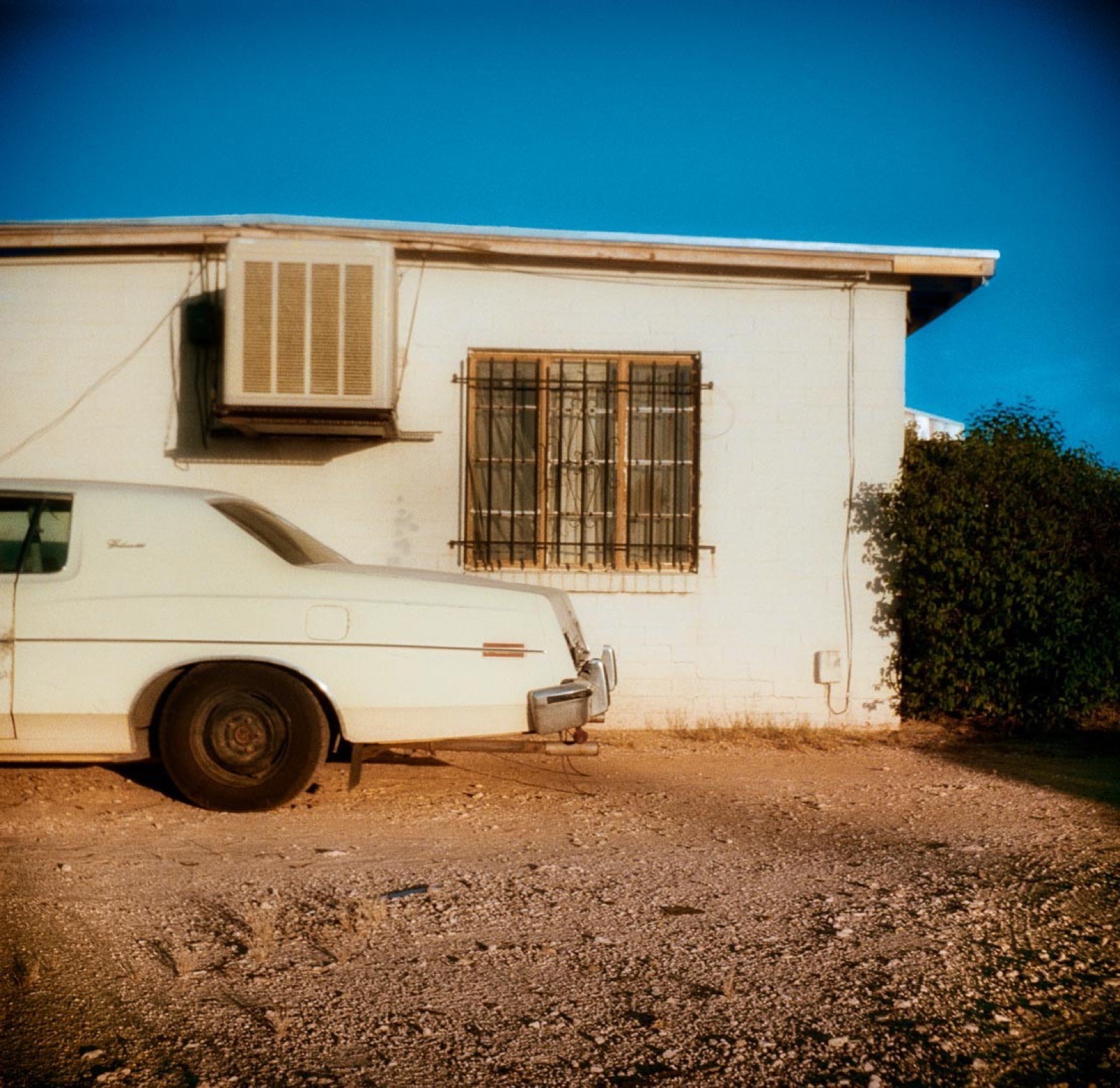

The picture is built on a collision of two flat planes: the pale cinderblock wall of a low house and the equally pale flank of a 1970s sedan parked before it, the two whites pressed together beneath a sky of saturated, cloudless blue. A barred window, a boxy air-conditioning unit, a hedge crowding the right corner, gravel below — the components of an ordinary American exterior, arranged with a deliberateness that borders on the sculptural.
Made as an archival pigment print on Dibond, the image follows the strategy that runs through Hido's daytime work: he finds rather than fabricates his tableaux, but frames them so squarely that the found world begins to look staged. The car's cropped body reads almost as a monolith; the security bars turn domestic anxiety into pattern. Nothing is added, yet everything feels chosen.
This is the constructedness of the deadpan — a mode Hido shares with a generation who learned that describing suburban surfaces with cool exactitude is itself a form of authorship. The harsh, even light refuses drama and, in refusing it, produces a quieter unease. We are left to wonder who lives behind the bars, and why the plainness of the scene should feel so much like a set awaiting its actors.