Pink is a Touch, Red is a Stare, St George, Maine, 2019
Archival Pigment Print.
76.2 x 101.6 cm / 30 x 40 in
106.7 x 142.2 cm / 42 x 56 in
Hand-signed by the artist, with title, date, and edition number inscribed in ink on an archival label affixed to the reverse side of the mounted photograph.
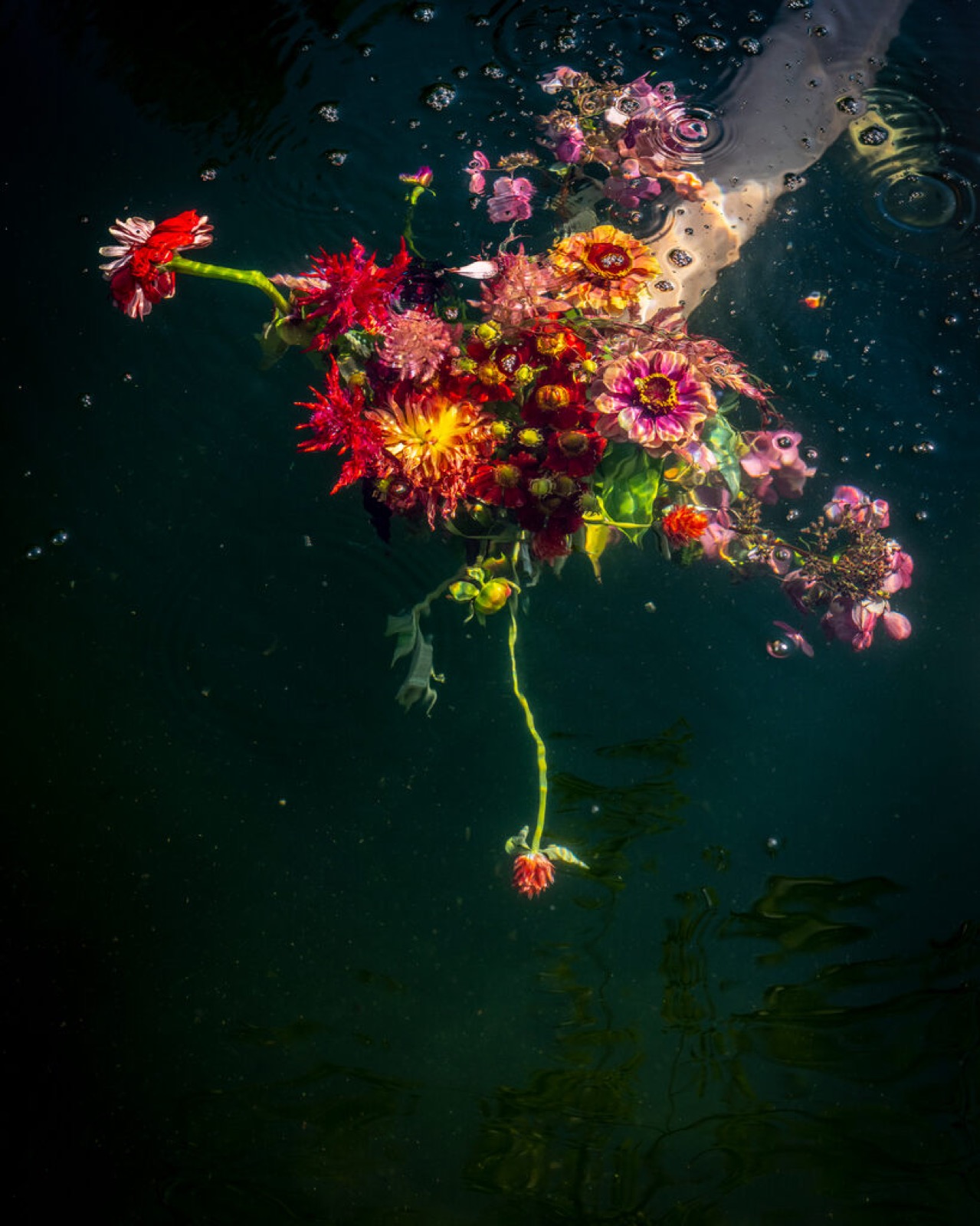
Red arrives as a shout and pink as a whisper, both floating on water so darkly green it reads as black. A cut bouquet lies half-submerged at the surface, dahlias and zinnias in scarlet, orange, magenta, a single yellow eye at the center burning brightest of all, while beads of air cling around the petals and a lighter patch of reflected sky opens at the upper right, ringed by the fine circles of a fallen drop.
What matters to a picture like this is contact: the way the flowers touch the water and the water touches them back, softening stems, dragging one bloom under on a long green thread until a small orange bud hangs suspended in the depth. These are the ordinary flowers of a garden bed, and the act of laying them on water is a homely one, close to grief, close to ceremony. Photography here does what it has always done to such gestures: fixes the fugitive, holds the wet and perishable still.
Harvey, who works on the Maine coast and is collected across American museums, has built her books, among them Blue Violet and You an Orchestra a Bomb, on exactly this traffic between the domestic and the overwhelming. The physical print completes the transaction. Made as an archival pigment print, its surface can carry saturated reds and greens to their limit while keeping the black water dense and bottomless, so the bouquet seems to hover on a skin of darkness, a bright thing set adrift and, for now, kept.

Red arrives as a shout and pink as a whisper, both floating on water so darkly green it reads as black. A cut bouquet lies half-submerged at the surface, dahlias and zinnias in scarlet, orange, magenta, a single yellow eye at the center burning brightest of all, while beads of air cling around the petals and a lighter patch of reflected sky opens at the upper right, ringed by the fine circles of a fallen drop.
What matters to a picture like this is contact: the way the flowers touch the water and the water touches them back, softening stems, dragging one bloom under on a long green thread until a small orange bud hangs suspended in the depth. These are the ordinary flowers of a garden bed, and the act of laying them on water is a homely one, close to grief, close to ceremony. Photography here does what it has always done to such gestures: fixes the fugitive, holds the wet and perishable still.
Harvey, who works on the Maine coast and is collected across American museums, has built her books, among them Blue Violet and You an Orchestra a Bomb, on exactly this traffic between the domestic and the overwhelming. The physical print completes the transaction. Made as an archival pigment print, its surface can carry saturated reds and greens to their limit while keeping the black water dense and bottomless, so the bouquet seems to hover on a skin of darkness, a bright thing set adrift and, for now, kept.